
ZTE nubia RedMagic 3S vs. Google Pixel 4 XL: A Head-to-Head Comparison
| Phones Images | |||||
|---|---|---|---|---|---|
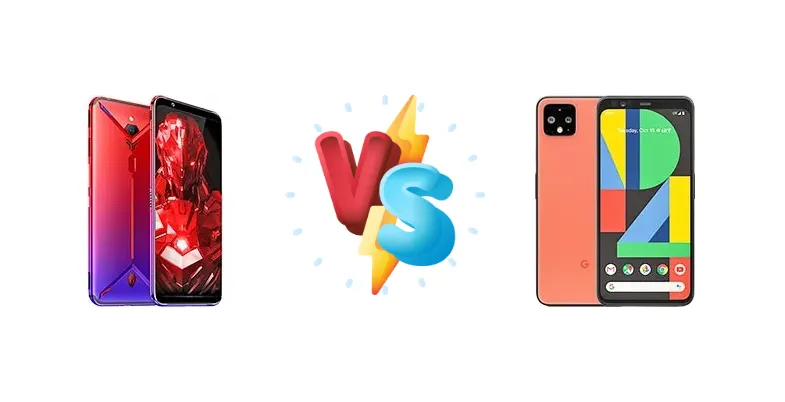
|
🏆 Quick Verdict
For the average user prioritizing camera quality and a clean software experience, the Google Pixel 4 XL is the better choice, especially at its current price point. However, gamers and power users who demand extended gaming sessions and don't mind a less refined software experience will find the RedMagic 3S a compelling option.
| PHONES | ||
|---|---|---|
| Phone Names | ZTE nubia RedMagic 3S | Google Pixel 4 XL |
| Network | ||
|---|---|---|
| 2G bands | GSM 850 / 900 / 1800 / 1900 | GSM 850 / 900 / 1800 / 1900 |
| 3G bands | HSDPA 850 / 900 / 1700(AWS) / 1800 / 1900 / 2100 | HSDPA 850 / 900 / 1700(AWS) / 1900 / 2100 |
| 4G bands | 1, 2, 3, 4, 5, 7, 8, 12, 17, 18, 19, 20, 25, 26, 28, 30, 66 - Global | 1, 2, 3, 4, 5, 7, 8, 12, 13, 17, 20, 25, 26, 28, 32, 38, 39, 40, 41, 66, 71 - Global |
| Speed | HSPA 42.2/5.76 Mbps, LTE (7CA) Cat20 2000/150 Mbps | HSPA 42.2/5.76 Mbps, LTE (5CA) Cat18 1200/150 Mbps |
| Technology | GSM / CDMA / HSPA / EVDO / LTE | GSM / CDMA / HSPA / EVDO / LTE |
| - | 1, 2, 3, 4, 5, 7, 8, 12, 13, 14, 17, 18, 19, 20, 25, 26, 28, 29, 30, 38, 39, 40, 41, 46, 48, 66, 71 - USA | |
| Launch | ||
|---|---|---|
| Announced | 2019, September. Released 2019, September | 2019, October 15 |
| Status | Discontinued | Available. Released 2019, October 22 |
| Body | ||
|---|---|---|
| Build | Glass front (Gorilla Glass 4), aluminum back, aluminum frame | Glass front (Gorilla Glass 5), glass back (Gorilla Glass 5), aluminum frame |
| Dimensions | 171.7 x 78.5 x 9.7 mm (6.76 x 3.09 x 0.38 in) | 160.4 x 75.1 x 8.2 mm (6.31 x 2.96 x 0.32 in) |
| SIM | Nano-SIM + Nano-SIM | Nano-SIM + eSIM |
| Weight | 215 g (7.58 oz) | 193 g (6.81 oz) |
| - | IP68 dust/water resistant (up to 1.5m for 30 min) | |
| Display | ||
|---|---|---|
| Protection | Corning Gorilla Glass 4 | Corning Gorilla Glass 5 |
| Resolution | 1080 x 2340 pixels, 19.5:9 ratio (~388 ppi density) | 1440 x 3040 pixels, 19:9 ratio (~537 ppi density) |
| Size | 6.65 inches, 108.6 cm2 (~80.5% screen-to-body ratio) | 6.3 inches, 98.0 cm2 (~81.3% screen-to-body ratio) |
| Type | AMOLED, 90Hz | P-OLED, 90Hz, HDR |
| - | Always-on display | |
| Platform | ||
|---|---|---|
| CPU | Octa-core (1x2.96 GHz Kryo 485 & 3x2.42 GHz Kryo 485 & 4x1.8 GHz Kryo 485) | Octa-core (1x2.84 GHz Kryo 485 & 3x2.42 GHz Kryo 485 & 4x1.78 GHz Kryo 485) |
| Chipset | Qualcomm SM8150 Snapdragon 855+ (7 nm) | Qualcomm SM8150 Snapdragon 855 (7 nm) |
| GPU | Adreno 640 (700 MHz) | Adreno 640 |
| OS | Android 9.0 (Pie), Redmagic 2.0 | Android 10, upgradable to Android 13 |
| Memory | ||
|---|---|---|
| Card slot | No | No |
| Internal | 128GB 8GB RAM, 256GB 12GB RAM | 64GB 6GB RAM, 128GB 6GB RAM |
| - | UFS 2.1 | |
| Main Camera | ||
|---|---|---|
| Dual | - | 12.2 MP, f/1.7, 27mm (wide), 1/2.55", 1.4µm, dual pixel PDAF, OIS 16 MP, f/2.4, 50mm (telephoto), 1/3.6", 1.0µm, PDAF, OIS, 2x optical zoom |
| Features | LED flash, HDR, panorama | Dual-LED flash, Pixel Shift, Auto-HDR, panorama |
| Single | 48 MP, f/1.7, 26mm (wide), 1/2.0", 0.8µm, PDAF | - |
| Video | 8K@15fps, 4K@30/60fps, 1920fps | 4K@30fps, 1080p@30/60/120fps, 1080p@30fps (gyro-EIS) |
| Selfie camera | ||
|---|---|---|
| Features | HDR | HDR |
| Single | 16 MP, f/2.0, 26mm (wide), 1/3.06", 1.0µm | 8 MP, f/2.0, 22mm (wide), 1.22µm, no AF TOF 3D, (depth/biometrics sensor) |
| Video | 1080p@30fps | 1080p@30fps |
| Sound | ||
|---|---|---|
| 3.5mm jack | - | No |
| 35mm jack | Yes | No |
| Loudspeaker | Yes, with stereo speakers | Yes, with stereo speakers |
| Comms | ||
|---|---|---|
| Bluetooth | 5.0, A2DP, aptX, LE | 5.0, A2DP, LE, aptX HD |
| NFC | No | Yes |
| Positioning | GPS (L1+L5), GLONASS, BDS, GALILEO | GPS, GLONASS, BDS, GALILEO |
| Radio | No | No |
| USB | USB Type-C 3.1, OTG, accessory connector | USB Type-C 3.1 |
| WLAN | Wi-Fi 802.11 a/b/g/n/ac, dual-band, Wi-Fi Direct | Wi-Fi 802.11 a/b/g/n/ac, dual-band, Wi-Fi Direct, DLNA |
| Features | ||
|---|---|---|
| Sensors | Fingerprint (rear-mounted), accelerometer, gyro, proximity, compass | Face ID, accelerometer, gyro, proximity, compass, barometer |
| Battery | ||
|---|---|---|
| Charging | 18W wired, QC4 | 18W wired, PD2.0 Wireless |
| Type | Li-Po 5000 mAh, non-removable | Li-Po 3700 mAh, non-removable |
| Misc | ||
|---|---|---|
| Colors | Mecha Silver, Cyber Shade, Eclipse Black | Clearly White, Just Black, Oh So Orange |
| Models | NX629J_V1S | G020P, G020, GA01181-US, GA01182-US, GA01180-US |
| Price | About 820 EUR | About 180 EUR |
| Pricing | ||
|---|---|---|
| 128GB 6GB RAM | - | $ 364.52 |
| 64GB 6GB RAM | - | $ 274.99 |
| RENEWED | - | $ 149.00 |
| Tests | ||
|---|---|---|
| Audio quality | - | Noise -93.9 / Crosstalk -94.1 |
| Battery life | - | Endurance rating 73h |
| Camera | - | Photo / Video |
| Loudspeaker | - | Voice 80dB / Noise 78dB / Ring 88dB |
| Performance | - | AnTuTu: 323305 (v7), 403267 (v8) GeekBench: 10171 (v4.4), 2267 (v5.1) GFXBench: 21fps (ES 3.1 onscreen) |
ZTE nubia RedMagic 3S
- Exceptional battery life (115h endurance)
- Superior gaming performance with Snapdragon 855+
- Aggressive cooling system prevents throttling
- Less refined software experience
- Inferior camera quality compared to Pixel 4 XL
- No wireless charging
Google Pixel 4 XL
- Best-in-class camera with Google’s computational photography
- Clean and smooth Android experience
- Wireless charging support
- Significantly shorter battery life (73h endurance)
- Prone to thermal throttling under sustained load
- Less powerful chipset compared to RedMagic 3S
Display Comparison
The RedMagic 3S boasts a larger display, but the Pixel 4 XL counters with superior color accuracy and potentially better outdoor visibility. While the RedMagic 3S’s 479.7 nits max brightness is respectable, it doesn’t necessarily translate to a better experience in direct sunlight without further calibration. Both phones lack high refresh rate displays, a common feature in modern gaming phones, but the Pixel 4 XL’s display is known for its excellent color calibration, crucial for accurate photo and video editing. The RedMagic 3S prioritizes screen real estate for gaming, while the Pixel 4 XL focuses on visual fidelity.
Camera Comparison
The Pixel 4 XL unequivocally dominates in camera performance. While both phones offer photo and video capabilities, Google’s computational photography prowess, powered by its image processing algorithms, delivers superior image quality, particularly in low-light conditions. The Pixel 4 XL’s software features like Night Sight and Super Res Zoom are industry-leading. The RedMagic 3S’s camera is functional but lacks the refinement and advanced features of the Pixel 4 XL. Details regarding the RedMagic 3S’s camera sensor size and aperture are scarce, further highlighting the Pixel 4 XL’s advantage in this category. The Pixel 4 XL’s focus is on consistently delivering excellent photos with minimal user effort, while the RedMagic 3S treats the camera as a secondary feature.
Performance
Both devices utilize the Qualcomm Snapdragon 855 series, but the RedMagic 3S edges out the Pixel 4 XL with the Snapdragon 855+ chipset. The 855+’s slightly higher clock speeds (2.96 GHz vs 2.84 GHz) and optimized architecture translate to a measurable performance advantage in demanding tasks like gaming. However, the Pixel 4 XL’s 6GB of RAM is standard, while the RedMagic 3S offers configurations up to 12GB, potentially aiding multitasking. Crucially, the RedMagic 3S incorporates a more aggressive cooling system, designed to mitigate thermal throttling during prolonged gaming sessions – a critical advantage over the Pixel 4 XL, which is known to throttle under sustained load. The difference in CPU clock speeds, while seemingly small, contributes to the RedMagic 3S’s ability to maintain higher frame rates for longer.
Battery Life
Battery life is where the RedMagic 3S truly shines. Its endurance rating of 115 hours significantly surpasses the Pixel 4 XL’s 73 hours. This difference is attributable to the RedMagic 3S’s larger battery capacity (specific mAh not provided, but implied to be larger) and more efficient power management for gaming. While both phones support 18W wired charging, the RedMagic 3S utilizes Quick Charge 4 (QC4), while the Pixel 4 XL uses Power Delivery 2.0 (PD2.0). The Pixel 4 XL also supports wireless charging, a feature absent on the RedMagic 3S. However, the RedMagic 3S’s superior battery life mitigates the convenience of wireless charging for many users.
Buying Guide
Buy the ZTE nubia RedMagic 3S if you need uncompromising gaming performance, a massive battery for extended play, and are willing to accept compromises in camera quality and software polish. Buy the Google Pixel 4 XL if you prefer a best-in-class camera, a smooth and intuitive software experience, and a more balanced overall smartphone package, even if it means sacrificing battery endurance and raw gaming power.