
ZTE nubia RedMagic 3S vs. Apple iPhone 11 Pro Max: A Clash of Philosophies
| Phones Images | |||||
|---|---|---|---|---|---|
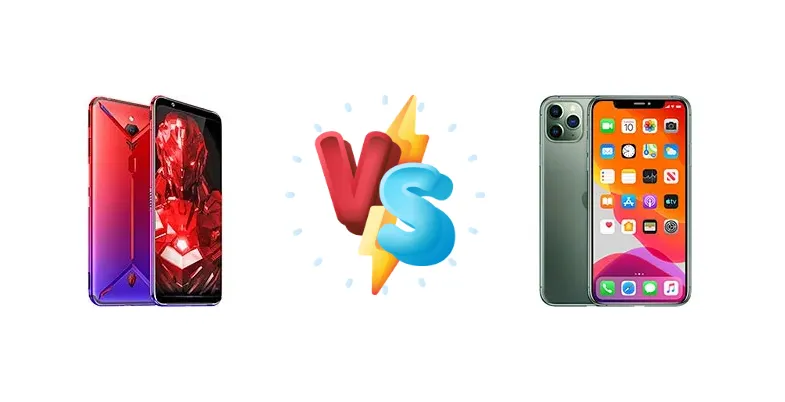
|
🏆 Quick Verdict
For the average user prioritizing a polished experience, excellent camera, and long-term software updates, the iPhone 11 Pro Max is the better choice. However, the RedMagic 3S delivers significantly more raw gaming performance for a lower price, making it ideal for dedicated mobile gamers.
| PHONES | ||
|---|---|---|
| Phone Names | ZTE nubia RedMagic 3S | Apple iPhone 11 Pro Max |
| Network | ||
|---|---|---|
| 2G bands | GSM 850 / 900 / 1800 / 1900 | GSM 850 / 900 / 1800 / 1900 |
| 3G bands | HSDPA 850 / 900 / 1700(AWS) / 1800 / 1900 / 2100 | HSDPA 850 / 900 / 1700(AWS) / 1900 / 2100 |
| 4G bands | 1, 2, 3, 4, 5, 7, 8, 12, 17, 18, 19, 20, 25, 26, 28, 30, 66 - Global | 1, 2, 3, 4, 5, 7, 8, 11, 12, 13, 17, 18, 19, 20, 21, 25, 26, 28, 29, 30, 32, 34, 38, 39, 40, 41, 42, 46, 48, 66 - A2218 |
| Speed | HSPA 42.2/5.76 Mbps, LTE (7CA) Cat20 2000/150 Mbps | HSPA, LTE 1.6 Gbps DL, EV-DO Rev.A 3.1 Mbps |
| Technology | GSM / CDMA / HSPA / EVDO / LTE | GSM / CDMA / HSPA / EVDO / LTE |
| - | 1, 2, 3, 4, 5, 7, 8, 12, 13, 14, 17, 18, 19, 20, 25, 26, 29, 30, 34, 38, 39, 40, 41, 42, 46, 48, 66, 71 - A2161, A2220 | |
| Launch | ||
|---|---|---|
| Announced | 2019, September. Released 2019, September | 2019, September 10 |
| Status | Discontinued | Available. Released 2019, September 20 |
| Body | ||
|---|---|---|
| Build | Glass front (Gorilla Glass 4), aluminum back, aluminum frame | Glass front (Corning-made glass), glass back (Corning-made glass), stainless steel frame |
| Dimensions | 171.7 x 78.5 x 9.7 mm (6.76 x 3.09 x 0.38 in) | 158 x 77.8 x 8.1 mm (6.22 x 3.06 x 0.32 in) |
| SIM | Nano-SIM + Nano-SIM | · Nano-SIM + eSIM· Nano-SIM + Nano-SIM (China) |
| Weight | 215 g (7.58 oz) | 226 g (7.97 oz) |
| - | IP68 dust/water resistant (up to 4m for 30 min) Apple Pay (Visa, MasterCard, AMEX certified) | |
| Display | ||
|---|---|---|
| Protection | Corning Gorilla Glass 4 | Scratch-resistant glass |
| Resolution | 1080 x 2340 pixels, 19.5:9 ratio (~388 ppi density) | 1242 x 2688 pixels, 19.5:9 ratio (~458 ppi density) |
| Size | 6.65 inches, 108.6 cm2 (~80.5% screen-to-body ratio) | 6.5 inches, 102.9 cm2 (~83.7% screen-to-body ratio) |
| Type | AMOLED, 90Hz | Super Retina XDR OLED, HDR10, Dolby Vision, 800 nits (HBM), 1200 nits (peak) |
| Platform | ||
|---|---|---|
| CPU | Octa-core (1x2.96 GHz Kryo 485 & 3x2.42 GHz Kryo 485 & 4x1.8 GHz Kryo 485) | Hexa-core (2x2.65 GHz Lightning + 4x1.8 GHz Thunder) |
| Chipset | Qualcomm SM8150 Snapdragon 855+ (7 nm) | Apple A13 Bionic (7 nm+) |
| GPU | Adreno 640 (700 MHz) | Apple GPU (4-core graphics) |
| OS | Android 9.0 (Pie), Redmagic 2.0 | iOS 13, upgradable to iOS 26.1 |
| Memory | ||
|---|---|---|
| Card slot | No | No |
| Internal | 128GB 8GB RAM, 256GB 12GB RAM | 64GB 4GB RAM, 256GB 4GB RAM, 512GB 4GB RAM |
| - | NVMe | |
| Main Camera | ||
|---|---|---|
| Features | LED flash, HDR, panorama | Dual-LED dual-tone flash, HDR (photo/panorama) |
| Single | 48 MP, f/1.7, 26mm (wide), 1/2.0", 0.8µm, PDAF | 13 MP, f/2.2, PDAF |
| Triple | - | 12 MP, f/1.8, 26mm (wide), 1/2.55", 1.4µm, dual pixel PDAF, OIS 12 MP, f/2.0, 52mm (telephoto), 1/3.4", 1.0µm, PDAF, OIS, 2x optical zoom 12 MP, f/2.4, 120˚, 13mm (ultrawide), 1/3.6" |
| Video | 8K@15fps, 4K@30/60fps, 1920fps | 4K@24/25/30/60fps, 1080p@25/30/60/120/240fps, HDR, stereo sound rec. |
| Selfie camera | ||
|---|---|---|
| Features | HDR | HDR |
| Single | 16 MP, f/2.0, 26mm (wide), 1/3.06", 1.0µm | 12 MP, f/2.2, 23mm (wide), 1/3.6", 1.0µm SL 3D, (depth/biometrics sensor) |
| Video | 1080p@30fps | 4K@24/25/30/60fps, 1080p@25/30/60/120fps, gyro-EIS |
| Sound | ||
|---|---|---|
| 3.5mm jack | - | No |
| 35mm jack | Yes | No |
| Loudspeaker | Yes, with stereo speakers | Yes, with stereo speakers |
| Comms | ||
|---|---|---|
| Bluetooth | 5.0, A2DP, aptX, LE | 5.0, A2DP, LE |
| NFC | No | Yes |
| Positioning | GPS (L1+L5), GLONASS, BDS, GALILEO | GPS, GLONASS, GALILEO, QZSS |
| Radio | No | No |
| USB | USB Type-C 3.1, OTG, accessory connector | Lightning, USB 2.0 |
| WLAN | Wi-Fi 802.11 a/b/g/n/ac, dual-band, Wi-Fi Direct | Wi-Fi 802.11 a/b/g/n/ac/6, dual-band, hotspot |
| Features | ||
|---|---|---|
| Sensors | Fingerprint (rear-mounted), accelerometer, gyro, proximity, compass | Face ID, accelerometer, gyro, proximity, compass, barometer |
| - | Ultra Wideband (UWB) support | |
| Battery | ||
|---|---|---|
| Charging | 18W wired, QC4 | Wired, PD2.0, 50% in 30 min Wireless (Qi) |
| Type | Li-Po 5000 mAh, non-removable | Li-Ion 3969 mAh, non-removable (15.04 Wh) |
| Misc | ||
|---|---|---|
| Colors | Mecha Silver, Cyber Shade, Eclipse Black | Matte Space Gray, Matte Silver, Matte Gold, Matte Midnight Green |
| Models | NX629J_V1S | A2218, A2161, A2220, iPhone12,5 |
| Price | About 820 EUR | $ 233.00 / C$ 369.75 / £ 226.95 / € 249.00 |
| SAR | - | 1.16 W/kg (head) 1.17 W/kg (body) |
| SAR EU | - | 0.95 W/kg (head) 0.99 W/kg (body) |
| Pricing | ||
|---|---|---|
| 256GB 4GB RAM | - | $ 874.46 |
| 512GB 4GB RAM | - | $ 1,004.31 |
| 64GB 4GB RAM | - | $ 435.00 |
| RENEWED | - | $ 485.00 |
| Tests | ||
|---|---|---|
| Audio quality | - | Noise -94.3dB / Crosstalk -81.5dB |
| Battery life | - | Endurance rating 102h |
| Camera | - | Photo / Video |
| Display | - | Contrast ratio: Infinite (nominal) |
| Loudspeaker | - | -25.6 LUFS (Very good) |
| Performance | - | AnTuTu: 459713 (v7), 536883 (v8) GeekBench: 13870 (v4.4), 3503 (v5.1) GFXBench: 57fps (ES 3.1 onscreen) |
ZTE nubia RedMagic 3S
- Superior gaming performance due to Snapdragon 855+ and cooling system
- Longer battery endurance for gaming
- Lower price point
- Less refined software experience
- Inferior camera quality
- Slower charging speeds
Apple iPhone 11 Pro Max
- Excellent camera system
- Seamless user experience within the Apple ecosystem
- Long-term software support
- Lower gaming performance compared to RedMagic 3S
- Higher price (though decreasing)
- Slower charging than some Android competitors
Display Comparison
The iPhone 11 Pro Max boasts a significantly brighter display at 820 nits compared to the RedMagic 3S’s 479.7 nits. This translates to superior visibility outdoors. While both feature OLED technology, the iPhone’s ‘infinite’ (nominal) contrast ratio provides deeper blacks and more vibrant colors. The RedMagic 3S, however, likely features a higher refresh rate (though not specified in the data), a key advantage for smoother gaming visuals, while the iPhone is locked at 60Hz. The iPhone's display is also likely to have better color accuracy, important for content creation.
Camera Comparison
Both devices offer photo and video capabilities, but the iPhone 11 Pro Max is expected to deliver superior image quality due to Apple’s advanced image processing and likely larger sensor size (not specified in the data). The RedMagic 3S’s camera is likely geared towards acceptable performance rather than flagship-level photography. The iPhone’s triple-lens system (not detailed in the data) provides versatility with ultrawide and telephoto options, while the RedMagic 3S likely relies on a more basic dual-camera setup. The iPhone’s video recording capabilities are also expected to be significantly better, with features like Cinematic mode and ProRes video (available on later iPhones).
Performance
The Qualcomm Snapdragon 855+ in the RedMagic 3S and the Apple A13 Bionic in the iPhone 11 Pro Max represent different architectural philosophies. The A13 Bionic, built on a 7nm+ process, generally outperforms the 7nm Snapdragon 855+ in single-core tasks and efficiency. The RedMagic 3S’s octa-core CPU configuration (2.96 GHz Kryo 485) aims for peak clock speeds, beneficial for gaming, but may suffer from more thermal throttling under sustained load. The iPhone’s hexa-core design (2.65 GHz Lightning + 1.8 GHz Thunder) prioritizes sustained performance and power efficiency. The RedMagic 3S’s active cooling system is a crucial differentiator, mitigating throttling and maintaining higher performance levels during extended gaming.
Battery Life
The RedMagic 3S boasts an endurance rating of 115 hours, slightly exceeding the iPhone 11 Pro Max’s 102 hours. However, this doesn’t tell the whole story. The RedMagic 3S’s 18W charging with QC4 is slower than the iPhone 11 Pro Max’s wired PD2.0 charging, which can achieve 50% charge in 30 minutes. The iPhone also supports Qi wireless charging, a convenience the RedMagic 3S lacks. The RedMagic 3S’s larger endurance rating is likely due to its focus on gaming optimization and potentially a larger battery capacity (not specified), but the iPhone’s faster charging and wireless capabilities offer a more convenient user experience.
Buying Guide
Buy the ZTE nubia RedMagic 3S if you need uncompromising gaming performance, extended battery life during gaming sessions, and are comfortable with a less refined software experience. Buy the Apple iPhone 11 Pro Max if you prefer a premium build quality, a superior camera system, a seamless user experience within the Apple ecosystem, and guaranteed software updates for years to come.