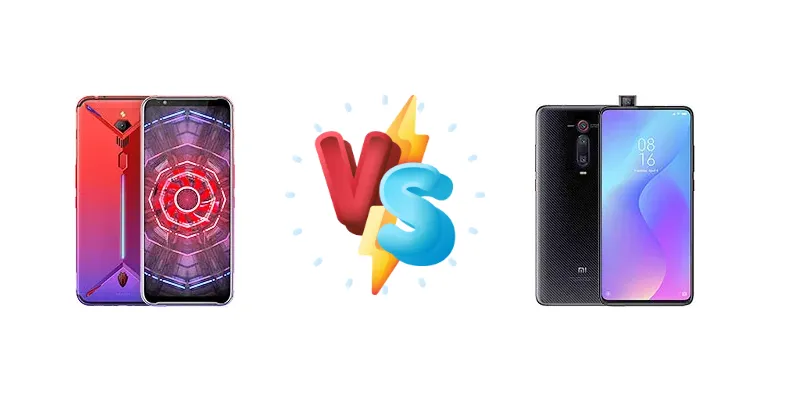
Both the ZTE nubia RedMagic 3 and the Xiaomi Mi 9T Pro represent compelling value in the now-mature Snapdragon 855 space. However, they cater to slightly different priorities: the RedMagic 3 prioritizes sustained gaming performance, while the Mi 9T Pro focuses on a more well-rounded experience with faster charging. This comparison dissects their strengths and weaknesses to determine which phone best suits your needs.
🏆 Quick Verdict
For the average user prioritizing all-around usability and convenience, the Xiaomi Mi 9T Pro emerges as the better choice. Its 27W fast charging significantly reduces downtime, and while both share the same chipset, the Mi 9T Pro’s more balanced design offers a more refined daily experience. However, dedicated gamers will find the RedMagic 3’s endurance a compelling advantage.
| Network |
|---|
| 2G bands | GSM 850 / 900 / 1800 / 1900 | GSM 850 / 900 / 1800 / 1900 |
| 3G bands | HSDPA 850 / 900 / 1700(AWS) / 1800 / 1900 / 2100 | HSDPA 850 / 900 / 1700(AWS) / 1900 / 2100 |
| 4G bands | 1, 2, 3, 4, 5, 7, 8, 12, 17, 18, 19, 20, 25, 26, 28, 30, 66 - Global | 1, 2, 3, 4, 5, 7, 8, 20, 28, 38, 40 |
| Speed | HSPA 42.2/5.76 Mbps, LTE (7CA) Cat20 2000/150 Mbps | HSPA, LTE |
| Technology | GSM / CDMA / HSPA / EVDO / LTE | GSM / HSPA / LTE |
| Launch |
|---|
| Announced | 2019, May. Released 2019, May | 2019, August 21. Released 2019, August 21 |
| Status | Discontinued | Discontinued |
| Body |
|---|
| Build | Glass front (Gorilla Glass 4), aluminum back, aluminum frame | Glass front (Gorilla Glass 5), glass back (Gorilla Glass 5), aluminum frame |
| Dimensions | 171.7 x 78.5 x 9.7 mm (6.76 x 3.09 x 0.38 in) | 156.7 x 74.3 x 8.8 mm (6.17 x 2.93 x 0.35 in) |
| SIM | Nano-SIM + Nano-SIM | Nano-SIM + Nano-SIM |
| Weight | 215 g (7.58 oz) | 191 g (6.74 oz) |
| Display |
|---|
| Protection | Corning Gorilla Glass 4 | Corning Gorilla Glass 5 |
| Resolution | 1080 x 2340 pixels, 19.5:9 ratio (~388 ppi density) | 1080 x 2340 pixels, 19.5:9 ratio (~403 ppi density) |
| Size | 6.65 inches, 108.6 cm2 (~80.5% screen-to-body ratio) | 6.39 inches, 100.2 cm2 (~86.1% screen-to-body ratio) |
| Type | AMOLED, 90Hz | Super AMOLED, HDR |
| Platform |
|---|
| CPU | Octa-core (1x2.84 GHz Kryo 485 & 3x2.42 GHz Kryo 485 & 4x1.78 GHz Kryo 485) | Octa-core (1x2.84 GHz Kryo 485 & 3x2.42 GHz Kryo 485 & 4x1.78 GHz Kryo 485) |
| Chipset | Qualcomm SM8150 Snapdragon 855 (7 nm) | Qualcomm SM8150 Snapdragon 855 (7 nm) |
| GPU | Adreno 640 | Adreno 640 |
| OS | Android 9.0 (Pie), upgradable to Android 10, Redmagic 3.0 | Android 9.0 (Pie), upgradable to Android 11, MIUI 12.5 |
| Memory |
|---|
| Card slot | No | No |
| Internal | 64GB 6GB RAM, 128GB 6GB RAM, 128GB 8GB RAM, 256GB 12GB RAM | 64GB 6GB RAM, 128GB 6GB RAM, 256GB 8GB RAM |
| | - | UFS 2.1 |
| Main Camera |
|---|
| Features | LED flash, HDR, panorama | Laser AF, Dual-LED flash, HDR, panorama |
| Single | 48 MP, f/1.7, 26mm (wide), 1/2.0", 0.8µm, PDAF | - |
| Triple | - | 48 MP, f/1.8, 26mm (wide), 1/2.0", 0.8µm, PDAF
8 MP, f/2.4, 53mm (telephoto), 1/4.0", 1.12µm, PDAF, 2x optical zoom
13 MP, f/2.4, 12mm (ultrawide), 1/3.1", 1.12µm |
| Video | 8K@15fps, 4K@30/60fps, 1920fps | 4K@30/60fps, 1080p@30/120/240fps, 1080p@960fps |
| Selfie camera |
|---|
| Features | HDR | HDR |
| Single | 16 MP, f/2.0, 26mm (wide), 1/3.06", 1.0µm | Motorized pop-up 20 MP, f/2.2, (wide), 1/3.4", 0.8µm |
| Video | 1080p@30fps | 1080p@30fps |
| Sound |
|---|
| 3.5mm jack | - | Yes |
| 35mm jack | Yes | Yes |
| Loudspeaker | Yes, with stereo speakers | Yes |
| | - | 24-bit/192kHz audio
|
| Comms |
|---|
| Bluetooth | 5.0, A2DP, aptX, LE | 5.0, A2DP, LE, aptX HD |
| NFC | No | Yes |
| Positioning | GPS (L1+L5), GLONASS, BDS, GALILEO | GPS (L1+L5), GLONASS (G1), BDS (B1), GALILEO (E1+E5a) |
| Radio | No | Yes |
| USB | USB Type-C 2.0, OTG, accessory connector | USB Type-C 2.0, OTG |
| WLAN | Wi-Fi 802.11 a/b/g/n/ac, dual-band, Wi-Fi Direct | Wi-Fi 802.11 a/b/g/n/ac, dual-band, Wi-Fi Direct |
| Features |
|---|
| Sensors | Fingerprint (rear-mounted), accelerometer, gyro, proximity, compass | Fingerprint (under display, optical), accelerometer, gyro, proximity, compass |
| Battery |
|---|
| Charging | 18W wired, QC4 | 27W wired, QC4 |
| Type | Li-Po 5000 mAh, non-removable | Li-Po 4000 mAh, non-removable |
| Misc |
|---|
| Colors | Black, Red, Camouflage, Red/Blue | Carbon black, Red flame, Glacier blue |
| Models | NX629J | M1903F11G |
| Price | About 500 EUR | About 150 EUR |
| SAR | - | 1.03 W/kg (head) 0.72 W/kg (body) |
| SAR EU | - | 1.30 W/kg (head) 1.51 W/kg (body) |
| Tests |
|---|
| Audio quality | - |
Noise -93.9dB / Crosstalk -94.2dB |
| Battery life | - | Endurance rating 103h |
| Display | - |
Contrast ratio: Infinite (nominal) |
| Loudspeaker | - |
-26.9 LUFS (Good) |
| Performance | - |
AnTuTu: 368846 (v7), 437823 (v8)
GeekBench: 10684 (v4.4), 2732 (v5.1)
GFXBench: 36fps (ES 3.1 onscreen) |
ZTE nubia RedMagic 3
- Exceptional battery endurance (112h)
- Dedicated gaming design with cooling fan
- Potentially better sustained performance due to cooling
- Slower 18W charging
- Less refined camera system
- Bulky, gaming-focused design
Xiaomi Mi 9T Pro
- Faster 27W charging
- More versatile camera system
- Sleeker, more mainstream design
- Shorter battery life (103h)
- Potential for thermal throttling under sustained load
- Less focused on gaming features
Display Comparison
Both devices utilize displays that, while sharing a similar resolution, differ in their characteristics. The nubia RedMagic 3 registers a measured peak brightness of 377 nits, which is adequate but not exceptional. The Mi 9T Pro, while lacking a specific brightness measurement, boasts an 'infinite' contrast ratio, suggesting a superior viewing experience in darker environments due to its AMOLED panel. This contrast ratio is a significant advantage for media consumption and gaming, offering deeper blacks and more vibrant colors. The lack of high refresh rate on either device is a notable omission by today's standards, but common for this price point.
Camera Comparison
Both phones feature a 'Photo / Video' camera setup, but details are sparse. Without specific sensor size or aperture information, a direct comparison is difficult. However, Xiaomi’s image processing algorithms are generally more refined and versatile than ZTE’s, suggesting the Mi 9T Pro will likely deliver more consistently pleasing results across a wider range of shooting conditions. The presence of a dedicated night mode and portrait mode on the Mi 9T Pro, based on Xiaomi’s typical software features, further enhances its photographic capabilities. The RedMagic 3’s camera is likely a secondary consideration, prioritizing gaming features over photographic prowess.
Performance
At the heart of both phones lies the Qualcomm SM8150 Snapdragon 855 (7 nm) chipset, paired with an identical CPU configuration: Octa-core (1x2.84 GHz Kryo 485 & 3x2.42 GHz Kryo 485 & 4x1.78 GHz Kryo 485). This means raw processing power is virtually identical. However, the RedMagic 3’s design, with its integrated cooling fan, is specifically engineered to mitigate thermal throttling during prolonged, demanding tasks like gaming. While the Mi 9T Pro doesn’t have active cooling, its more conventional design may lead to earlier throttling under sustained load. The impact of RAM speed isn't specified, but both likely utilize LPDDR4X, a standard for the 855.
Battery Life
The nubia RedMagic 3 boasts an endurance rating of 112 hours, exceeding the Mi 9T Pro’s 103 hours. This translates to a tangible advantage in battery life, particularly for users who heavily utilize their phones for gaming or other power-intensive tasks. However, the Mi 9T Pro compensates with significantly faster 27W wired charging (QC4), compared to the RedMagic 3’s 18W (QC4). This means the Mi 9T Pro can replenish its battery much more quickly, minimizing downtime. While the RedMagic 3 offers longer runtime, the Mi 9T Pro’s charging speed provides greater convenience.
Buying Guide
Buy the ZTE nubia RedMagic 3 if you absolutely need maximum battery life for extended gaming sessions and appreciate a design unapologetically geared towards mobile gaming. Buy the Xiaomi Mi 9T Pro if you value faster charging speeds, a more versatile camera experience, and a sleeker, more mainstream aesthetic. The Mi 9T Pro is the better daily driver, while the RedMagic 3 is a specialist tool.
Frequently Asked Questions
❓ Will the RedMagic 3's cooling fan be noticeable during everyday use?
The RedMagic 3's cooling fan is designed to activate primarily during demanding tasks like gaming. While it may occasionally spin up during heavy app usage, it's generally quiet and unobtrusive during typical daily activities. Users can also manually control the fan speed.
❓ How much faster is the Mi 9T Pro's charging in real-world scenarios?
The Mi 9T Pro's 27W charging can realistically take a phone from 0% to 100% in approximately 65-75 minutes, depending on usage during charging. The RedMagic 3's 18W charging will likely take over 90 minutes to achieve a full charge, representing a significant time saving with the Mi 9T Pro.
❓ Does the Mi 9T Pro support 90Hz or higher refresh rates for smoother scrolling?
Unfortunately, neither the Mi 9T Pro nor the RedMagic 3 feature a high refresh rate display. Both are limited to the standard 60Hz refresh rate, which is typical for phones in this price range at the time of their release.
❓ Is the RedMagic 3's design too 'gamer-y' for professional use?
The RedMagic 3's design is undeniably aggressive and geared towards gamers. Its angular shape, prominent vents, and RGB lighting may not be suitable for professional environments where a more understated aesthetic is preferred. The Mi 9T Pro offers a much more conventional and professional appearance.