
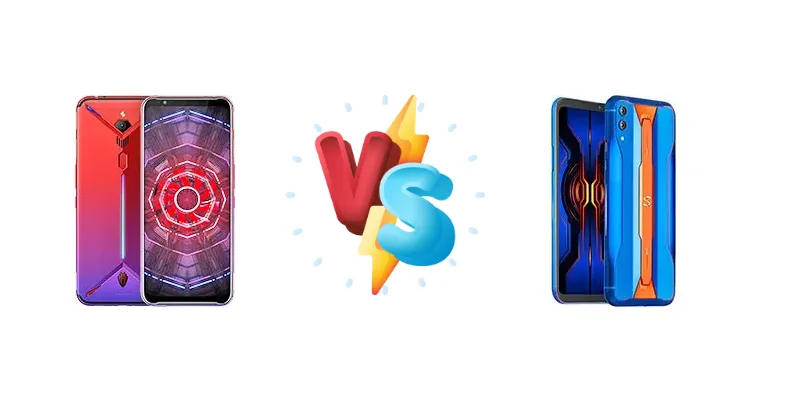
ZTE nubia RedMagic 3 vs Xiaomi Black Shark 2 Pro: The Ultimate Gaming Phone Showdown
| Phones Images | |||||
|---|---|---|---|---|---|
|
🏆 Quick Verdict
For the average gamer prioritizing sustained performance and faster charging, the Xiaomi Black Shark 2 Pro emerges as the winner. Its Snapdragon 855+ chipset and 27W charging provide a noticeable edge, especially during extended gaming sessions. However, the RedMagic 3 remains a compelling option for those seeking maximum endurance.
| PHONES | ||
|---|---|---|
| Phone Names | ZTE nubia RedMagic 3 | Xiaomi Black Shark 2 Pro |
| Network | ||
|---|---|---|
| 2G bands | GSM 850 / 900 / 1800 / 1900 | GSM 850 / 900 / 1800 / 1900 |
| 3G bands | HSDPA 850 / 900 / 1700(AWS) / 1800 / 1900 / 2100 | HSDPA 850 / 900 / 1900 / 2100 |
| 4G bands | 1, 2, 3, 4, 5, 7, 8, 12, 17, 18, 19, 20, 25, 26, 28, 30, 66 - Global | 1, 2, 3, 4, 5, 7, 8, 19, 20, 28, 34, 38, 39, 40, 41 - Global |
| Speed | HSPA 42.2/5.76 Mbps, LTE (7CA) Cat20 2000/150 Mbps | HSPA 42.2/5.76 Mbps, LTE (5CA/3CA) Cat18 1200/150 Mbps |
| Technology | GSM / CDMA / HSPA / EVDO / LTE | GSM / CDMA / HSPA / EVDO / LTE |
| - | 1, 3, 4, 5, 7, 8, 34, 38, 39, 40, 41 - China | |
| Launch | ||
|---|---|---|
| Announced | 2019, May. Released 2019, May | 2019, July. Released 2019, August |
| Status | Discontinued | Discontinued |
| Body | ||
|---|---|---|
| Build | Glass front (Gorilla Glass 4), aluminum back, aluminum frame | Glass front, aluminum back, aluminum frame |
| Dimensions | 171.7 x 78.5 x 9.7 mm (6.76 x 3.09 x 0.38 in) | 163.6 x 75 x 8.8 mm (6.44 x 2.95 x 0.35 in) |
| SIM | Nano-SIM + Nano-SIM | Nano-SIM + Nano-SIM |
| Weight | 215 g (7.58 oz) | 205 g (7.23 oz) |
| Display | ||
|---|---|---|
| Protection | Corning Gorilla Glass 4 | - |
| Resolution | 1080 x 2340 pixels, 19.5:9 ratio (~388 ppi density) | 1080 x 2340 pixels, 19.5:9 ratio (~403 ppi density) |
| Size | 6.65 inches, 108.6 cm2 (~80.5% screen-to-body ratio) | 6.39 inches, 100.2 cm2 (~81.7% screen-to-body ratio) |
| Type | AMOLED, 90Hz | AMOLED |
| - | Always-on display | |
| Platform | ||
|---|---|---|
| CPU | Octa-core (1x2.84 GHz Kryo 485 & 3x2.42 GHz Kryo 485 & 4x1.78 GHz Kryo 485) | Octa-core (1x2.96 GHz Kryo 485 & 3x2.42 GHz Kryo 485 & 4x1.78 GHz Kryo 485) |
| Chipset | Qualcomm SM8150 Snapdragon 855 (7 nm) | Qualcomm SM8150 Snapdragon 855+ (7 nm) |
| GPU | Adreno 640 | Adreno 640 (700 MHz) |
| OS | Android 9.0 (Pie), upgradable to Android 10, Redmagic 3.0 | Android 9.0 (Pie) |
| Memory | ||
|---|---|---|
| Card slot | No | No |
| Internal | 64GB 6GB RAM, 128GB 6GB RAM, 128GB 8GB RAM, 256GB 12GB RAM | 128GB 8GB RAM, 128GB 12GB RAM, 256GB 12GB RAM |
| - | UFS 3.0 | |
| Main Camera | ||
|---|---|---|
| Dual | - | 48 MP, f/1.8, 28mm (wide), 1/2.0", 0.8µm, PDAF 12 MP, f/2.2, 54mm (telephoto), 1.0µm, PDAF, 2x optical zoom |
| Features | LED flash, HDR, panorama | LED flash, HDR, panorama |
| Single | 48 MP, f/1.7, 26mm (wide), 1/2.0", 0.8µm, PDAF | - |
| Video | 8K@15fps, 4K@30/60fps, 1920fps | 4K@30/60fps, 1080p@30/60/120fps, 720p@1920fps |
| Selfie camera | ||
|---|---|---|
| Features | HDR | HDR |
| Single | 16 MP, f/2.0, 26mm (wide), 1/3.06", 1.0µm | 20 MP, f/2.0, (wide), 1/3", 0.9µm |
| Video | 1080p@30fps | 1080p@30fps |
| Sound | ||
|---|---|---|
| 3.5mm jack | - | No |
| 35mm jack | Yes | No |
| Loudspeaker | Yes, with stereo speakers | Yes, with stereo speakers |
| Comms | ||
|---|---|---|
| Bluetooth | 5.0, A2DP, aptX, LE | 5.0, A2DP, aptX HD, LE |
| NFC | No | No |
| Positioning | GPS (L1+L5), GLONASS, BDS, GALILEO | GPS, GLONASS, GALILEO, QZSS, BDS |
| Radio | No | No |
| USB | USB Type-C 2.0, OTG, accessory connector | USB Type-C 2.0 |
| WLAN | Wi-Fi 802.11 a/b/g/n/ac, dual-band, Wi-Fi Direct | Wi-Fi 802.11 a/b/g/n/ac, dual-band, Wi-Fi Direct |
| Features | ||
|---|---|---|
| Sensors | Fingerprint (rear-mounted), accelerometer, gyro, proximity, compass | Fingerprint (under display, optical), accelerometer, gyro, proximity, compass |
| Battery | ||
|---|---|---|
| Charging | 18W wired, QC4 | 27W wired |
| Type | Li-Po 5000 mAh, non-removable | Li-Ion 4000 mAh, non-removable |
| Misc | ||
|---|---|---|
| Colors | Black, Red, Camouflage, Red/Blue | Shadow Black, Iceberg Grey, Gulf Blue, Streamer Purple |
| Models | NX629J | DLT-A0, DLT-H0 |
| Price | About 500 EUR | About 550 EUR |
ZTE nubia RedMagic 3
- Exceptional battery endurance (112h rating)
- More affordable price point
- Aggressive gaming aesthetic
- Slower 18W charging
- Snapdragon 855 is outperformed by 855+
- Camera is likely a secondary consideration
Xiaomi Black Shark 2 Pro
- Faster Snapdragon 855+ chipset
- Significantly faster 27W charging
- Potentially better thermal management
- Likely shorter battery life compared to RedMagic 3
- Potentially higher price
- Gaming design may not appeal to everyone
Display Comparison
The nubia RedMagic 3 features a display with a measured peak brightness of 377 nits. While adequate, this is a potential drawback in brightly lit environments. The Black Shark 2 Pro’s display specifications aren’t provided, but given Xiaomi’s typical display quality, it likely offers comparable or slightly better brightness. Both phones target a high refresh rate for smoother gameplay, but the RedMagic 3’s focus on maximizing screen real estate and minimizing bezels is evident in its design. Color accuracy is likely similar between the two, given both utilize AMOLED panels, but without specific measurements, it’s difficult to definitively state.
Camera Comparison
Both devices feature camera systems, but neither prioritizes photography as a primary feature. The RedMagic 3’s camera is listed as ‘Photo / Video’ without further detail, suggesting a standard configuration for the era. The Black Shark 2 Pro’s camera specs are also unavailable, but Xiaomi typically includes capable sensors in their devices. Given the gaming focus, image processing likely prioritizes speed over detail. Users shouldn’t expect flagship-level camera performance from either phone; they are designed for gaming, not photography.
Performance
The core difference lies in the chipsets: the RedMagic 3 utilizes the Snapdragon 855, while the Black Shark 2 Pro boasts the Snapdragon 855+. The ‘+’ variant offers a modest clock speed increase (2.96 GHz vs 2.84 GHz on the Kryo 485 prime core), resulting in a roughly 4-5% performance uplift in CPU-bound tasks. More importantly, the 855+ features an improved GPU, providing a more significant boost in gaming performance. Both phones share the same CPU core configuration (1x2.84/2.96 GHz, 3x2.42 GHz, 4x1.78 GHz), but the Black Shark 2 Pro’s chipset is better equipped to handle sustained loads due to its enhanced thermal management capabilities. The lack of LPDDR5x RAM specifications for either device means we can assume they both utilize LPDDR4X, which is standard for the time.
Battery Life
The nubia RedMagic 3 boasts an impressive endurance rating of 112 hours, indicating excellent battery life. However, its 18W wired charging with QC4 support is relatively slow compared to the Black Shark 2 Pro’s 27W wired charging. While the RedMagic 3’s larger battery capacity (specific mAh not provided) contributes to its longevity, the Black Shark 2 Pro’s faster charging allows for quicker top-ups, minimizing downtime between gaming sessions. A full charge on the RedMagic 3 will take considerably longer than on the Black Shark 2 Pro.
Buying Guide
Buy the ZTE nubia RedMagic 3 if you prioritize long-lasting battery life and a more affordable price point. It’s ideal for gamers who enjoy marathon sessions and don’t mind slightly slower charging. Buy the Xiaomi Black Shark 2 Pro if you demand the highest possible performance, faster charging speeds, and a more refined overall gaming experience. It’s the better choice for competitive gamers and those who frequently play graphically demanding titles.