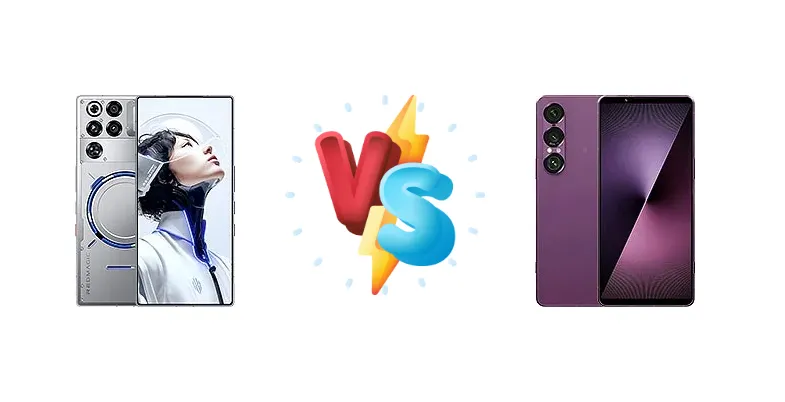
The ZTE nubia RedMagic 11 Pro+ and the Sony Xperia 1 VII represent opposite ends of the flagship spectrum. The RedMagic prioritizes unadulterated performance for mobile gaming, while the Xperia 1 VII aims for a holistic, cinematic experience with a focus on content creation and consumption. This comparison dissects their key differences to determine which device best suits your needs.
🏆 Quick Verdict
For the dedicated mobile gamer, the ZTE nubia RedMagic 11 Pro+ is the clear winner, offering a significantly more powerful chipset and faster charging. However, the Sony Xperia 1 VII excels in battery endurance, display quality, and a more balanced user experience, making it ideal for multimedia enthusiasts and professionals.
| Network |
|---|
| 2G bands | GSM 850 / 900 / 1800 / 1900 | GSM 850 / 900 / 1800 / 1900 |
| 3G bands | HSDPA 850 / 900 / 1700(AWS) / 1900 / 2100 | HSDPA 800 / 850 / 900 / 1700(AWS) / 1900 / 2100 |
| 4G bands | LTE | 1, 2, 3, 4, 5, 7, 8, 12, 13, 17, 19, 20, 25, 26, 28, 32, 34, 38, 39, 40, 41, 66 - Europe |
| 5G bands | SA/NSA | 1, 3, 5, 7, 8, 20, 28, 38, 40, 41, 75, 77, 78 SA/NSA/Sub6 - Europe |
| Speed | HSPA, LTE, 5G | HSPA, LTE, 5G |
| Technology | GSM / CDMA / HSPA / EVDO / LTE / 5G | GSM / HSPA / LTE / 5G |
| Launch |
|---|
| Announced | 2025, October 17 | 2025, May 13 |
| Status | Available. Released 2025, October 17 | Available. Released 2025, June 04 |
| Body |
|---|
| Build | Glass front, aluminum frame, glass back | Glass front (Gorilla Glass Victus 2), glass back (Gorilla Glass Victus), aluminum frame |
| Dimensions | 163.8 x 76.5 x 8.9 mm (6.45 x 3.01 x 0.35 in) | 162 x 74 x 8.2 mm (6.38 x 2.91 x 0.32 in) |
| SIM | Nano-SIM + Nano-SIM | · Nano-SIM + eSIM· Nano-SIM + Nano-SIM |
| Weight | 230 g (8.11 oz) | 197 g (6.95 oz) |
| Display |
|---|
| Protection | - | Corning Gorilla Glass Victus 2, Mohs level 5 |
| Resolution | 1216 x 2688 pixels (~431 ppi density) | 1080 x 2340 pixels, 19.5:9 ratio (~396 ppi density) |
| Size | 6.85 inches, 113.7 cm2 (~90.7% screen-to-body ratio) | 6.5 inches, 103.7 cm2 (~86.5% screen-to-body ratio) |
| Type | AMOLED, 1B colors, 144Hz, 2592Hz PWM, 2000 nits (peak) | LTPO OLED, 1B colors, 120Hz, HDR BT.2020 |
| Platform |
|---|
| CPU | Octa-core (2x4.6 GHz Oryon V3 Phoenix L + 6x3.62 GHz Oryon V3 Phoenix M) | Octa-core (2x4.32 GHz Oryon V2 Phoenix L + 6x3.53 GHz Oryon V2 Phoenix M) |
| Chipset | Qualcomm SM8850-AC Snapdragon 8 Elite Gen 5 (3 nm) | Qualcomm SM8750-AB Snapdragon 8 Elite (3 nm) |
| GPU | Adreno 840 | Adreno 830 |
| OS | Android 16, Redmagic OS 11 | Android 15, up to 4 major Android upgrades |
| Memory |
|---|
| Card slot | No | microSDXC (uses shared SIM slot) |
| Internal | 256GB 12GB RAM, 512GB 16GB RAM, 1TB 16GB RAM, 1TB 24GB RAM | 256GB 12GB RAM, 512GB 12GB RAM |
| Main Camera |
|---|
| Dual | 50 MP, f/1.9, (wide), 1/1.55", 1.0µm, PDAF, OIS
50 MP, f/2.2, (ultrawide), 1/2.88", 0.61µm
Auxiliary lens | - |
| Features | LED flash, HDR, panorama | Zeiss optics, Zeiss T* lens coating, color spectrum sensor, LED flash, panorama, HDR, eye tracking |
| Triple | - | 48 MP, f/1.9, 24mm (wide), 1/1.35", 1.12µm, dual pixel PDAF, OIS
12 MP, f/2.3, 85mm (telephoto), f/3.5, 170mm (telephoto), 1/3.5", 1.0µm, dual pixel PDAF, 3.5x-7.1x continuous optical zoom, OIS, 4cm macro @ 120mm, no AF
48 MP, f/2.0, 16mm (ultrawide), 1/1.56", 1.0µm, PDAF |
| Video | 8K@30fps, 4K@30/60fps, 1080p@30/60/120/240fps | 4K@24/30/60/120fps HDR, 1080p@30/60/120fps; 5-axis gyro-EIS, OIS |
| Selfie camera |
|---|
| Features | HDR | HDR |
| Single | 16 MP, f/2.0, (wide), 1/2.77", 1.12µm, under display | 12 MP, f/2.0, 24mm (wide), 1/2.9", 1.22µm |
| Video | 1080p@30/60fps | 4K@30/60fps, 1080p@30/60fps, 5-axis gyro-EIS |
| Sound |
|---|
| 35mm jack | Yes | Yes |
| Loudspeaker | Yes, with stereo speakers | Yes, with stereo speakers |
| Comms |
|---|
| Bluetooth | 5.4, A2DP, LE | 6.0, A2DP, LE Audio, aptX HD, aptX Adaptive, aptX Lossless |
| Infrared port | Yes | - |
| NFC | Yes | Yes |
| Positioning | GPS (L1+L5), GLONASS, BDS, GALILEO | GPS, GLONASS, BDS, GALILEO, QZSS |
| Radio | No | No |
| USB | USB Type-C 3.2 Gen 2, OTG, accessory connector, DisplayPort | USB Type-C 3.2, OTG, video output |
| WLAN | Wi-Fi 802.11 a/b/g/n/ac/6e/7, tri-band, Wi-Fi Direct | Wi-Fi 802.11 a/b/g/n/ac/6e/7, tri-band, Wi-Fi Direct, DLNA |
| Features |
|---|
| Sensors | Fingerprint (under display, ultrasonic), accelerometer, gyro, proximity, compass | Fingerprint (side-mounted), accelerometer, gyro, proximity, barometer, compass |
| Battery |
|---|
| Charging | 120W wired
80W wireless | 30W wired, PD3.0, PPS, 50% in 30 min
15W wireless
Reverse wireless |
| Type | Si/C Li-Ion 7500 mAh | 5000 mAh |
| Misc |
|---|
| Colors | Black, Transparent Black, Transparent Silver | Moss Green, Orchid Purple, Slate Black |
| Models | NX809J | XQ-FS54, XQFS54EUKCG.GC, XQFS54EUKCV.GC, XQFS54EUKCB.GC, PDX256 |
| Price | About 690 EUR | € 1,338.99 / $ 1,394.99 / £ 1,149.94 |
| EU LABEL |
|---|
| Battery | - | 43:30h endurance, 1400 cycles |
| Energy | - | Class B |
| Free fall | - | Class B (181 falls) |
| Repairability | - | Class D |
ZTE nubia RedMagic 11 Pro+
- Superior CPU performance with Snapdragon 8 Elite Gen 5
- Ultra-fast 120W wired and 80W wireless charging
- Gaming-centric features (triggers, cooling)
- Battery life likely lower than Xperia 1 VII
- Camera likely not as advanced as Xperia 1 VII
Sony Xperia 1 VII
- Exceptional battery life and endurance
- Bright and color-accurate display
- Advanced camera system with Sony’s imaging expertise
- Slightly less powerful CPU than RedMagic 11 Pro+
- Slower charging speeds compared to RedMagic 11 Pro+
Display Comparison
The Sony Xperia 1 VII boasts a measured peak brightness of 1475 nits, ensuring excellent visibility even in direct sunlight. While the RedMagic 11 Pro+’s display specs are not provided, its focus on gaming suggests a high refresh rate, but likely sacrifices peak brightness for power efficiency. The Xperia 1 VII’s panel is likely to offer superior color accuracy and potentially wider color gamut coverage, catering to content creators. The Xperia 1 VII’s endurance rating of 43:30h suggests a more efficient display panel, even if the RedMagic has a larger capacity battery.
Camera Comparison
Detailed camera specs for the RedMagic 11 Pro+ are absent, but given its gaming focus, the camera is likely a secondary consideration. The Xperia 1 VII, consistent with Sony’s Alpha camera expertise, likely features a sophisticated camera system with a large main sensor, optical image stabilization (OIS), and advanced image processing algorithms. The Xperia 1 VII’s emphasis on professional-grade photography and videography suggests features like manual controls and support for various video formats. Without specific details on the RedMagic’s camera, it’s safe to assume the Xperia 1 VII offers a more versatile and higher-quality photographic experience.
Performance
The RedMagic 11 Pro+ leverages the Qualcomm SM8850-AC Snapdragon 8 Elite Gen 5, featuring an octa-core CPU with peak clock speeds of 4.6 GHz on its Oryon V3 Phoenix L cores. This is a step up from the Xperia 1 VII’s Snapdragon 8 Elite (SM8750-AB) with 4.32 GHz Oryon V2 Phoenix L cores. The newer Oryon V3 architecture in the RedMagic promises improved IPC and efficiency. While both utilize a 3nm process, the RedMagic’s higher clock speeds and newer architecture translate to a tangible performance advantage in CPU-intensive tasks and gaming. The RedMagic’s active cooling system, not detailed here, is crucial for sustaining these peak speeds, while the Xperia 1 VII relies on more passive thermal management.
Battery Life
The Sony Xperia 1 VII distinguishes itself with an impressive 43:30h endurance rating and 15:32h of active use, indicating exceptional battery life. It supports 30W wired charging with PD3.0 and PPS, reaching 50% charge in 30 minutes, alongside 15W wireless and reverse wireless charging. The RedMagic 11 Pro+ counters with significantly faster 120W wired charging and 80W wireless charging, promising drastically quicker top-ups. However, the lack of endurance data suggests the RedMagic’s larger battery (spec not provided) may be offset by its power-hungry chipset and high-refresh-rate display. The RedMagic prioritizes speed of charging, while the Xperia 1 VII prioritizes longevity.
Buying Guide
Buy the ZTE nubia RedMagic 11 Pro+ if you demand the highest possible frame rates in demanding games, prioritize rapid charging, and appreciate gaming-centric features like shoulder triggers. Buy the Sony Xperia 1 VII if you value exceptional battery life, a stunningly bright and color-accurate display, and a refined, all-around flagship experience geared towards content creation and consumption.
Frequently Asked Questions
❓ Does the Snapdragon 8 Elite Gen 5 in the RedMagic 11 Pro+ generate excessive heat during prolonged gaming sessions?
The RedMagic 11 Pro+ incorporates an advanced cooling system (details not provided) designed to mitigate thermal throttling. While the Snapdragon 8 Elite Gen 5 is a powerful chip, the cooling solution aims to maintain peak performance for extended periods. However, sustained high loads will inevitably generate heat, and performance may still be limited in the most demanding titles.
❓ How does the Xperia 1 VII’s 30W charging compare to other flagships in terms of real-world charging time?
While 30W is slower than the RedMagic 11 Pro+'s 120W, the Xperia 1 VII utilizes PD3.0 and PPS for optimized charging. The 50% in 30 minutes claim is reasonable, but it’s still slower than the RedMagic. The Xperia 1 VII prioritizes battery health and longevity over ultra-fast charging speeds.
❓ Is the lack of detailed camera specs on the RedMagic 11 Pro+ a significant drawback for photography enthusiasts?
Yes, if photography is a priority, the RedMagic 11 Pro+ is likely to be a compromise. Its focus is on gaming, and the camera is likely a secondary consideration. The Xperia 1 VII, with Sony’s imaging technology, offers a far more comprehensive and capable camera experience.