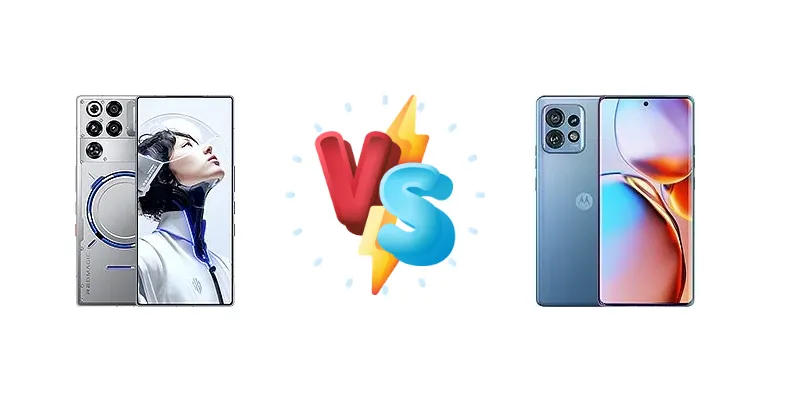
The ZTE nubia RedMagic 11 Pro+ and Motorola Edge 40 Pro represent distinct approaches to the flagship Android experience. The RedMagic aggressively targets mobile gamers with cutting-edge processing power, while the Motorola Edge 40 Pro aims for a more balanced profile, emphasizing camera capabilities and rapid charging alongside strong performance. This comparison dissects their key differences to determine which device best suits your needs.
🏆 Quick Verdict
For the dedicated mobile gamer, the ZTE nubia RedMagic 11 Pro+ is the clear winner, leveraging the Snapdragon 8 Elite Gen 5 for unparalleled performance. However, the Motorola Edge 40 Pro offers a more versatile experience with its refined camera system and competitive charging speeds, making it the better choice for everyday users.
| Network |
|---|
| 2G bands | GSM 850 / 900 / 1800 / 1900 | GSM 850 / 900 / 1800 / 1900 |
| 3G bands | HSDPA 850 / 900 / 1700(AWS) / 1900 / 2100 | HSDPA 850 / 900 / 1700(AWS) / 1900 / 2100 |
| 4G bands | LTE | 1, 2, 3, 4, 5, 7, 8, 12, 13, 17, 18, 19, 20, 25, 26, 28, 32, 38, 39, 40, 41, 42, 43, 48, 66 |
| 5G bands | SA/NSA | 1, 2, 3, 5, 7, 8, 20, 28, 38, 40, 41, 66, 77, 78 SA/NSA/Sub6 |
| Speed | HSPA, LTE, 5G | HSPA, LTE, 5G |
| Technology | GSM / CDMA / HSPA / EVDO / LTE / 5G | GSM / HSPA / LTE / 5G |
| Launch |
|---|
| Announced | 2025, October 17 | 2023, April 04 |
| Status | Available. Released 2025, October 17 | Available. Released 2023, April 04 |
| Body |
|---|
| Build | Glass front, aluminum frame, glass back | Glass front (Gorilla Glass Victus), glass back (Gorilla Glass Victus), aluminum frame |
| Dimensions | 163.8 x 76.5 x 8.9 mm (6.45 x 3.01 x 0.35 in) | 161.2 x 74 x 8.6 mm (6.35 x 2.91 x 0.34 in) |
| SIM | Nano-SIM + Nano-SIM | Nano-SIM + eSIM |
| Weight | 230 g (8.11 oz) | 199 g (7.02 oz) |
| | - | IP68 dust/water resistant (up to 1.5m for 30 min) |
| Display |
|---|
| Protection | - | Corning Gorilla Glass Victus |
| Resolution | 1216 x 2688 pixels (~431 ppi density) | 1080 x 2400 pixels, 20:9 ratio (~394 ppi density) |
| Size | 6.85 inches, 113.7 cm2 (~90.7% screen-to-body ratio) | 6.67 inches, 108.0 cm2 (~90.5% screen-to-body ratio) |
| Type | AMOLED, 1B colors, 144Hz, 2592Hz PWM, 2000 nits (peak) | OLED, 1B colors, 165Hz, HDR10+, Dolby Vision, 1300 nits (peak) |
| Platform |
|---|
| CPU | Octa-core (2x4.6 GHz Oryon V3 Phoenix L + 6x3.62 GHz Oryon V3 Phoenix M) | Octa-core (1x3.2 GHz Cortex-X3 & 2x2.8 GHz Cortex-A715 & 2x2.8 GHz Cortex-A710 & 3x2.0 GHz Cortex-A510) |
| Chipset | Qualcomm SM8850-AC Snapdragon 8 Elite Gen 5 (3 nm) | Qualcomm SM8550-AB Snapdragon 8 Gen 2 (4 nm) |
| GPU | Adreno 840 | Adreno 740 |
| OS | Android 16, Redmagic OS 11 | Android 13, up to 3 major Android upgrades |
| Memory |
|---|
| Card slot | No | No |
| Internal | 256GB 12GB RAM, 512GB 16GB RAM, 1TB 16GB RAM, 1TB 24GB RAM | 256GB 12GB RAM, 512GB 12GB RAM |
| | - | UFS 4.0 |
| Main Camera |
|---|
| Dual | 50 MP, f/1.9, (wide), 1/1.55", 1.0µm, PDAF, OIS
50 MP, f/2.2, (ultrawide), 1/2.88", 0.61µm
Auxiliary lens | - |
| Features | LED flash, HDR, panorama | Dual-LED flash, panorama, HDR |
| Triple | - | 50 MP, f/1.8, (wide), 1/1.55", 1.0µm, multi-directional PDAF, OIS
12 MP, f/1.6, (telephoto), 1/2.93", 1.22µm, PDAF, 2x optical zoom
50 MP, f/2.2, 114˚ (ultrawide), 1/2.76", 0.64µm, AF |
| Video | 8K@30fps, 4K@30/60fps, 1080p@30/60/120/240fps | 8K@30fps, 4K@30/60fps, 1080p@30/60/120/240/960fps, 10-bit HDR10+, gyro-EIS |
| Selfie camera |
|---|
| Features | HDR | HDR |
| Single | 16 MP, f/2.0, (wide), 1/2.77", 1.12µm, under display | 60 MP, f/2.2, (wide), 1/2.8", 0.61µm |
| Video | 1080p@30/60fps | 4K@30/60fps, 1080p@30/60fps |
| Sound |
|---|
| 3.5mm jack | - | No |
| 35mm jack | Yes | No |
| Loudspeaker | Yes, with stereo speakers | Yes, with stereo speakers |
| Comms |
|---|
| Bluetooth | 5.4, A2DP, LE | 5.3, A2DP, LE |
| Infrared port | Yes | - |
| NFC | Yes | Yes |
| Positioning | GPS (L1+L5), GLONASS, BDS, GALILEO | GPS, GLONASS, GALILEO, BDS |
| Radio | No | No |
| USB | USB Type-C 3.2 Gen 2, OTG, accessory connector, DisplayPort | USB Type-C 3.2, OTG, DisplayPort 1.4 |
| WLAN | Wi-Fi 802.11 a/b/g/n/ac/6e/7, tri-band, Wi-Fi Direct | Wi-Fi 802.11 a/b/g/n/ac/6e/7, tri-band, Wi-Fi Direct |
| Features |
|---|
| Sensors | Fingerprint (under display, ultrasonic), accelerometer, gyro, proximity, compass | Fingerprint (under display, optical), accelerometer, gyro, proximity, compass |
| | - | Ready For 3.5 support |
| Battery |
|---|
| Charging | 120W wired
80W wireless | 125W wired, PD3.0, QC5, 50% in 6 min, 100% in 23 min
15W wireless
5W reverse wired
5W reverse wireless |
| Type | Si/C Li-Ion 7500 mAh | Li-Po 4600 mAh |
| Misc |
|---|
| Colors | Black, Transparent Black, Transparent Silver | Interstellar Black, Lunar Blue |
| Models | NX809J | - |
| Price | About 690 EUR | € 313.87 |
| Tests |
|---|
| Battery life | - |
Endurance rating 117h
|
| Camera | - |
Photo / Video |
| Display | - |
Contrast ratio: Infinite (nominal) |
| Loudspeaker | - |
-22.6 LUFS (Excellent)
|
| Performance | - |
AnTuTu: 1273764 (v9)
GeekBench: 4896 (v5.1), 5352 (v6)
GFXBench: 112fps (ES 3.1 onscreen) |
ZTE nubia RedMagic 11 Pro+
- Unmatched CPU performance with Snapdragon 8 Elite Gen 5
- Ultra-fast 120W wired charging
- Potentially superior thermal management due to 3nm process
- Limited camera details suggest a lower priority
- Wireless charging specifications are missing
Motorola Edge 40 Pro
- Fast 125W wired charging with PD3.0 and QC5 support
- Versatile charging options (wireless, reverse wired/wireless)
- Strong emphasis on camera capabilities
- Snapdragon 8 Gen 2 is outperformed by the Snapdragon 8 Elite Gen 5
- 4nm process may result in more thermal throttling under sustained load
Display Comparison
The Motorola Edge 40 Pro boasts a display capable of reaching 1050 nits of peak brightness, ensuring excellent visibility even in direct sunlight. While the RedMagic 11 Pro+’s display specifications are not provided, RedMagic phones typically prioritize refresh rate over peak brightness. The Edge 40 Pro’s infinite contrast ratio (nominal) suggests a high-quality OLED panel. The lack of detailed display specs for the RedMagic makes a direct comparison difficult, but its focus on gaming suggests a high refresh rate is likely present, potentially at the expense of peak brightness.
Camera Comparison
Both devices feature capable camera systems, but details are limited. The Motorola Edge 40 Pro is positioned as a strong contender in mobile photography and videography, though specific sensor details are absent. The RedMagic 11 Pro+, while likely equipped with a competent camera, prioritizes gaming features over camera innovation. Without sensor size or aperture information for either device, a definitive camera comparison is impossible. However, Motorola’s marketing typically emphasizes camera performance, suggesting a more refined experience in this area.
Performance
The core differentiator lies in the chipsets. The RedMagic 11 Pro+ features the Qualcomm SM8850-AC Snapdragon 8 Elite Gen 5 (3nm), utilizing Oryon V3 Phoenix cores clocked up to 4.6GHz. This represents a significant leap in CPU performance compared to the Motorola Edge 40 Pro’s Snapdragon 8 Gen 2 (4nm), which tops out at 3.2GHz. The 3nm process node of the Snapdragon 8 Elite Gen 5 promises superior power efficiency and thermal management, crucial for sustained gaming. While the Snapdragon 8 Gen 2 is still a powerhouse, the RedMagic’s chipset is designed for uncompromising performance. The RedMagic’s likely higher RAM speed (LPDDR5x is expected) further enhances its gaming capabilities.
Battery Life
Both phones offer incredibly fast wired charging: 120W for the RedMagic 11 Pro+ and 125W for the Motorola Edge 40 Pro. The Motorola Edge 40 Pro claims a 50% charge in 6 minutes and 100% in 23 minutes. The RedMagic 11 Pro+’s charging speed is comparable, but real-world performance will depend on thermal management. The Edge 40 Pro also offers 15W wireless charging, 5W reverse wired, and 5W reverse wireless, features absent from the provided RedMagic specs. Both devices share an endurance rating of 117 hours, suggesting similar battery life despite potential differences in battery capacity.
Buying Guide
Buy the ZTE nubia RedMagic 11 Pro+ if you prioritize maximum gaming performance, require the fastest possible processor, and value features like high-wattage charging and active cooling. Buy the Motorola Edge 40 Pro if you prefer a more balanced flagship experience with a strong emphasis on camera quality, fast charging, and a more mainstream design.
Frequently Asked Questions
❓ Does the Snapdragon 8 Elite Gen 5 in the RedMagic 11 Pro+ significantly improve gaming frame rates compared to the Snapdragon 8 Gen 2?
Yes, the Snapdragon 8 Elite Gen 5’s Oryon V3 Phoenix cores and 3nm process node deliver a substantial performance uplift, particularly in CPU-bound games. Expect noticeably higher and more stable frame rates, especially in demanding titles. The improved thermal efficiency also allows for sustained peak performance for longer durations.
❓ How does the Motorola Edge 40 Pro’s charging compare to other flagship phones in terms of heat generation?
The Motorola Edge 40 Pro’s 125W charging is exceptionally fast, but the inclusion of features like PD3.0 and QC5 suggests intelligent charging protocols designed to minimize heat buildup. While some heat is inevitable during rapid charging, Motorola’s implementation aims to balance speed with thermal safety.
❓ Is the lack of detailed camera specs on the RedMagic 11 Pro+ a dealbreaker for photography enthusiasts?
If photography is a primary concern, the RedMagic 11 Pro+ may not be the best choice. While it likely has a functional camera, Motorola clearly prioritizes camera performance, and the RedMagic focuses on gaming. Expect a more basic camera experience on the RedMagic.