
ZTE nubia RedMagic 11 Pro vs Xiaomi Black Shark 5 Pro: A Gamer's Definitive Guide
| Phones Images | |||||
|---|---|---|---|---|---|
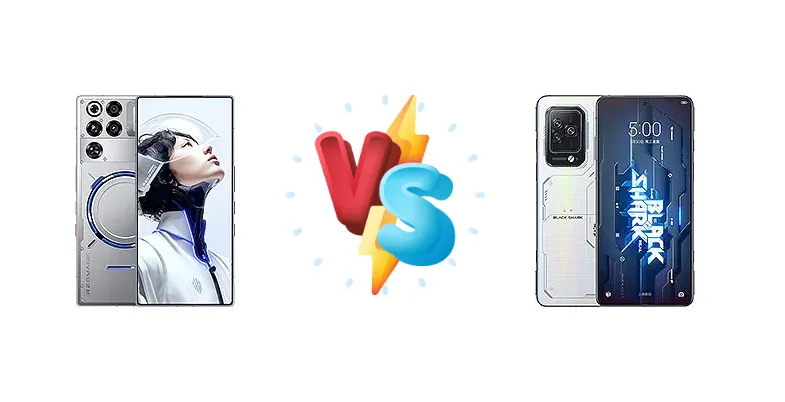
|
🏆 Quick Verdict
For the dedicated mobile gamer prioritizing raw performance and extended playtime, the ZTE nubia RedMagic 11 Pro emerges as the winner. Its Snapdragon 8 Elite Gen 5 chipset and exceptional 20:02 hour battery life outweigh the Black Shark 5 Pro’s faster charging, offering a more sustained and powerful gaming experience.
| PHONES | ||
|---|---|---|
| Phone Names | ZTE nubia RedMagic 11 Pro | Xiaomi Black Shark 5 Pro |
| Network | ||
|---|---|---|
| 2G bands | GSM 850 / 900 / 1800 / 1900 | GSM 850 / 900 / 1800 / 1900 |
| 3G bands | HSDPA 800 / 850 / 900 / 1700(AWS) / 1900 / 2100 | HSDPA 800 / 850 / 900 / 1700(AWS) / 1900 / 2100 |
| 4G bands | 1, 2, 3, 4, 5, 7, 8, 12, 17, 18, 19, 20, 26, 28, 34, 38, 39, 40, 41, 42, 66 | 1, 2, 3, 4, 5, 7, 8, 12, 17, 18, 19, 26, 28, 34, 38, 39, 40, 41 |
| 5G bands | 1, 2, 3, 5, 7, 8, 20, 26, 28, 38, 40, 41, 66, 77, 78 SA/NSA | 1, 3, 8, 28, 41, 77, 78, 79 SA/NSA |
| Speed | HSPA, LTE, 5G | HSPA, LTE, 5G |
| Technology | GSM / HSPA / LTE / 5G | GSM / CDMA / HSPA / EVDO / LTE / 5G |
| Launch | ||
|---|---|---|
| Announced | 2025, November 03 | 2022, March 30 |
| Status | Available. Released 2025, November 13 | Available. Released 2022, April 04 |
| Body | ||
|---|---|---|
| Build | Glass front (Gorilla Glass), aluminum frame, glass back | - |
| Dimensions | 163.8 x 76.5 x 8.9 mm (6.45 x 3.01 x 0.35 in) | 163.9 x 76.5 x 9.5 mm (6.45 x 3.01 x 0.37 in) |
| SIM | Nano-SIM + Nano-SIM | Nano-SIM + Nano-SIM |
| Weight | 230 g (8.11 oz) | 220 g (7.76 oz) |
| Display | ||
|---|---|---|
| Protection | Corning Gorilla Glass | - |
| Resolution | 1216 x 2688 pixels (~431 ppi density) | 1080 x 2400 pixels, 20:9 ratio (~395 ppi density) |
| Size | 6.85 inches, 113.7 cm2 (~90.7% screen-to-body ratio) | 6.67 inches, 107.4 cm2 (~85.7% screen-to-body ratio) |
| Type | AMOLED, 1B colors, 144Hz, 2592Hz PWM, 1800 nits (peak) | OLED, 1B colors, 144Hz, HDR10+ |
| Platform | ||
|---|---|---|
| CPU | Octa-core (2x4.6 GHz Oryon V3 Phoenix L + 6x3.62 GHz Oryon V3 Phoenix M) | Octa-core (1x3.00 GHz Cortex-X2 & 3x2.50 GHz Cortex-A710 & 4x1.80 GHz Cortex-A510) |
| Chipset | Qualcomm SM8850-AC Snapdragon 8 Elite Gen 5 (3 nm) | Qualcomm SM8450 Snapdragon 8 Gen 1 (4 nm) |
| GPU | Adreno 840 | Adreno 730 |
| OS | Android 16, Redmagic OS 11 | Android 12, Joy UI 13 |
| Memory | ||
|---|---|---|
| Card slot | No | No |
| Internal | 256GB 12GB RAM, 512GB 16GB RAM, 1TB 24GB RAM | 128GB 8GB RAM, 256GB 8GB RAM, 256GB 12GB RAM, 512GB 16GB RAM |
| Main Camera | ||
|---|---|---|
| Features | LED flash, HDR, panorama | LED flash, HDR, panorama |
| Single | - | 16 MP, (wide), 1/3.06", 1.0µm |
| Triple | 50 MP, f/1.9, (wide), 1/1.55", 1.0µm, PDAF, OIS 50 MP, f/2.2, (ultrawide), 1/2.88", 0.61µm Auxiliary lens | 108 MP, f/1.8, (wide), 1/1.52", 0.7µm, PDAF 13 MP, f/2.4, 120˚ (ultrawide), 1/3.06", 1.12µm 5 MP, f/2.4, (telephoto macro), AF |
| Video | 8K@30fps, 4K@30/60fps, 1080p@30/60/120/240fps | 4K@30/60fps, 1080p@30/60/240fps, 1080p@960fps; HDR10+ |
| Selfie camera | ||
|---|---|---|
| Features | HDR | HDR |
| Single | 16 MP, f/2.0, (wide), 1/2.77", 1.12µm, under display | 16 MP, (wide), 1/3.06", 1.0µm |
| Video | 1080p@30/60fps | 1080p@30fps |
| Sound | ||
|---|---|---|
| 3.5mm jack | - | No |
| 35mm jack | Yes | No |
| Loudspeaker | Yes, with stereo speakers | Yes, with stereo speakers |
| Comms | ||
|---|---|---|
| Bluetooth | 5.4, A2DP, LE | 5.2, A2DP, LE, aptX HD, aptX Adaptive |
| Infrared port | Yes | - |
| NFC | Yes | Yes |
| Positioning | GPS (L1+L5), GLONASS, BDS, GALILEO | GPS, GLONASS, GALILEO, QZSS, BDS |
| Radio | No | No |
| USB | USB Type-C 3.2 Gen 2, OTG, accessory connector, DisplayPort | USB Type-C 2.0, video output |
| WLAN | Wi-Fi 802.11 a/b/g/n/ac/6e/7, tri-band, Wi-Fi Direct | Wi-Fi 802.11 a/b/g/n/ac/6, dual-band, Wi-Fi Direct |
| Features | ||
|---|---|---|
| Sensors | Fingerprint (under display, ultrasonic), accelerometer, gyro, proximity, compass | Fingerprint (side-mounted), accelerometer, gyro, proximity, compass, barometer (China only) |
| Battery | ||
|---|---|---|
| Charging | 80W wired 80W wireless, 100% in 68 min | 120W wired, 100% in 15 min |
| Type | Si/C Li-Ion 7500 mAh | Li-Po 4650 mAh |
| Misc | ||
|---|---|---|
| Colors | Matte Black Cryo, Transparent Silver Subzero, Transparent Black Nightfreeze | Black, White |
| Models | - | SHARK KTUS-H0 |
| Price | € 698.00 / £ 618.00 | About 720 EUR |
| Tests | ||
|---|---|---|
| Battery life | - | Endurance rating 83h |
| Camera | - | Photo / Video |
| Display | - | Contrast ratio: Infinite (nominal) |
| Performance | - | AnTuTu: 876704 (v8), 1007133 (v9) GeekBench: 3665 (v5.1) GFXBench: 82fps (ES 3.1 onscreen) |
ZTE nubia RedMagic 11 Pro
- Superior CPU and GPU performance with Snapdragon 8 Elite Gen 5
- Exceptional battery life (20:02h active use)
- Significantly brighter display (1569 nits)
- Slower wired charging than Black Shark 5 Pro
- Wireless charging adds bulk
Xiaomi Black Shark 5 Pro
- Ultra-fast 120W wired charging (100% in 15 minutes)
- Established gaming brand with accessories
- Potentially refined software experience
- Older Snapdragon 8 Gen 1 chipset
- Dimmer display (682 nits)
- Shorter battery life compared to RedMagic 11 Pro
Display Comparison
The ZTE nubia RedMagic 11 Pro significantly outshines the Xiaomi Black Shark 5 Pro in display quality, boasting a measured peak brightness of 1569 nits compared to the Black Shark’s 682 nits. This difference is crucial for outdoor visibility and HDR content. While both feature infinite contrast ratios (nominal), the RedMagic’s superior brightness provides a more vibrant and immersive visual experience. Details regarding refresh rates and panel technology (LTPO) are missing for both, but the RedMagic’s brightness advantage is a clear win.
Camera Comparison
Both devices feature photo and video capabilities, but neither is positioned as a camera-centric phone. Detailed camera specs are lacking, making a direct comparison difficult. The Black Shark 5 Pro likely benefits from Xiaomi’s established image processing algorithms, but without sensor size or aperture information, it’s impossible to definitively declare a winner. The presence of a 2MP macro camera on the Black Shark is likely a marketing feature with limited real-world utility.
Performance
The core difference lies in the chipsets: the RedMagic 11 Pro utilizes the Qualcomm SM8850-AC Snapdragon 8 Elite Gen 5 (3nm), while the Black Shark 5 Pro features the older SM8450 Snapdragon 8 Gen 1 (4nm). The 3nm process of the Snapdragon 8 Elite Gen 5 offers superior power efficiency and thermal performance compared to the 4nm node of the Gen 1. The RedMagic’s CPU configuration (2x4.6 GHz Oryon V3 Phoenix L + 6x3.62 GHz Oryon V3 Phoenix M) also suggests a performance edge over the Black Shark’s (1x3.00 GHz Cortex-X2 & 3x2.50 GHz Cortex-A710 & 4x1.80 GHz Cortex-A510). This translates to smoother frame rates and less throttling during extended gaming sessions. RAM specifications are missing for both, but LPDDR5x is expected in both devices.
Battery Life
The ZTE nubia RedMagic 11 Pro delivers a remarkable 20:02 hours of active use, showcasing exceptional battery endurance. While the Xiaomi Black Shark 5 Pro has an endurance rating of 83 hours, this is an older metric and doesn’t directly translate to real-world gaming performance. The Black Shark compensates with incredibly fast 120W wired charging (100% in 15 minutes), while the RedMagic offers 80W wired and 80W wireless (100% in 68 minutes). The RedMagic’s longer battery life provides more uninterrupted gaming, while the Black Shark prioritizes quick top-ups.
Buying Guide
Buy the ZTE nubia RedMagic 11 Pro if you need uncompromising performance, a brighter display for visibility, and all-day battery life for marathon gaming sessions. Buy the Xiaomi Black Shark 5 Pro if you prioritize the absolute fastest charging speeds and are willing to trade some sustained performance and screen brightness for that convenience.