
ZTE nubia RedMagic 11 Pro vs. vivo iQOO 12 Pro: A Deep Dive into Gaming and Charging
| Phones Images | |||||
|---|---|---|---|---|---|
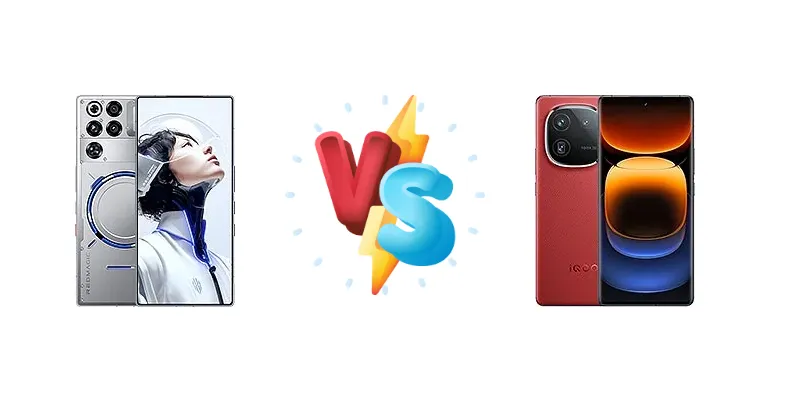
|
🏆 Quick Verdict
For dedicated mobile gamers prioritizing sustained performance and battery life, the ZTE nubia RedMagic 11 Pro is the clear winner. Its Snapdragon 8 Elite Gen 5 and impressive 20:02 active use score outweigh the iQOO 12 Pro’s faster charging. However, the iQOO 12 Pro is a strong contender for users seeking a more versatile flagship.
| PHONES | ||
|---|---|---|
| Phone Names | ZTE nubia RedMagic 11 Pro | vivo iQOO 12 Pro |
| Network | ||
|---|---|---|
| 2G bands | GSM 850 / 900 / 1800 / 1900 | GSM 850 / 900 / 1800 / 1900 |
| 3G bands | HSDPA 800 / 850 / 900 / 1700(AWS) / 1900 / 2100 | HSDPA 800 / 850 / 900 / 1700(AWS) / 1900 / 2100 |
| 4G bands | 1, 2, 3, 4, 5, 7, 8, 12, 17, 18, 19, 20, 26, 28, 34, 38, 39, 40, 41, 42, 66 | 1, 2, 3, 4, 5, 7, 8, 12, 17, 18, 19, 20, 25, 26, 28, 34, 38, 39, 40, 41, 42, 66 |
| 5G bands | 1, 2, 3, 5, 7, 8, 20, 26, 28, 38, 40, 41, 66, 77, 78 SA/NSA | 1, 2, 3, 5, 7, 8, 12, 20, 25, 26, 28, 66, 38, 40, 41, 77, 78 SA/NSA |
| Speed | HSPA, LTE, 5G | HSPA, LTE, 5G |
| Technology | GSM / HSPA / LTE / 5G | GSM / CDMA / HSPA / CDMA2000 / LTE / 5G |
| Launch | ||
|---|---|---|
| Announced | 2025, November 03 | 2023, November 07 |
| Status | Available. Released 2025, November 13 | Available. Released 2023, November 14 |
| Body | ||
|---|---|---|
| Build | Glass front (Gorilla Glass), aluminum frame, glass back | - |
| Dimensions | 163.8 x 76.5 x 8.9 mm (6.45 x 3.01 x 0.35 in) | 164.6 x 75.4 x 8.6 mm or 8.8 mm |
| SIM | Nano-SIM + Nano-SIM | Nano-SIM + Nano-SIM |
| Weight | 230 g (8.11 oz) | 205 g or 210 g (7.23 oz) |
| Display | ||
|---|---|---|
| Protection | Corning Gorilla Glass | - |
| Resolution | 1216 x 2688 pixels (~431 ppi density) | 1440 x 3200 pixels, 20:9 ratio (~518 ppi density) |
| Size | 6.85 inches, 113.7 cm2 (~90.7% screen-to-body ratio) | 6.78 inches, 111.0 cm2 (~89.4% screen-to-body ratio) |
| Type | AMOLED, 1B colors, 144Hz, 2592Hz PWM, 1800 nits (peak) | LTPO AMOLED, 1B colors, 144Hz, HDR10+, 1600 nits (HBM), 3000 nits (peak) |
| Platform | ||
|---|---|---|
| CPU | Octa-core (2x4.6 GHz Oryon V3 Phoenix L + 6x3.62 GHz Oryon V3 Phoenix M) | Octa-core (1x3.3 GHz Cortex-X4 & 3x3.2 GHz Cortex-A720 & 2x3.0 GHz Cortex-A720 & 2x2.3 GHz Cortex-A520) |
| Chipset | Qualcomm SM8850-AC Snapdragon 8 Elite Gen 5 (3 nm) | Qualcomm SM8650-AB Snapdragon 8 Gen 3 (4 nm) |
| GPU | Adreno 840 | Adreno 750 |
| OS | Android 16, Redmagic OS 11 | Android 14, up to 2 major Android upgrades, Funtouch 14 (International), OriginOS 4 (China) |
| Memory | ||
|---|---|---|
| Card slot | No | No |
| Internal | 256GB 12GB RAM, 512GB 16GB RAM, 1TB 24GB RAM | 256GB 16GB RAM, 512GB 16GB RAM, 1TB 16GB RAM |
| Main Camera | ||
|---|---|---|
| Features | LED flash, HDR, panorama | Color spectrum sensor, Dual-LED flash, HDR, panorama |
| Triple | 50 MP, f/1.9, (wide), 1/1.55", 1.0µm, PDAF, OIS 50 MP, f/2.2, (ultrawide), 1/2.88", 0.61µm Auxiliary lens | 50 MP, f/1.7, 23mm (wide), 1/1.3", 1.2µm, ulti-directional PDAF, OIS 64 MP, f/2.6, 70mm (periscope telephoto), 1/2.0", PDAF, OIS, 3x optical zoom 50 MP, f/2.0, 15mm, 119˚ (ultrawide), AF |
| Video | 8K@30fps, 4K@30/60fps, 1080p@30/60/120/240fps | 8K@30fps, 4K@24/30/60fps, 1080p@30/60/120/240fps, gyro-EIS |
| Selfie camera | ||
|---|---|---|
| Features | HDR | HDR |
| Single | 16 MP, f/2.0, (wide), 1/2.77", 1.12µm, under display | 16 MP, f/2.5, (wide) |
| Video | 1080p@30/60fps | 1080p@30fps, gyro-EIS |
| Sound | ||
|---|---|---|
| 35mm jack | Yes | No |
| Loudspeaker | Yes, with stereo speakers | Yes, with stereo speakers |
| Comms | ||
|---|---|---|
| Bluetooth | 5.4, A2DP, LE | 5.4, A2DP, LE, aptX HD, aptX Adaptive, aptX Lossless |
| Infrared port | Yes | Yes |
| NFC | Yes | Yes |
| Positioning | GPS (L1+L5), GLONASS, BDS, GALILEO | GPS (L1+L5), GLONASS (G1), BDS (B1I+B1c+B2a), GALILEO (E1+E5a), QZSS (L1+L5) |
| Radio | No | No |
| USB | USB Type-C 3.2 Gen 2, OTG, accessory connector, DisplayPort | USB Type-C 2.0, OTG |
| WLAN | Wi-Fi 802.11 a/b/g/n/ac/6e/7, tri-band, Wi-Fi Direct | Wi-Fi 802.11 a/b/g/n/ac/6/7, tri-band, Wi-Fi Direct |
| Features | ||
|---|---|---|
| Sensors | Fingerprint (under display, ultrasonic), accelerometer, gyro, proximity, compass | Fingerprint (under display, ultrasonic), accelerometer, gyro, proximity, compass |
| Battery | ||
|---|---|---|
| Charging | 80W wired 80W wireless, 100% in 68 min | 120W wired 50W wireless 10W reverse wireless |
| Type | Si/C Li-Ion 7500 mAh | 5100 mAh |
| Misc | ||
|---|---|---|
| Colors | Matte Black Cryo, Transparent Silver Subzero, Transparent Black Nightfreeze | Black, Red, White (BMW M branding) |
| Models | - | V2329A |
| Price | € 698.00 / £ 618.00 | About 650 EUR |
ZTE nubia RedMagic 11 Pro
- Superior sustained gaming performance with Snapdragon 8 Elite Gen 5
- Exceptional battery life (20:02 active use)
- Potentially better thermal management due to 3nm process
- Slower charging speeds (80W wired, 80W wireless)
- Likely less refined camera system
- Gaming-focused design may not appeal to all
vivo iQOO 12 Pro
- Ultra-fast 120W wired charging
- 50W wireless and 10W reverse wireless charging
- Potentially better camera system (based on brand reputation)
- Snapdragon 8 Gen 3 may throttle more under sustained load
- Likely shorter battery life compared to RedMagic 11 Pro
- May not offer the same level of gaming-specific optimizations
Display Comparison
The RedMagic 11 Pro boasts a peak brightness of 1569 nits, ensuring excellent visibility even in direct sunlight. While the iQOO 12 Pro’s display specs aren’t provided, vivo typically employs high-quality AMOLED panels. The RedMagic’s focus on gaming suggests a potentially higher refresh rate and lower response time, crucial for competitive play. The absence of LTPO information for either device makes it difficult to assess power efficiency gains from variable refresh rates, but the RedMagic’s gaming focus suggests optimization for smooth visuals.
Camera Comparison
Detailed camera specifications are missing for both devices. However, given iQOO’s history, the 12 Pro likely features a more sophisticated camera system with larger sensors and advanced image processing. The RedMagic line traditionally prioritizes gaming features over camera prowess. Without specific sensor details, it’s reasonable to assume the iQOO 12 Pro will deliver more versatile and higher-quality photos and videos, particularly in challenging lighting conditions. The absence of information on OIS for either device makes it difficult to assess low-light performance.
Performance
The core difference lies in the chipsets: the RedMagic 11 Pro utilizes the Qualcomm SM8850-AC Snapdragon 8 Elite Gen 5 (3nm), featuring a unique octa-core configuration with Oryon V3 Phoenix cores clocked up to 4.6 GHz. This contrasts with the iQOO 12 Pro’s Snapdragon 8 Gen 3 (4nm). While the Gen 3 is a powerful chip, the Elite Gen 5’s Oryon cores are designed for sustained peak performance, potentially offering a significant advantage in demanding games. The 3nm process of the Elite Gen 5 also suggests superior thermal efficiency, minimizing throttling during prolonged gaming. The iQOO 12 Pro’s Cortex-X4 prime core at 3.3 GHz will excel in burst workloads, but may not maintain peak performance as consistently as the RedMagic.
Battery Life
The RedMagic 11 Pro shines with an impressive 20:02 hours of active use, indicating exceptional battery life. While the iQOO 12 Pro’s battery capacity is unknown, its 120W wired charging significantly surpasses the RedMagic’s 80W. The iQOO 12 Pro can reach 100% charge in a claimed 68 minutes, while the RedMagic takes a similar time. The iQOO 12 Pro also offers 50W wireless charging and 10W reverse wireless charging, features absent on the RedMagic. The RedMagic’s longer active use time suggests a more efficient chipset and software optimization, but the iQOO 12 Pro’s faster charging provides convenience.
Buying Guide
Buy the ZTE nubia RedMagic 11 Pro if you need maximum gaming performance, extended battery life during intense sessions, and are willing to accept a more niche design. Buy the vivo iQOO 12 Pro if you prefer a more balanced flagship experience with incredibly fast 120W wired charging, a potentially better camera system (based on brand reputation), and a more mainstream aesthetic.