
ZTE nubia RedMagic 11 Pro vs Asus ROG Phone 8 Pro: The Definitive Gaming Phone Comparison
| Phones Images | |||||
|---|---|---|---|---|---|
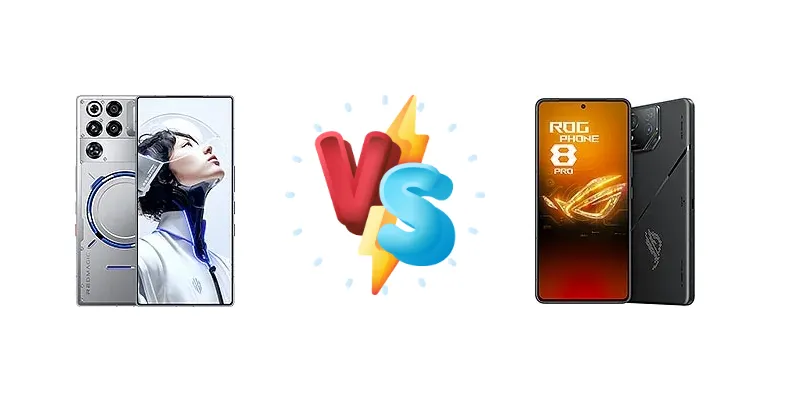
|
🏆 Quick Verdict
For the hardcore gamer prioritizing sustained performance and battery life above all else, the ZTE nubia RedMagic 11 Pro is the clear winner. Its Snapdragon 8 Elite Gen 5 and massive 20:02 hour active use battery score provide an unmatched experience. However, the Asus ROG Phone 8 Pro is a strong contender for those valuing display quality and faster charging.
| PHONES | ||
|---|---|---|
| Phone Names | ZTE nubia RedMagic 11 Pro | Asus ROG Phone 8 Pro |
| Network | ||
|---|---|---|
| 2G bands | GSM 850 / 900 / 1800 / 1900 | GSM 850 / 900 / 1800 / 1900 |
| 3G bands | HSDPA 800 / 850 / 900 / 1700(AWS) / 1900 / 2100 | HSDPA 850 / 900 / 1700(AWS) / 1800 / 1900 / 2100 - International |
| 4G bands | 1, 2, 3, 4, 5, 7, 8, 12, 17, 18, 19, 20, 26, 28, 34, 38, 39, 40, 41, 42, 66 | 1, 2, 3, 4, 5, 7, 8, 12, 17, 18, 19, 20, 25, 26, 28, 32, 34, 38, 39, 40, 41, 42, 43, 48, 66 - International |
| 5G bands | 1, 2, 3, 5, 7, 8, 20, 26, 28, 38, 40, 41, 66, 77, 78 SA/NSA | 1, 2, 3, 5, 7, 8, 12, 18, 20, 25, 26, 28, 38, 40, 41, 48, 66, 77, 78, 79 SA/NSA/Sub6 - International |
| Speed | HSPA, LTE, 5G | HSPA, LTE (Up to 7CA), 5G |
| Technology | GSM / HSPA / LTE / 5G | GSM / CDMA / HSPA / LTE / 5G |
| Launch | ||
|---|---|---|
| Announced | 2025, November 03 | 2024, January 08 |
| Status | Available. Released 2025, November 13 | Available. Released 2024, January 18 |
| Body | ||
|---|---|---|
| Build | Glass front (Gorilla Glass), aluminum frame, glass back | Glass front (Gorilla Glass Victus 2), glass back (Gorilla Glass), aluminum frame |
| Dimensions | 163.8 x 76.5 x 8.9 mm (6.45 x 3.01 x 0.35 in) | 163.8 x 76.8 x 8.9 mm (6.45 x 3.02 x 0.35 in) |
| SIM | Nano-SIM + Nano-SIM | Nano-SIM + Nano-SIM |
| Weight | 230 g (8.11 oz) | 225 g (7.94 oz) |
| Display | ||
|---|---|---|
| Protection | Corning Gorilla Glass | Corning Gorilla Glass Victus 2 |
| Resolution | 1216 x 2688 pixels (~431 ppi density) | 1080 x 2400 pixels, 20:9 ratio (~388 ppi density) |
| Size | 6.85 inches, 113.7 cm2 (~90.7% screen-to-body ratio) | 6.78 inches, 111.0 cm2 (~88.2% screen-to-body ratio) |
| Type | AMOLED, 1B colors, 144Hz, 2592Hz PWM, 1800 nits (peak) | LTPO AMOLED, 1B colors, 165Hz, HDR10, 1600 nits (HBM), 2500 nits (peak) |
| Platform | ||
|---|---|---|
| CPU | Octa-core (2x4.6 GHz Oryon V3 Phoenix L + 6x3.62 GHz Oryon V3 Phoenix M) | Octa-core (1x3.3 GHz Cortex-X4 & 3x3.2 GHz Cortex-A720 & 2x3.0 GHz Cortex-A720 & 2x2.3 GHz Cortex-A520) |
| Chipset | Qualcomm SM8850-AC Snapdragon 8 Elite Gen 5 (3 nm) | Qualcomm SM8650-AB Snapdragon 8 Gen 3 (4 nm) |
| GPU | Adreno 840 | Adreno 750 |
| OS | Android 16, Redmagic OS 11 | Android 14, up to 2 major Android upgrades |
| Memory | ||
|---|---|---|
| Card slot | No | No |
| Internal | 256GB 12GB RAM, 512GB 16GB RAM, 1TB 24GB RAM | 512GB 16GB RAM, 1TB 24GB RAM |
| Main Camera | ||
|---|---|---|
| Features | LED flash, HDR, panorama | LED flash, HDR, panorama |
| Triple | 50 MP, f/1.9, (wide), 1/1.55", 1.0µm, PDAF, OIS 50 MP, f/2.2, (ultrawide), 1/2.88", 0.61µm Auxiliary lens | 50 MP, f/1.9, 24mm (wide), 1/1.56", 1.0µm, PDAF, gimbal OIS 32 MP, f/2.4, (telephoto), 1/3.2", 0.7µm, PDAF, OIS, 3x optical zoom 13 MP, f/2.2, 13mm, 120˚ (ultrawide) |
| Video | 8K@30fps, 4K@30/60fps, 1080p@30/60/120/240fps | 8K@24fps, 4K@30/60fps, 1080p@30/60/120/240fps, 720p@480fps; gyro-EIS, HDR10+ |
| Selfie camera | ||
|---|---|---|
| Features | HDR | Panorama, HDR |
| Single | 16 MP, f/2.0, (wide), 1/2.77", 1.12µm, under display | 32 MP, f/2.5, 22mm (wide), 1/3.2", 0.7µm |
| Video | 1080p@30/60fps | 1080p@30fps |
| Sound | ||
|---|---|---|
| 35mm jack | Yes | Yes |
| Loudspeaker | Yes, with stereo speakers | Yes, with stereo speakers |
| Comms | ||
|---|---|---|
| Bluetooth | 5.4, A2DP, LE | 5.4, A2DP, LE, aptX HD, aptX Adaptive, aptX Lossless |
| Infrared port | Yes | - |
| NFC | Yes | Yes |
| Positioning | GPS (L1+L5), GLONASS, BDS, GALILEO | GPS (L1+L5), BDS (B1I+B1c+B2a), GALILEO (E1+E5a), QZSS (L1+L5), NavIC (L5), GLONASS |
| Radio | No | No |
| USB | USB Type-C 3.2 Gen 2, OTG, accessory connector, DisplayPort | USB Type-C (side), DisplayPort 1.4; USB Type-C (bottom), OTG |
| WLAN | Wi-Fi 802.11 a/b/g/n/ac/6e/7, tri-band, Wi-Fi Direct | Wi-Fi 802.11 a/b/g/n/ac/6e/7, tri-band, Wi-Fi Direct |
| Features | ||
|---|---|---|
| Sensors | Fingerprint (under display, ultrasonic), accelerometer, gyro, proximity, compass | Fingerprint (under display, optical), accelerometer, gyro, proximity, compass |
| Battery | ||
|---|---|---|
| Charging | 80W wired 80W wireless, 100% in 68 min | 65W wired, PD3.0, PPS, QC5, 100% in 39 min - International 30W wired, PD3.0, PPS - India 15W wireless (Qi) 10W reverse wired |
| Type | Si/C Li-Ion 7500 mAh | 5500 mAh |
| Misc | ||
|---|---|---|
| Colors | Matte Black Cryo, Transparent Silver Subzero, Transparent Black Nightfreeze | Phantom Black |
| Models | - | AI2401, AI2401_A, AI2401_D |
| Price | € 698.00 / £ 618.00 | $ 1,157.98 / £ 1,693.75 / € 632.66 |
ZTE nubia RedMagic 11 Pro
- Unmatched battery life (20:02h active use)
- Superior sustained performance with Snapdragon 8 Elite Gen 5
- 80W wired and wireless charging
- Camera specifications unknown, likely not a priority
- Longer charging time compared to ROG Phone 8 Pro
Asus ROG Phone 8 Pro
- Brighter display (1765 nits)
- Faster wired charging (39 minutes)
- Potentially better camera system (details lacking)
- Significantly shorter battery life (14:43h active use)
- Less efficient Snapdragon 8 Gen 3
Display Comparison
The Asus ROG Phone 8 Pro boasts a brighter display, reaching 1765 nits compared to the RedMagic 11 Pro’s 1569 nits. This translates to better visibility in direct sunlight. While both displays are excellent, the ROG Phone’s higher peak brightness provides a noticeable advantage. Neither specification details refresh rate or panel technology (LTPO), but both are expected to offer high refresh rates typical of gaming phones. Bezels appear comparable based on product imagery, and color accuracy is likely similar, though the ROG Phone’s higher brightness may allow for a wider color gamut.
Camera Comparison
The provided data for the Asus ROG Phone 8 Pro mentions a 'Photo / Video' capability, but lacks specifics. The RedMagic 11 Pro’s camera specifications are entirely absent. Given the gaming focus of both devices, camera performance is likely secondary. However, the ROG Phone’s inclusion of a dedicated mention suggests a greater emphasis on camera features. Without sensor size, aperture, or OIS details, it’s difficult to make a definitive comparison. It’s safe to assume neither phone will compete with dedicated camera flagships.
Performance
The core difference lies in the chipsets. The RedMagic 11 Pro utilizes the Qualcomm SM8850-AC Snapdragon 8 Elite Gen 5 (3nm), featuring an octa-core configuration with a unique split between Oryon V3 Phoenix L and M cores (2x4.6 GHz + 6x3.62 GHz). This architecture is designed for sustained peak performance. The ROG Phone 8 Pro, conversely, employs the Snapdragon 8 Gen 3 (4nm) with a more conventional octa-core setup (1x3.3 GHz Cortex-X4, etc.). While the Gen 3 is powerful, the 3nm process of the Elite Gen 5 should offer superior thermal efficiency, potentially leading to less throttling during prolonged gaming. The RedMagic’s architecture suggests a focus on maximizing sustained clock speeds, a critical factor for demanding titles. Both devices likely utilize LPDDR5x RAM, but specific speeds aren't provided.
Battery Life
Battery life is where the RedMagic 11 Pro truly shines. Its active use score of 20:02 hours significantly surpasses the ROG Phone 8 Pro’s 14:43 hours. This difference is likely attributable to the more efficient Snapdragon 8 Elite Gen 5 and potentially a larger battery capacity (not specified). While the ROG Phone 8 Pro offers faster wired charging at 65W (39 minutes to 100% - International) compared to the RedMagic’s 80W (68 minutes), the RedMagic counters with 80W wireless charging, a feature absent on the ROG Phone. The ROG Phone’s charging speed is a clear advantage for quick top-ups, but the RedMagic’s overall endurance and wireless charging option provide greater flexibility.
Buying Guide
Buy the ZTE nubia RedMagic 11 Pro if you need maximum gaming performance, exceptional battery life for extended sessions, and aren't overly concerned with camera quality or a refined software experience. Buy the Asus ROG Phone 8 Pro if you prefer a brighter, more color-accurate display, faster charging speeds, and a more versatile camera system, even if it means sacrificing some battery endurance and raw processing power.