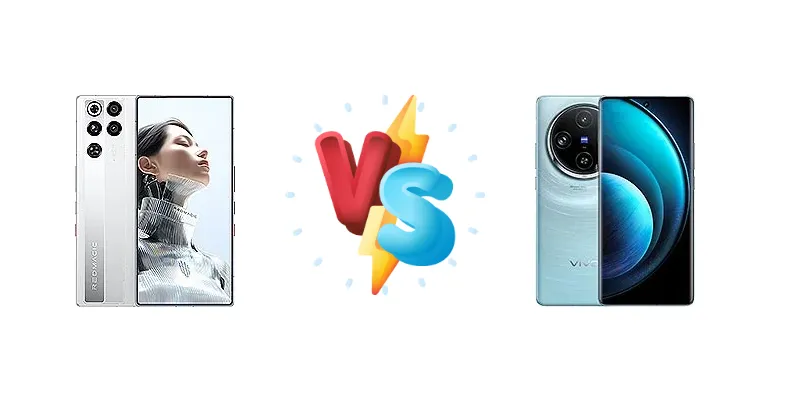
The ZTE nubia RedMagic 11 Pro (China) and the vivo X100 Pro represent distinct philosophies in the flagship Android space. The RedMagic prioritizes unadulterated gaming performance, while the X100 Pro aims for a more balanced experience with a strong emphasis on camera capabilities. This comparison dissects their core differences to help you choose the right device.
🏆 Quick Verdict
For dedicated mobile gamers, the ZTE nubia RedMagic 11 Pro is the clear winner, thanks to its Snapdragon 8 Elite Gen 5 and optimized cooling. However, the vivo X100 Pro excels in photography, battery endurance, and offers a more refined all-around experience for mainstream users.
| Network |
|---|
| 2G bands | GSM 850 / 900 / 1800 / 1900 | GSM 850 / 900 / 1800 / 1900 |
| 3G bands | HSDPA 850 / 900 / 1700(AWS) / 1900 / 2100 | HSDPA 800 / 850 / 900 / 1700(AWS) / 1900 / 2100 |
| 4G bands | LTE | 1, 2, 3, 4, 5, 7, 8, 12, 17, 18, 19, 20, 26, 28, 32, 38, 39, 40, 41, 42, 66 - International |
| 5G bands | SA/NSA | 1, 3, 5, 7, 8, 20, 28, 38, 40, 41, 66, 75, 77, 78, 79 SA/NSA - International |
| Speed | HSPA, LTE, 5G | HSPA, LTE, 5G |
| Technology | GSM / CDMA / HSPA / EVDO / LTE / 5G | GSM / CDMA / HSPA / LTE / 5G |
| Launch |
|---|
| Announced | 2025, October 17 | 2023, November 13 |
| Status | Available. Released 2025, October 17 | Available. Released 2023, November 21 |
| Body |
|---|
| Build | Glass front, aluminum frame, glass back | Glass front, aluminum frame, glass back |
| Dimensions | 163.8 x 76.5 x 8.9 mm (6.45 x 3.01 x 0.35 in) | 164.1 x 75.3 x 8.9 mm or 9.1 mm |
| SIM | Nano-SIM + Nano-SIM | · Nano-SIM + eSIM· Nano-SIM + Nano-SIM |
| Weight | 230 g (8.11 oz) | 221 g or 225 g (7.80 oz) |
| Display |
|---|
| Resolution | 1216 x 2688 pixels (~431 ppi density) | 1260 x 2800 pixels, 20:9 ratio (~452 ppi density) |
| Size | 6.85 inches, 113.7 cm2 (~90.7% screen-to-body ratio) | 6.78 inches, 111.5 cm2 (~90.2% screen-to-body ratio) |
| Type | AMOLED, 1B colors, 144Hz, 2592Hz PWM, 2000 nits (peak) | LTPO AMOLED, 1B colors, 120Hz, HDR10+, 3000 nits (peak) |
| Platform |
|---|
| CPU | Octa-core (2x4.6 GHz Oryon V3 Phoenix L + 6x3.62 GHz Oryon V3 Phoenix M) | Octa-core (1x3.25 GHz Cortex-X4 & 3x2.85 GHz Cortex-X4 & 4x2.0 GHz Cortex-A720) |
| Chipset | Qualcomm SM8850-AC Snapdragon 8 Elite Gen 5 (3 nm) | Mediatek Dimensity 9300 (4 nm) |
| GPU | Adreno 840 | Immortalis-G720 MC12 |
| OS | Android 16, Redmagic OS 11 | Android 14, upgradable to Android 15, Funtouch 15 (International), OriginOS 4 (China) |
| Memory |
|---|
| Card slot | No | No |
| Internal | 256GB 12GB RAM, 512GB 16GB RAM | 256GB 12GB RAM, 256GB 16GB RAM, 512GB 16GB RAM, 1TB 16GB RAM |
| Main Camera |
|---|
| Dual | 50 MP, f/1.9, (wide), 1/1.55", 1.0µm, PDAF, OIS
50 MP, f/2.2, (ultrawide), 1/2.88", 0.61µm
Auxiliary lens | - |
| Features | LED flash, HDR, panorama | Laser AF, color spectrum sensor, Zeiss optics, Zeiss T* lens coating, LED flash, panorama, HDR, 3D LUT import |
| Triple | - | 50 MP, f/1.8, 23mm (wide), 1/0.98", 1.6µm, dual pixel PDAF, OIS
50 MP, f/2.5, 100mm (periscope telephoto), 1/2.51", 0.7µm, PDAF (18cm - ∞), OIS, 4.3x optical zoom
50 MP, f/2.0, 15mm, 119˚ (ultrawide), 1/2.76", 0.64µm, AF |
| Video | 8K@30fps, 4K@30/60fps, 1080p@30/60/120/240fps | 8K@30fps, 4K@30/60fps, 1080p, gyro-EIS |
| Selfie camera |
|---|
| Features | HDR | HDR |
| Single | 16 MP, f/2.0, (wide), 1/2.77", 1.12µm, under display | 32 MP, f/2.0, 20mm (ultrawide) |
| Video | 1080p@30/60fps | 4K@30/60fps, 1080p@30/60fps |
| Sound |
|---|
| 35mm jack | Yes | No |
| Loudspeaker | Yes, with stereo speakers | Yes, with stereo speakers |
| Comms |
|---|
| Bluetooth | 5.4, A2DP, LE | 5.4, A2DP, LE, aptX HD, LHDC |
| Infrared port | Yes | Yes |
| NFC | Yes | Yes |
| Positioning | GPS (L1+L5), GLONASS, BDS, GALILEO | GPS (L1+L5), GLONASS (L1), BDS (B1I+B1c+B2a+B2b), GALILEO (E1+E5a+E5b), QZSS (L1+L5), NavIC (L5) |
| Radio | No | No |
| USB | USB Type-C 3.2 Gen 2, OTG, accessory connector, DisplayPort | USB Type-C 3.2, OTG |
| WLAN | Wi-Fi 802.11 a/b/g/n/ac/6e/7, tri-band, Wi-Fi Direct | Wi-Fi 802.11 a/b/g/n/ac/6/7, tri-band, Wi-Fi Direct |
| Features |
|---|
| Sensors | Fingerprint (under display, ultrasonic), accelerometer, gyro, proximity, compass | Fingerprint (under display, optical), accelerometer, gyro, proximity, compass |
| Battery |
|---|
| Charging | 80W wired | 100W wired, 50% in 14 min
50W wireless
Reverse wired |
| Type | Si/C Li-Ion 8000 mAh | Li-Ion 5400 mAh |
| Misc |
|---|
| Colors | Black, Silver | Startrail Blue, Asteroid Black, Sunset Orange, White |
| Models | NX809J | V2324A, V2309 |
| Price | About 600 EUR | ₹ 59,999 |
| SAR EU | - | 0.99 W/kg (head) 1.19 W/kg (body) |
ZTE nubia RedMagic 11 Pro (China)
- Superior gaming performance with Snapdragon 8 Elite Gen 5
- Potentially better thermal management due to 3nm process
- Optimized for high refresh rate gaming
- Likely weaker camera system compared to vivo X100 Pro
- Slower charging speed (80W vs 100W)
- Battery life potentially shorter than X100 Pro
vivo X100 Pro
- Excellent camera performance and image quality
- Longer battery life (13:53h active use)
- Faster charging (100W wired, 50W wireless)
- Dimensity 9300 may throttle more under sustained gaming load
- Less focused on gaming-specific features
- Potentially higher price
Display Comparison
The vivo X100 Pro boasts a significantly brighter display, reaching a measured 1472 nits, which translates to superior visibility in direct sunlight. While the RedMagic 11 Pro’s display specs are currently unknown, nubia typically focuses on high refresh rates for gaming. The X100 Pro’s brightness advantage is crucial for outdoor use and HDR content consumption. We anticipate the RedMagic 11 Pro will prioritize refresh rate over peak brightness, catering to the needs of competitive gamers.
Camera Comparison
The vivo X100 Pro is positioned as a photography powerhouse, though specific sensor details are missing. vivo’s flagship phones consistently deliver excellent image quality, and we expect the X100 Pro to continue this trend. The RedMagic 11 Pro, while likely including a capable camera system, prioritizes gaming features and will likely fall short of the X100 Pro’s photographic capabilities. The X100 Pro’s image processing algorithms are likely tuned for vibrant colors and detailed images, while the RedMagic will likely offer a more neutral approach. The absence of detailed camera specs for the RedMagic suggests it’s not a primary selling point.
Performance
The core battle lies in the chipsets. The RedMagic 11 Pro utilizes the Qualcomm Snapdragon 8 Elite Gen 5 (3nm), featuring a unique Oryon V3 Phoenix CPU architecture (2x4.6 GHz + 6x3.62 GHz). This architecture, designed by Qualcomm, promises significant performance gains over previous Snapdragon generations. The vivo X100 Pro counters with the MediaTek Dimensity 9300 (4nm), employing a Cortex-X4 based CPU (1x3.25 GHz + 3x2.85 GHz + 4x2.0 GHz). The 3nm process of the Snapdragon 8 Elite Gen 5 should offer better thermal efficiency, potentially leading to sustained performance during extended gaming sessions. However, the Dimensity 9300’s CPU configuration is designed for peak performance in short bursts, and its efficiency is competitive. The RedMagic’s focus on gaming suggests optimized software and cooling solutions to maximize the Snapdragon’s potential.
Battery Life
The vivo X100 Pro demonstrates impressive battery life, achieving 13:53h in active use. It also supports 100W wired charging (50% in 14 minutes) and 50W wireless charging, alongside reverse wired charging. The RedMagic 11 Pro offers 80W wired charging, which is fast but slower than the X100 Pro. While the RedMagic 11 Pro’s battery capacity is unknown, the X100 Pro’s combination of capacity and charging speed provides a significant advantage for users who prioritize all-day battery life and quick top-ups.
Buying Guide
Buy the ZTE nubia RedMagic 11 Pro if you demand the highest possible frame rates in demanding mobile games, prioritize active cooling, and are willing to compromise on camera versatility. Buy the vivo X100 Pro if you value exceptional camera quality, all-day battery life, fast charging (including wireless), and a more polished software experience.
Frequently Asked Questions
❓ Does the MediaTek Dimensity 9300 in the vivo X100 Pro suffer from overheating during prolonged gaming sessions?
While the Dimensity 9300 is a powerful chip, it's built on a 4nm process, which is less efficient than the Snapdragon 8 Elite Gen 5’s 3nm process. This means the X100 Pro may experience more thermal throttling during extended gaming, potentially leading to reduced frame rates over time. However, vivo’s cooling solutions are typically robust, mitigating this issue to some extent.
❓ How does the cooling system on the ZTE nubia RedMagic 11 Pro compare to the vivo X100 Pro?
The RedMagic series is renowned for its advanced cooling systems, often incorporating vapor chambers, fans, and multiple layers of heat dissipation materials. The X100 Pro likely employs a more conventional cooling solution. This gives the RedMagic 11 Pro a significant advantage in maintaining peak performance during demanding gaming sessions, minimizing thermal throttling.
❓ Is the 80W charging on the RedMagic 11 Pro significantly slower than the 100W on the vivo X100 Pro in real-world use?
While 100W is faster on paper, the difference in charging speed isn't always dramatic. The X100 Pro reaches 50% in 14 minutes, while the RedMagic 11 Pro will likely take slightly longer. Both offer rapid charging, and the difference may not be noticeable for casual users. However, for those who frequently need to quickly top up their battery, the X100 Pro’s faster charging is a benefit.