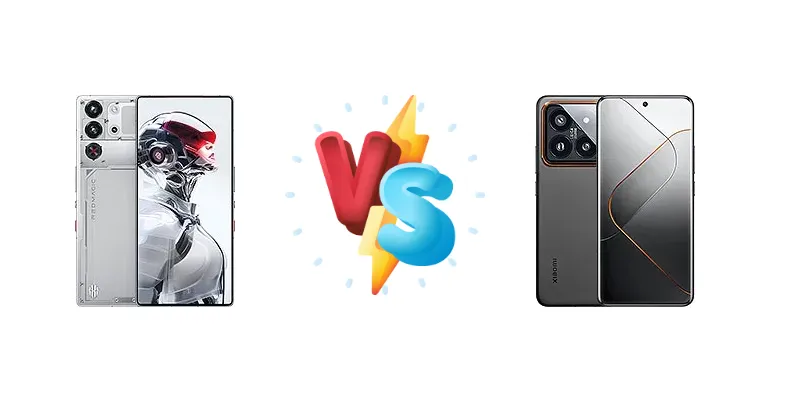
The ZTE nubia RedMagic 10S Pro+ and the Xiaomi 14 Pro represent distinct approaches to the high-end smartphone market. The RedMagic focuses relentlessly on gaming, boasting a cutting-edge chipset and substantial battery, while the Xiaomi 14 Pro aims for a more holistic flagship experience, balancing performance, camera capabilities, and charging speed. This comparison dissects their key differences to help you choose the right device.
🏆 Quick Verdict
For dedicated mobile gamers prioritizing sustained performance and battery endurance, the ZTE nubia RedMagic 10S Pro+ is the clear winner. However, the Xiaomi 14 Pro delivers a more versatile experience with significantly faster charging and a more refined camera system, making it the better choice for everyday users.
| Network |
|---|
| 2G bands | GSM 850 / 900 / 1800 / 1900 | GSM 850 / 900 / 1800 / 1900 |
| 3G bands | HSDPA 850 / 900 / 1700(AWS) / 1900 / 2100 | HSDPA 800 / 850 / 900 / 1700(AWS) / 1900 / 2100 |
| 4G bands | LTE | 1, 3, 4, 5, 7, 8, 18, 19, 26, 28, 34, 38, 39, 40, 41, 42, 48, 66 |
| 5G bands | SA/NSA | 1, 3, 5, 7, 8, 28, 38, 40, 41, 48, 66, 77, 78, 79 SA/NSA |
| Speed | HSPA, LTE, 5G | HSPA, LTE, 5G |
| Technology | GSM / CDMA / HSPA / EVDO / LTE / 5G | GSM / CDMA / HSPA / CDMA2000 / LTE / 5G |
| Launch |
|---|
| Announced | 2025, May 26 | 2023, October 26 |
| Status | Available. Released 2025, May 26 | Available. Released 2023, November 01 |
| Body |
|---|
| Build | Glass front, aluminum frame, glass back | Glass front, aluminum frame or titanium frame, glass back |
| Dimensions | 163.4 x 76.1 x 8.9 mm (6.43 x 3.00 x 0.35 in) | 161.4 x 75.3 x 8.5 mm |
| SIM | Nano-SIM + Nano-SIM | Nano-SIM + Nano-SIM |
| Weight | 229 g (8.08 oz) | 223 g or 230 g (7.87 oz) |
| Display |
|---|
| Protection | Mohs level 4 | Shatterproof glass |
| Resolution | 1216 x 2688 pixels (~431 ppi density) | 1440 x 3200 pixels, 20:9 ratio (~522 ppi density) |
| Size | 6.85 inches, 113.7 cm2 (~91.4% screen-to-body ratio) | 6.73 inches, 108.9 cm2 (~89.6% screen-to-body ratio) |
| Type | AMOLED, 1B colors, 144Hz, 2000 nits (peak) | LTPO AMOLED, 68B colors, 120Hz, Dolby Vision, HDR10+, 3000 nits (peak) |
| Platform |
|---|
| CPU | Octa-core (2x4.47 GHz Oryon V2 Phoenix L + 6x3.53 GHz Oryon V2 Phoenix M) | Octa-core (1x3.3 GHz Cortex-X4 & 3x3.2 GHz Cortex-A720 & 2x3.0 GHz Cortex-A720 & 2x2.3 GHz Cortex-A520) |
| Chipset | Qualcomm SM8750-AC Snapdragon 8 Elite (3 nm) | Qualcomm SM8650-AB Snapdragon 8 Gen 3 (4 nm) |
| GPU | Adreno 830 (1200 MHz) | Adreno 750 |
| OS | Android 15, Redmagic OS 10.5 | Android 14, HyperOS |
| Memory |
|---|
| Card slot | No | No |
| Internal | 512GB 16GB RAM, 1TB 24GB RAM | 256GB 12GB RAM, 512GB 16GB RAM, 1TB 16GB RAM |
| Main Camera |
|---|
| Dual | 50 MP, f/1.9, 23mm (wide), 1/1.55", 1.0µm, PDAF, OIS
50 MP, f/2.0, 13mm (ultrawide), 1/2.88", 0.61µm, AF
Auxiliary lens | - |
| Features | LED flash, HDR, panorama | Laser AF, color spectrum sensor, Leica lens, Dual-LED dual-tone flash, HDR, panorama |
| Triple | - | 50 MP, f/1.4-f/4.0, 23mm (wide), 1/1.31", 1.2µm, dual pixel PDAF, OIS
50 MP, f/2.0, 75mm (telephoto), PDAF (10cm - ∞), OIS, 3.2x optical zoom
50 MP, f/2.2, 14mm, 115˚ (ultrawide), AF |
| Video | 8K@30fps, 4K@30/60fps, 1080p@30/60/120/240fps | 8K@24fps (HDR), 4K@24/30/60fps (HDR10+, 10-bit Dolby Vision HDR, 10-bit LOG), 1080p@30/60/120/240/960fps, 720p@1920fps, gyro-EIS |
| Selfie camera |
|---|
| Features | HDR | HDR, panorama |
| Single | 16 MP, f/2.0, (wide), 1/2.77", 1.0µm, under display | 32 MP, f/2.0, 22mm (wide), 0.7µm |
| Video | 1080p@30/60fps | 4K@30/60fps, 1080p@30/60fps, gyro-EIS |
| Sound |
|---|
| 35mm jack | Yes | No |
| Loudspeaker | Yes, with stereo speakers | Yes, with stereo speakers |
| Comms |
|---|
| Bluetooth | 5.4, A2DP, LE | 5.4, A2DP, LE, aptX HD, aptX Adaptive |
| Infrared port | Yes | Yes |
| NFC | Yes | Yes |
| Positioning | GPS (L1+L2+L5), GLONASS, BDS, GALILEO | GPS (L1+L5), GLONASS (G1), BDS (B1I+B1c+B2a), GALILEO (E1+E5a), QZSS (L1+L5), NavIC (L5) |
| Radio | No | No |
| USB | USB Type-C 3.2 Gen 2, OTG, accessory connector, DisplayPort | USB Type-C 3.2 Gen 2, OTG |
| WLAN | Wi-Fi 802.11 a/b/g/n/ac/6e/7, tri-band, Wi-Fi Direct | Wi-Fi 802.11 a/b/g/n/ac/6e/7, dual-band, Wi-Fi Direct |
| Features |
|---|
| Sensors | Fingerprint (under display, optical), accelerometer, gyro, proximity, compass | Fingerprint (under display, optical), accelerometer, proximity, gyro, compass, barometer |
| Battery |
|---|
| Charging | 120W wired, 100% in 35 min | 120W wired, PD3.0, QC4, 100% in 18 min
50W wireless, 100% in 40 min
10W reverse wireless |
| Type | Si/C Li-Ion 7500 mAh | Li-Po 4880 mAh |
| Misc |
|---|
| Colors | Dark Knight, White Knight, Transparent Silver Deuterium, Transparent Dark Knight | Black, Silver, Titanium, Green |
| Models | NX789J | 23116PN5BC |
| Price | About 730 EUR | About 650 EUR |
| EU LABEL |
|---|
| Battery | 80:12h endurance, 1200 cycles | - |
| Energy | Class A | - |
| Free fall | Class C (90 falls) | - |
| Repairability | Class C | - |
ZTE nubia RedMagic 10SPro+
- Exceptional gaming performance with Snapdragon 8 Elite
- Superior battery life and longevity (80:12h endurance, 1200 cycles)
- Potentially better thermal management due to 3nm process
- Likely less refined camera system
- Slower charging compared to Xiaomi 14 Pro
Xiaomi 14 Pro
- Faster wired charging (18 minutes)
- Wireless and reverse wireless charging capabilities
- Likely superior camera system with advanced features
- Shorter battery life compared to RedMagic 10S Pro+
- Potentially more thermal throttling under sustained load
Display Comparison
While both devices likely feature high-refresh-rate AMOLED displays, specific details like peak brightness and color accuracy are missing. However, the RedMagic’s gaming focus suggests a display tuned for responsiveness and low latency. The Xiaomi 14 Pro, given Xiaomi’s history, likely prioritizes color accuracy and HDR content playback. The absence of LTPO information makes it difficult to assess power efficiency differences, but the RedMagic’s larger battery may mitigate any potential inefficiencies.
Camera Comparison
The context data lacks camera specifications, but Xiaomi is renowned for its camera technology. The Xiaomi 14 Pro is expected to feature a sophisticated camera system with a large main sensor, advanced image processing, and optical image stabilization (OIS). The RedMagic, while likely including a capable camera, will likely prioritize features less critical for photography, such as a dedicated image signal processor optimized for gaming-related tasks. We can anticipate the Xiaomi 14 Pro to excel in low-light photography and video recording, while the RedMagic’s camera will be adequate but not a primary selling point.
Performance
The core battle lies in the chipsets. The RedMagic 10S Pro+ utilizes the Qualcomm SM8750-AC Snapdragon 8 Elite (3nm), featuring a unique octa-core configuration with Oryon V2 Phoenix cores clocked up to 4.47 GHz. This contrasts with the Xiaomi 14 Pro’s Snapdragon 8 Gen 3 (4nm). The 3nm process of the Snapdragon 8 Elite should offer superior power efficiency and thermal performance compared to the 4nm Gen 3, potentially allowing for sustained peak performance during prolonged gaming. The Oryon cores are designed for high single-core performance, crucial for many mobile games. While the Gen 3 boasts a Cortex-X4 prime core, the RedMagic’s architecture appears geared towards maximizing sustained gaming throughput. The RedMagic’s likely larger RAM capacity (based on brand trends) further supports its gaming focus.
Battery Life
The RedMagic 10S Pro+ boasts an 80:12h endurance rating and a 1200 cycle lifespan, indicating exceptional battery life and longevity. Its 120W wired charging reaches 100% in 35 minutes. The Xiaomi 14 Pro, while also offering 120W wired charging (18 minutes to 100%), adds 50W wireless charging (40 minutes) and 10W reverse wireless charging. The Xiaomi’s faster wired charging is a significant advantage for users who frequently need a quick top-up. However, the RedMagic’s superior endurance and cycle count suggest it will retain its battery capacity for a longer period.
Buying Guide
Buy the ZTE nubia RedMagic 10S Pro+ if you demand the absolute best in mobile gaming performance, require exceptional battery life for extended play sessions, and appreciate features like active cooling. Buy the Xiaomi 14 Pro if you prioritize a balanced flagship experience with a top-tier camera, incredibly fast charging (both wired and wireless), and a more polished software experience for daily use.
Frequently Asked Questions
❓ Will the Snapdragon 8 Elite in the RedMagic 10S Pro+ overheat during extended gaming sessions?
The Snapdragon 8 Elite’s 3nm process and the RedMagic’s focus on cooling solutions (likely including a vapor chamber and fan) are designed to mitigate thermal throttling. While some heat generation is inevitable, the 10S Pro+ should maintain higher sustained performance than devices with less advanced cooling or larger process nodes.
❓ How much faster is the Xiaomi 14 Pro's 120W charging in real-world use compared to the RedMagic 10S Pro+'s 120W charging?
The Xiaomi 14 Pro’s 18-minute full charge is significantly faster than the RedMagic’s 35-minute charge. This difference is due to optimizations in Xiaomi’s charging circuitry and software, allowing it to push more power to the battery more efficiently. While both are fast, the Xiaomi offers a more convenient quick-charge solution.
❓ Does the Xiaomi 14 Pro support high frame rate gaming (90fps or 120fps) in popular titles like PUBG Mobile or Genshin Impact?
The Snapdragon 8 Gen 3 is capable of supporting high frame rates in most mobile games. The Xiaomi 14 Pro is expected to offer settings to enable 60fps, 90fps, or even 120fps in titles like PUBG Mobile and Genshin Impact, depending on the game’s optimization and the device’s thermal conditions.