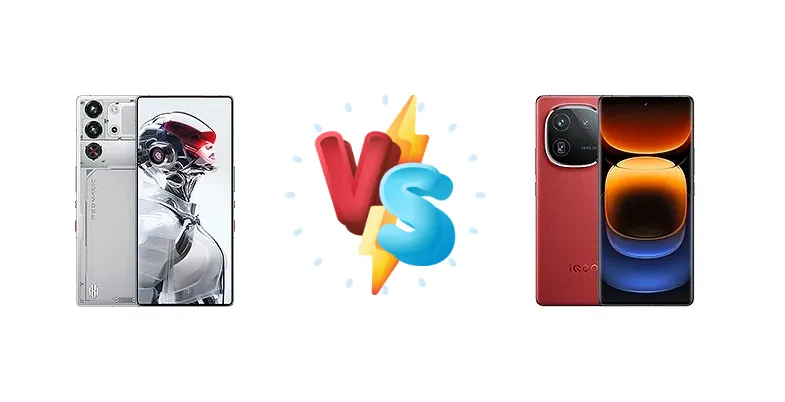
The ZTE nubia RedMagic 10S Pro+ and vivo iQOO 12 Pro represent two distinct approaches to the Android flagship space. The RedMagic prioritizes raw gaming performance and sustained endurance, while the iQOO 12 Pro aims for a more balanced experience with faster wireless charging and broader appeal. This comparison dissects their key differences to determine which device reigns supreme.
🏆 Quick Verdict
For dedicated mobile gamers prioritizing sustained performance and battery life, the ZTE nubia RedMagic 10S Pro+ is the clear winner. Its Snapdragon 8 Elite chipset and 80-hour endurance provide a significant advantage. However, the iQOO 12 Pro offers a more versatile package with 50W wireless charging and a potentially more refined software experience for the average user.
| Network |
|---|
| 2G bands | GSM 850 / 900 / 1800 / 1900 | GSM 850 / 900 / 1800 / 1900 |
| 3G bands | HSDPA 850 / 900 / 1700(AWS) / 1900 / 2100 | HSDPA 800 / 850 / 900 / 1700(AWS) / 1900 / 2100 |
| 4G bands | LTE | 1, 2, 3, 4, 5, 7, 8, 12, 17, 18, 19, 20, 25, 26, 28, 34, 38, 39, 40, 41, 42, 66 |
| 5G bands | SA/NSA | 1, 2, 3, 5, 7, 8, 12, 20, 25, 26, 28, 66, 38, 40, 41, 77, 78 SA/NSA |
| Speed | HSPA, LTE, 5G | HSPA, LTE, 5G |
| Technology | GSM / CDMA / HSPA / EVDO / LTE / 5G | GSM / CDMA / HSPA / CDMA2000 / LTE / 5G |
| Launch |
|---|
| Announced | 2025, May 26 | 2023, November 07 |
| Status | Available. Released 2025, May 26 | Available. Released 2023, November 14 |
| Body |
|---|
| Build | Glass front, aluminum frame, glass back | - |
| Dimensions | 163.4 x 76.1 x 8.9 mm (6.43 x 3.00 x 0.35 in) | 164.6 x 75.4 x 8.6 mm or 8.8 mm |
| SIM | Nano-SIM + Nano-SIM | Nano-SIM + Nano-SIM |
| Weight | 229 g (8.08 oz) | 205 g or 210 g (7.23 oz) |
| Display |
|---|
| Protection | Mohs level 4 | - |
| Resolution | 1216 x 2688 pixels (~431 ppi density) | 1440 x 3200 pixels, 20:9 ratio (~518 ppi density) |
| Size | 6.85 inches, 113.7 cm2 (~91.4% screen-to-body ratio) | 6.78 inches, 111.0 cm2 (~89.4% screen-to-body ratio) |
| Type | AMOLED, 1B colors, 144Hz, 2000 nits (peak) | LTPO AMOLED, 1B colors, 144Hz, HDR10+, 1600 nits (HBM), 3000 nits (peak) |
| Platform |
|---|
| CPU | Octa-core (2x4.47 GHz Oryon V2 Phoenix L + 6x3.53 GHz Oryon V2 Phoenix M) | Octa-core (1x3.3 GHz Cortex-X4 & 3x3.2 GHz Cortex-A720 & 2x3.0 GHz Cortex-A720 & 2x2.3 GHz Cortex-A520) |
| Chipset | Qualcomm SM8750-AC Snapdragon 8 Elite (3 nm) | Qualcomm SM8650-AB Snapdragon 8 Gen 3 (4 nm) |
| GPU | Adreno 830 (1200 MHz) | Adreno 750 |
| OS | Android 15, Redmagic OS 10.5 | Android 14, up to 2 major Android upgrades, Funtouch 14 (International), OriginOS 4 (China) |
| Memory |
|---|
| Card slot | No | No |
| Internal | 512GB 16GB RAM, 1TB 24GB RAM | 256GB 16GB RAM, 512GB 16GB RAM, 1TB 16GB RAM |
| Main Camera |
|---|
| Dual | 50 MP, f/1.9, 23mm (wide), 1/1.55", 1.0µm, PDAF, OIS
50 MP, f/2.0, 13mm (ultrawide), 1/2.88", 0.61µm, AF
Auxiliary lens | - |
| Features | LED flash, HDR, panorama | Color spectrum sensor, Dual-LED flash, HDR, panorama |
| Triple | - | 50 MP, f/1.7, 23mm (wide), 1/1.3", 1.2µm, ulti-directional PDAF, OIS
64 MP, f/2.6, 70mm (periscope telephoto), 1/2.0", PDAF, OIS, 3x optical zoom
50 MP, f/2.0, 15mm, 119˚ (ultrawide), AF |
| Video | 8K@30fps, 4K@30/60fps, 1080p@30/60/120/240fps | 8K@30fps, 4K@24/30/60fps, 1080p@30/60/120/240fps, gyro-EIS |
| Selfie camera |
|---|
| Features | HDR | HDR |
| Single | 16 MP, f/2.0, (wide), 1/2.77", 1.0µm, under display | 16 MP, f/2.5, (wide) |
| Video | 1080p@30/60fps | 1080p@30fps, gyro-EIS |
| Sound |
|---|
| 35mm jack | Yes | No |
| Loudspeaker | Yes, with stereo speakers | Yes, with stereo speakers |
| Comms |
|---|
| Bluetooth | 5.4, A2DP, LE | 5.4, A2DP, LE, aptX HD, aptX Adaptive, aptX Lossless |
| Infrared port | Yes | Yes |
| NFC | Yes | Yes |
| Positioning | GPS (L1+L2+L5), GLONASS, BDS, GALILEO | GPS (L1+L5), GLONASS (G1), BDS (B1I+B1c+B2a), GALILEO (E1+E5a), QZSS (L1+L5) |
| Radio | No | No |
| USB | USB Type-C 3.2 Gen 2, OTG, accessory connector, DisplayPort | USB Type-C 2.0, OTG |
| WLAN | Wi-Fi 802.11 a/b/g/n/ac/6e/7, tri-band, Wi-Fi Direct | Wi-Fi 802.11 a/b/g/n/ac/6/7, tri-band, Wi-Fi Direct |
| Features |
|---|
| Sensors | Fingerprint (under display, optical), accelerometer, gyro, proximity, compass | Fingerprint (under display, ultrasonic), accelerometer, gyro, proximity, compass |
| Battery |
|---|
| Charging | 120W wired, 100% in 35 min | 120W wired
50W wireless
10W reverse wireless |
| Type | Si/C Li-Ion 7500 mAh | 5100 mAh |
| Misc |
|---|
| Colors | Dark Knight, White Knight, Transparent Silver Deuterium, Transparent Dark Knight | Black, Red, White (BMW M branding) |
| Models | NX789J | V2329A |
| Price | About 730 EUR | About 650 EUR |
| EU LABEL |
|---|
| Battery | 80:12h endurance, 1200 cycles | - |
| Energy | Class A | - |
| Free fall | Class C (90 falls) | - |
| Repairability | Class C | - |
ZTE nubia RedMagic 10SPro+
- Superior CPU performance with Snapdragon 8 Elite
- Exceptional battery endurance (80 hours)
- Potentially better thermal management due to 3nm process
- Likely less versatile camera system
- Gaming-focused design may not appeal to all
vivo iQOO 12 Pro
- 50W wireless charging and 10W reverse wireless charging
- Potentially more refined software experience
- Likely more versatile camera system
- Snapdragon 8 Gen 3 is less power efficient than 8 Elite
- Shorter battery endurance compared to RedMagic
Display Comparison
While both devices likely feature high refresh rate AMOLED displays (data not provided), the core battle lies within their processors. The display quality will likely be similar, but the RedMagic's focus on gaming suggests a potentially higher PWM dimming rate for reduced flicker, benefiting users sensitive to screen flicker. Bezels are likely minimal on both, reflecting current flagship trends. Color accuracy will depend on software calibration, a detail not specified in the provided data.
Camera Comparison
The provided data lacks camera specifications. However, given the iQOO brand’s history, it’s reasonable to expect a more comprehensive camera system with features like OIS and potentially larger sensors. The RedMagic, while likely including a capable camera, typically prioritizes gaming features over camera prowess. Without specific sensor sizes or aperture details, it’s difficult to make a definitive judgment, but the iQOO 12 Pro is likely to offer a more versatile photographic experience.
Performance
The chipset is the defining difference. The RedMagic 10S Pro+ boasts the Qualcomm SM8750-AC Snapdragon 8 Elite (3nm), featuring an octa-core configuration with peak clock speeds of 4.47 GHz on its Oryon V2 Phoenix L cores. This contrasts with the iQOO 12 Pro’s Snapdragon 8 Gen 3 (4nm) with a peak clock of 3.3 GHz on its Cortex-X4 core. The 3nm process of the Snapdragon 8 Elite should offer superior power efficiency and thermal headroom, translating to sustained performance during extended gaming sessions. The RedMagic’s Oryon cores are also designed for higher single-core performance, crucial for many mobile games. The iQOO 12 Pro’s Gen 3 benefits from architectural improvements, but the RedMagic’s raw clock speed and process node give it an edge.
Battery Life
The RedMagic 10S Pro+ claims an 80-hour endurance and 1200 charge cycles, suggesting a focus on long-term battery health and usability. Both phones support 120W wired charging, achieving a 100% charge in 35 minutes. However, the iQOO 12 Pro adds 50W wireless charging and 10W reverse wireless charging, offering greater convenience. The RedMagic’s endurance rating suggests a larger battery capacity, potentially offsetting the iQOO’s faster wireless charging for users who prioritize overall runtime.
Buying Guide
Buy the ZTE nubia RedMagic 10S Pro+ if you need uncompromising gaming performance, extended battery life for marathon sessions, and are willing to accept a more niche, gaming-focused design. Buy the vivo iQOO 12 Pro if you prefer a more mainstream flagship experience with faster wireless charging, a potentially more polished software experience, and a broader range of features beyond gaming.
Frequently Asked Questions
❓ Will the Snapdragon 8 Elite in the RedMagic 10S Pro+ significantly reduce throttling during long gaming sessions compared to the iQOO 12 Pro?
The 3nm process and higher clock speeds of the Snapdragon 8 Elite are designed to minimize thermal throttling. While the iQOO 12 Pro’s Snapdragon 8 Gen 3 is a powerful chip, the RedMagic’s chipset should maintain higher sustained performance over extended gaming periods due to its superior thermal efficiency.
❓ Does the iQOO 12 Pro's 50W wireless charging make a substantial difference in daily usability compared to the RedMagic 10S Pro+'s lack of wireless charging?
For users who frequently utilize wireless charging, the iQOO 12 Pro’s 50W capability offers a significant convenience factor. While the RedMagic 10S Pro+ charges quickly via wired connection, the absence of wireless charging may be a drawback for those seeking a cable-free experience.
❓ How does the Oryon CPU architecture in the RedMagic 10S Pro+ impact real-world gaming performance?
The Oryon CPU cores are designed for high single-core performance, which is crucial for many mobile games. This translates to faster frame rates and smoother gameplay, particularly in titles that aren't fully optimized for multi-core processors. The RedMagic 10S Pro+ should exhibit a noticeable advantage in these scenarios.