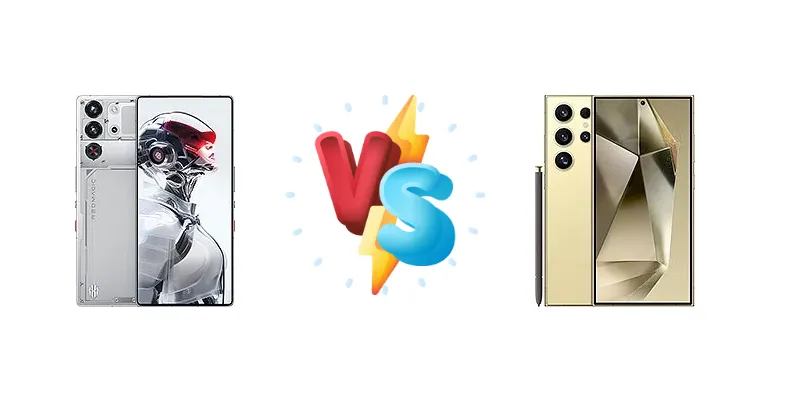
The ZTE nubia RedMagic 10S Pro+ and the Samsung Galaxy S24 Ultra represent opposite ends of the Android flagship spectrum. The RedMagic aggressively targets mobile gamers with its specialized hardware, while the S24 Ultra aims for a more balanced, premium experience encompassing photography, productivity, and entertainment. This comparison dissects their key differences to help you choose the right device.
🏆 Quick Verdict
For the average user prioritizing a versatile camera, long-term software support, and a polished ecosystem, the Samsung Galaxy S24 Ultra is the superior choice. However, the RedMagic 10S Pro+ delivers unmatched gaming performance and significantly faster charging, making it the clear winner for dedicated mobile gamers.
| Network |
|---|
| 2G bands | GSM 850 / 900 / 1800 / 1900 | GSM 850 / 900 / 1800 / 1900 |
| 3G bands | HSDPA 850 / 900 / 1700(AWS) / 1900 / 2100 | HSDPA 850 / 900 / 1700(AWS) / 1900 / 2100 |
| 4G bands | LTE | 1, 2, 3, 4, 5, 7, 8, 12, 13, 17, 18, 19, 20, 25, 26, 28, 32, 38, 39, 40, 41, 66 - International |
| 5G bands | SA/NSA | 1, 2, 3, 5, 7, 8, 12, 20, 25, 26, 28, 38, 40, 41, 66, 75, 77, 78 SA/NSA/Sub6 - International |
| Speed | HSPA, LTE, 5G | HSPA, LTE (up to 7CA), 5G |
| Technology | GSM / CDMA / HSPA / EVDO / LTE / 5G | GSM / CDMA / HSPA / EVDO / LTE / 5G |
| Launch |
|---|
| Announced | 2025, May 26 | 2024, January 17 |
| Status | Available. Released 2025, May 26 | Available. Released 2024, January 24 |
| Body |
|---|
| Build | Glass front, aluminum frame, glass back | Glass front (Corning Gorilla Armor), glass back (Corning Gorilla Armor), titanium frame (grade 2) |
| Dimensions | 163.4 x 76.1 x 8.9 mm (6.43 x 3.00 x 0.35 in) | 162.3 x 79 x 8.6 mm (6.39 x 3.11 x 0.34 in) |
| SIM | Nano-SIM + Nano-SIM | · Nano-SIM + Nano-SIM + eSIM + eSIM (max 2 at a time) - INT· Nano-SIM + eSIM + eSIM (max 2 at a time) - USA· Nano-SIM + Nano-SIM - CN |
| Weight | 229 g (8.08 oz) | 232 g or 233 g (8.18 oz) |
| Display |
|---|
| Protection | Mohs level 4 | Corning Gorilla Armor |
| Resolution | 1216 x 2688 pixels (~431 ppi density) | 1440 x 3120 pixels, 19.5:9 ratio (~505 ppi density) |
| Size | 6.85 inches, 113.7 cm2 (~91.4% screen-to-body ratio) | 6.8 inches, 113.5 cm2 (~88.5% screen-to-body ratio) |
| Type | AMOLED, 1B colors, 144Hz, 2000 nits (peak) | Dynamic LTPO AMOLED 2X, 120Hz, HDR10+, 2600 nits (peak) |
| Platform |
|---|
| CPU | Octa-core (2x4.47 GHz Oryon V2 Phoenix L + 6x3.53 GHz Oryon V2 Phoenix M) | 8-core (1x3.39GHz Cortex-X4 & 3x3.1GHz Cortex-A720 & 2x2.9GHz Cortex-A720 & 2x2.2GHz Cortex-A520) |
| Chipset | Qualcomm SM8750-AC Snapdragon 8 Elite (3 nm) | Qualcomm SM8650-AC Snapdragon 8 Gen 3 (4 nm) |
| GPU | Adreno 830 (1200 MHz) | Adreno 750 (1 GHz) |
| OS | Android 15, Redmagic OS 10.5 | Android 14, up to 7 major Android upgrades, One UI 8.0 |
| Memory |
|---|
| Card slot | No | No |
| Internal | 512GB 16GB RAM, 1TB 24GB RAM | 256GB 12GB RAM, 512GB 12GB RAM, 1TB 12GB RAM |
| Main Camera |
|---|
| Dual | 50 MP, f/1.9, 23mm (wide), 1/1.55", 1.0µm, PDAF, OIS
50 MP, f/2.0, 13mm (ultrawide), 1/2.88", 0.61µm, AF
Auxiliary lens | - |
| Features | LED flash, HDR, panorama | Laser AF, LED flash, auto-HDR, panorama |
| Quad | - | 200 MP, f/1.7, 24mm (wide), 1/1.3", 0.6µm, multi-directional PDAF, OIS
10 MP, f/2.4, 67mm (telephoto), 1/3.52", 1.12µm, PDAF, OIS, 3x optical zoom
50 MP, f/3.4, 111mm (periscope telephoto), 1/2.52", 0.7µm, PDAF, OIS, 5x optical zoom
12 MP, f/2.2, 13mm, 120˚ (ultrawide), 1/2.55", 1.4µm, dual pixel PDAF, Super Steady video |
| Video | 8K@30fps, 4K@30/60fps, 1080p@30/60/120/240fps | 8K@24/30fps, 4K@30/60/120fps, 1080p@30/60/120/240fps, HDR10+, stereo sound rec., gyro-EIS |
| Selfie camera |
|---|
| Features | HDR | HDR, HDR10+ |
| Single | 16 MP, f/2.0, (wide), 1/2.77", 1.0µm, under display | 12 MP, f/2.2, 26mm (wide), 1/3.2", 1.12µm, dual pixel PDAF |
| Video | 1080p@30/60fps | 4K@30/60fps, 1080p@30fps |
| Sound |
|---|
| 35mm jack | Yes | No |
| Loudspeaker | Yes, with stereo speakers | Yes, with stereo speakers |
| Comms |
|---|
| Bluetooth | 5.4, A2DP, LE | 5.3, A2DP, LE |
| Infrared port | Yes | - |
| NFC | Yes | Yes |
| Positioning | GPS (L1+L2+L5), GLONASS, BDS, GALILEO | GPS, GLONASS, BDS, GALILEO, QZSS |
| Radio | No | No |
| USB | USB Type-C 3.2 Gen 2, OTG, accessory connector, DisplayPort | USB Type-C 3.2, DisplayPort 1.2, OTG |
| WLAN | Wi-Fi 802.11 a/b/g/n/ac/6e/7, tri-band, Wi-Fi Direct | Wi-Fi 802.11 a/b/g/n/ac/6e/7, tri-band, Wi-Fi Direct |
| Features |
|---|
| Sensors | Fingerprint (under display, optical), accelerometer, gyro, proximity, compass | Fingerprint (under display, ultrasonic), accelerometer, gyro, proximity, compass, barometer |
| Battery |
|---|
| Charging | 120W wired, 100% in 35 min | 45W wired, PD3.0, 65% in 30 min
15W wireless (Qi)
4.5W reverse wireless |
| Type | Si/C Li-Ion 7500 mAh | Li-Ion 5000 mAh |
| Misc |
|---|
| Colors | Dark Knight, White Knight, Transparent Silver Deuterium, Transparent Dark Knight | Titanium Black, Titanium Gray, Titanium Violet, Titanium Yellow, Titanium Blue, Titanium Green, Titanium Orange |
| Models | NX789J | SM-S928B, SM-S928B/DS, SM-S928U, SM-S928U1, SM-S928W, SM-S928N, SM-S9280, SM-S928E, SM-S928E/DS |
| Price | About 730 EUR | $ 514.94 / C$ 929.99 / £ 630.00 / € 658.53 / ₹ 84,999 |
| SAR | - | 1.26 W/kg (head) 0.62 W/kg (body) |
| SAR EU | - | 1.06 W/kg (head) 1.30 W/kg (body) |
| EU LABEL |
|---|
| Battery | 80:12h endurance, 1200 cycles | - |
| Energy | Class A | - |
| Free fall | Class C (90 falls) | - |
| Repairability | Class C | - |
ZTE nubia RedMagic 10SPro+
- Unmatched gaming performance with Snapdragon 8 Elite
- Blazing-fast 120W charging
- Long battery lifespan (1200 cycles)
- Camera likely inferior to S24 Ultra
- Software support may be limited compared to Samsung
Samsung Galaxy S24 Ultra
- Exceptional camera system with versatile features
- Bright and color-accurate display
- Robust software support and ecosystem
- Slower 45W charging
- Less focused on raw gaming performance
Display Comparison
The Samsung Galaxy S24 Ultra boasts a peak brightness of 1447 nits, ensuring excellent visibility even in direct sunlight. While the RedMagic 10S Pro+’s display specs aren’t provided, its focus on gaming suggests a high refresh rate panel, but likely sacrifices peak brightness for power efficiency. The S24 Ultra’s display technology, likely LTPO AMOLED, dynamically adjusts refresh rates to conserve battery, a feature not explicitly mentioned for the RedMagic. Bezels on the S24 Ultra are minimized, contributing to a more immersive experience, while the RedMagic may prioritize cooling solutions that necessitate slightly larger bezels.
Camera Comparison
The S24 Ultra is renowned for its camera capabilities, though specific sensor details aren’t provided in the context data. It’s expected to feature a versatile multi-camera system with advanced image processing. The RedMagic 10S Pro+’s camera is less emphasized, suggesting a focus on functional photography rather than flagship-level image quality. The S24 Ultra’s OIS (Optical Image Stabilization) and lens apertures will likely be superior, resulting in better low-light performance and sharper images. The RedMagic likely prioritizes camera features useful for streaming or capturing gameplay.
Performance
The RedMagic 10S Pro+ is powered by the Qualcomm SM8750-AC Snapdragon 8 Elite (3nm), featuring an octa-core CPU with a unique configuration: 2x4.47 GHz Oryon V2 Phoenix L cores and 6x3.53 GHz Oryon V2 Phoenix M cores. This contrasts with the S24 Ultra’s Snapdragon 8 Gen 3 (4nm) with its 8-core setup (1x3.39GHz Cortex-X4, 3x3.1GHz Cortex-A720, 2x2.9GHz Cortex-A720, 2x2.2GHz Cortex-A520). The 3nm process of the Snapdragon 8 Elite should offer improved power efficiency and thermal performance compared to the 4nm Gen 3, potentially allowing for sustained peak performance during extended gaming sessions. The Oryon cores in the RedMagic are custom designs focused on maximizing single-core performance, crucial for many mobile titles. The S24 Ultra benefits from optimized software and potentially better sustained performance due to its larger cooling system, but the RedMagic’s raw CPU clock speeds are higher.
Battery Life
The RedMagic 10S Pro+ boasts an impressive 80:12h endurance rating and supports 120W wired charging, achieving a 100% charge in just 35 minutes. The S24 Ultra achieves 13:49h of active use, and charges at 45W, reaching 65% in 30 minutes. While the S24 Ultra has a longer overall endurance score, the RedMagic’s significantly faster charging is a major advantage for users who need to quickly top up their battery. The RedMagic also claims 1200 battery cycles, suggesting a longer lifespan before significant degradation.
Buying Guide
Buy the ZTE nubia RedMagic 10S Pro+ if you demand the absolute highest frame rates in demanding mobile games, prioritize rapid 120W charging, and appreciate gaming-centric features like built-in triggers. Buy the Samsung Galaxy S24 Ultra if you value a class-leading camera system, a brighter and more color-accurate display, and a more refined, all-around smartphone experience with robust software updates.
Frequently Asked Questions
❓ Does the Snapdragon 8 Elite in the RedMagic 10S Pro+ overheat during prolonged gaming sessions?
The Snapdragon 8 Elite’s 3nm process and the RedMagic’s aggressive cooling solutions (likely including a vapor chamber and fan) are designed to mitigate thermal throttling. While some heat is inevitable during intense gaming, the RedMagic is engineered to maintain high performance for extended periods, potentially outperforming the S24 Ultra in sustained gaming workloads.
❓ How does the 45W charging on the S24 Ultra compare to the RedMagic's 120W in real-world usage?
While the S24 Ultra’s 45W charging is respectable, the RedMagic 10S Pro+’s 120W charging is significantly faster. The RedMagic can fully charge in 35 minutes, while the S24 Ultra takes longer to reach 100%, even though it hits 65% in 30 minutes. This difference is crucial for gamers who need to quickly return to their sessions.
❓ Is the RedMagic 10S Pro+ a good choice for someone who occasionally games but primarily uses their phone for everyday tasks?
The RedMagic 10S Pro+ is less ideal for general use. Its gaming-focused design may result in compromises in areas like camera quality and software polish compared to the S24 Ultra. The S24 Ultra offers a more balanced experience for everyday tasks and occasional gaming.