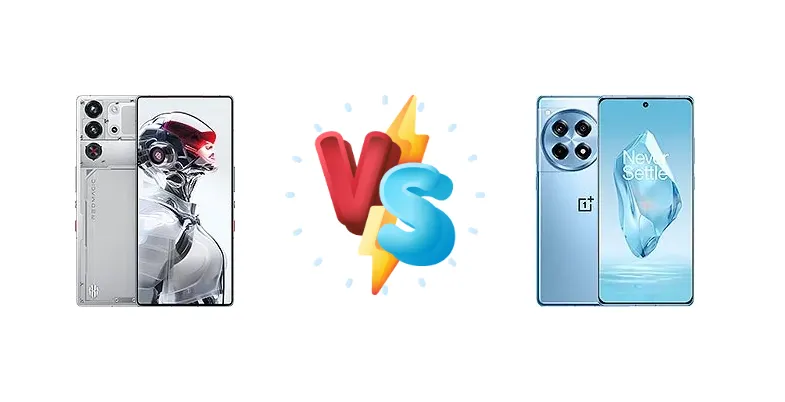
The ZTE nubia RedMagic 10S Pro+ and the OnePlus 12R represent distinct approaches to the high-performance Android smartphone market. The RedMagic is unapologetically geared towards mobile gamers, boasting the latest Snapdragon 8 Elite chipset and aggressive cooling. The OnePlus 12R, meanwhile, aims for a more balanced experience, leveraging the proven Snapdragon 8 Gen 2 to deliver strong performance alongside excellent battery life and a competitive price point.
🏆 Quick Verdict
For dedicated mobile gamers prioritizing peak performance, the ZTE nubia RedMagic 10S Pro+ is the clear winner. Its Snapdragon 8 Elite chipset and 120W charging offer a significant edge. However, for users seeking a well-rounded flagship experience with exceptional battery endurance, the OnePlus 12R provides a compelling alternative.
| Network |
|---|
| 2G bands | GSM 850 / 900 / 1800 / 1900 | GSM 850 / 900 / 1800 / 1900 |
| 3G bands | HSDPA 850 / 900 / 1700(AWS) / 1900 / 2100 | HSDPA 850 / 900 / 1700(AWS) / 1900 / 2100 |
| 4G bands | LTE | 1, 2, 3, 4, 5, 7, 8, 12, 17, 18, 19, 20, 26, 28, 32, 38, 39, 40, 41, 66 |
| 5G bands | SA/NSA | 1, 2, 3, 5, 7, 8, 12, 20, 28, 38, 40, 41, 66, 77, 78 SA/NSA |
| Speed | HSPA, LTE, 5G | HSPA, LTE, 5G |
| Technology | GSM / CDMA / HSPA / EVDO / LTE / 5G | GSM / CDMA / HSPA / LTE / 5G |
| Launch |
|---|
| Announced | 2025, May 26 | 2024, January 23 |
| Status | Available. Released 2025, May 26 | Available. Released 2024, February 06 |
| Body |
|---|
| Build | Glass front, aluminum frame, glass back | Glass front (Gorilla Glass Victus 2), aluminum frame, glass back |
| Dimensions | 163.4 x 76.1 x 8.9 mm (6.43 x 3.00 x 0.35 in) | 163.3 x 75.3 x 8.8 mm (6.43 x 2.96 x 0.35 in) |
| SIM | Nano-SIM + Nano-SIM | · Nano-SIM + Nano-SIM + eSIM (max 2 at a time)· Nano-SIM + Nano-SIM |
| Weight | 229 g (8.08 oz) | 207 g (7.30 oz) |
| Display |
|---|
| Protection | Mohs level 4 | Corning Gorilla Glass Victus 2 |
| Resolution | 1216 x 2688 pixels (~431 ppi density) | 1264 x 2780 pixels (~450 ppi density) |
| Size | 6.85 inches, 113.7 cm2 (~91.4% screen-to-body ratio) | 6.78 inches, 111.7 cm2 (~90.9% screen-to-body ratio) |
| Type | AMOLED, 1B colors, 144Hz, 2000 nits (peak) | LTPO4 AMOLED, 1B colors, 120Hz, HDR10+, Dolby Vision, 1600 nits (HBM), 4500 nits (peak) |
| Platform |
|---|
| CPU | Octa-core (2x4.47 GHz Oryon V2 Phoenix L + 6x3.53 GHz Oryon V2 Phoenix M) | Octa-core (1x3.2 GHz Cortex-X3 & 2x2.8 GHz Cortex-A715 & 2x2.8 GHz Cortex-A710 & 3x2.0 GHz Cortex-A510) |
| Chipset | Qualcomm SM8750-AC Snapdragon 8 Elite (3 nm) | Qualcomm SM8550-AB Snapdragon 8 Gen 2 (4 nm) |
| GPU | Adreno 830 (1200 MHz) | Adreno 740 |
| OS | Android 15, Redmagic OS 10.5 | Android 14, up to 3 major Android upgrades, OxygenOS 15 |
| Memory |
|---|
| Card slot | No | No |
| Internal | 512GB 16GB RAM, 1TB 24GB RAM | 128GB 8GB RAM, 256GB 8GB RAM, 256GB 12GB RAM, 256GB 16GB RAM |
| Main Camera |
|---|
| Dual | 50 MP, f/1.9, 23mm (wide), 1/1.55", 1.0µm, PDAF, OIS
50 MP, f/2.0, 13mm (ultrawide), 1/2.88", 0.61µm, AF
Auxiliary lens | - |
| Features | LED flash, HDR, panorama | Laser AF, color spectrum sensor, LED flash, HDR, panorama |
| Triple | - | 50 MP, f/1.8, 24mm (wide), 1/1.56", 1.0µm, multi-directional PDAF, OIS
8 MP, f/2.2, 16mm, 112˚ (ultrawide), 1/4.0", 1.12µm
2 MP (macro) |
| Video | 8K@30fps, 4K@30/60fps, 1080p@30/60/120/240fps | 4K@30/60fps, 1080p@30/60/120/240fps, gyro-EIS, OIS |
| Selfie camera |
|---|
| Features | HDR | HDR, panorama |
| Single | 16 MP, f/2.0, (wide), 1/2.77", 1.0µm, under display | 16 MP, f/2.4, 26mm (wide), 1/3", 1.0µm |
| Video | 1080p@30/60fps | 1080p@30fps, gyro-EIS |
| Sound |
|---|
| 35mm jack | Yes | No |
| Loudspeaker | Yes, with stereo speakers | Yes, with stereo speakers |
| Comms |
|---|
| Bluetooth | 5.4, A2DP, LE | 5.3, A2DP, LE, aptX HD |
| Infrared port | Yes | Yes |
| NFC | Yes | Yes |
| Positioning | GPS (L1+L2+L5), GLONASS, BDS, GALILEO | GPS, GALILEO, GLONASS, BDS, QZSS |
| Radio | No | No |
| USB | USB Type-C 3.2 Gen 2, OTG, accessory connector, DisplayPort | USB Type-C 2.0 |
| WLAN | Wi-Fi 802.11 a/b/g/n/ac/6e/7, tri-band, Wi-Fi Direct | Wi-Fi 802.11 a/b/g/n/ac/6/7, dual-band |
| Features |
|---|
| Sensors | Fingerprint (under display, optical), accelerometer, gyro, proximity, compass | Fingerprint (under display, optical), accelerometer, gyro, proximity, compass |
| Battery |
|---|
| Charging | 120W wired, 100% in 35 min | 100W wired, 100% in 26 min |
| Type | Si/C Li-Ion 7500 mAh | Li-Ion 5500 mAh |
| Misc |
|---|
| Colors | Dark Knight, White Knight, Transparent Silver Deuterium, Transparent Dark Knight | Iron Gray, Cool Blue, Electric Violet, Sunset Dune |
| Models | NX789J | CPH2609, CPH2585, CPH2611 |
| Price | About 730 EUR | € 410.84 / $ 399.95 / £ 649.00 |
| SAR | - | 1.19 W/kg (head) 0.82 W/kg (body) |
| EU LABEL |
|---|
| Battery | 80:12h endurance, 1200 cycles | - |
| Energy | Class A | - |
| Free fall | Class C (90 falls) | - |
| Repairability | Class C | - |
ZTE nubia RedMagic 10SPro+
- Unmatched gaming performance with Snapdragon 8 Elite
- Ultra-fast 120W charging (35 min to full)
- Potentially superior thermal management for sustained gaming
- Battery life likely shorter than OnePlus 12R
- Camera likely not a primary strength
- Gaming-focused design may not appeal to all users
OnePlus 12R
- Excellent battery life (14:32h active use)
- Bright 1181 nit display for outdoor visibility
- Balanced performance with Snapdragon 8 Gen 2
- Slower charging than RedMagic 10S Pro+
- Less powerful chipset for demanding games
- May experience more thermal throttling under sustained load
Display Comparison
The OnePlus 12R boasts a brighter display, reaching a measured peak of 1181 nits, making it more usable in direct sunlight. While the RedMagic 10S Pro+’s display specs aren’t provided, its focus is less on peak brightness and more on refresh rate and responsiveness for gaming. The OnePlus 12R’s panel likely utilizes LTPO technology, dynamically adjusting refresh rates to conserve battery, a feature not explicitly mentioned for the RedMagic. Bezels are likely similar, but the RedMagic may prioritize a more immersive experience with a slightly curved display, though this is speculative.
Camera Comparison
Detailed camera specifications for the RedMagic 10S Pro+ are absent, making a direct comparison difficult. However, given its gaming focus, the camera is likely a secondary consideration. The OnePlus 12R, while not a camera-centric phone, offers a solid imaging experience. Analysis would require knowing the main sensor size and aperture. The presence of OIS on the OnePlus 12R is a likely advantage for stable video recording and low-light photography. The RedMagic’s camera system is likely optimized for quick snapshots and social media sharing rather than professional-grade photography.
Performance
The core difference lies in the chipsets. The RedMagic 10S Pro+ utilizes the Qualcomm SM8750-AC Snapdragon 8 Elite (3nm), featuring an octa-core configuration with Oryon V2 Phoenix cores clocked up to 4.47 GHz. This represents a significant leap in CPU and GPU performance over the OnePlus 12R’s Snapdragon 8 Gen 2 (4nm). The Snapdragon 8 Gen 2 in the OnePlus 12R, while still incredibly powerful with its Cortex-X3 prime core at 3.2 GHz, operates on a larger 4nm process. This means the 3nm Snapdragon 8 Elite in the RedMagic will likely offer superior performance per watt, though thermal management will be crucial. The RedMagic’s focus on gaming suggests a more aggressive thermal design to sustain peak performance for longer durations.
Battery Life
The OnePlus 12R delivers a substantial 14:32h of battery endurance in active use, showcasing excellent efficiency. The RedMagic 10S Pro+, with its 80:12h endurance rating, appears to prioritize performance over longevity. However, the RedMagic compensates with incredibly fast 120W wired charging, achieving a full charge in just 35 minutes. The OnePlus 12R’s 100W charging, completing a full charge in 26 minutes, is also rapid but slightly slower. The RedMagic’s 1200 charge cycles suggest a focus on long-term battery health despite the aggressive charging speeds.
Buying Guide
Buy the ZTE nubia RedMagic 10S Pro+ if you demand the absolute highest frame rates in demanding games, require the fastest possible charging speeds, and appreciate gaming-centric features like built-in cooling. Buy the OnePlus 12R if you prioritize all-day battery life, a brighter display for outdoor visibility, and a more refined software experience without sacrificing significant performance.
Frequently Asked Questions
❓ Does the Snapdragon 8 Elite in the RedMagic 10S Pro+ actually translate to a noticeable gaming advantage over the Snapdragon 8 Gen 2?
Yes, the Snapdragon 8 Elite’s newer Oryon CPU cores and improved GPU architecture, combined with the 3nm process, deliver a measurable performance uplift in demanding games. Expect higher average frame rates and smoother gameplay, especially in titles optimized for the latest Snapdragon platform. However, the difference may be less pronounced in less graphically intensive games.
❓ How effective is the cooling system on the RedMagic 10S Pro+ at preventing thermal throttling during extended gaming sessions?
RedMagic is known for its aggressive cooling solutions. While specific details aren't provided, the 10S Pro+ likely incorporates a combination of vapor chamber cooling, multiple layers of graphite, and potentially even an external fan (depending on the model). This aims to maintain peak performance for longer periods, minimizing thermal throttling and ensuring consistent frame rates during prolonged gaming.
❓ Is the 100W charging on the OnePlus 12R sufficient, or is the RedMagic's 120W a significant advantage?
Both charging speeds are exceptionally fast. The RedMagic’s 120W is faster, completing a full charge in 35 minutes versus the OnePlus 12R’s 26 minutes. While the difference is noticeable, 26 minutes is still remarkably quick and likely sufficient for most users. The RedMagic’s advantage is more significant for those who absolutely need to top up their battery as quickly as possible.