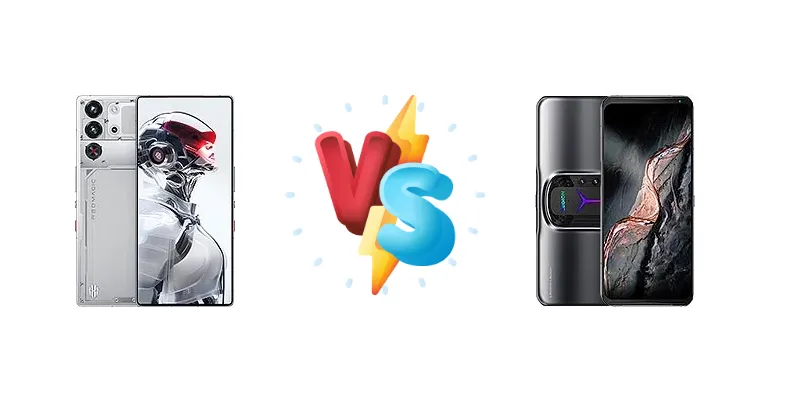
The gaming phone market is heating up, with the ZTE nubia RedMagic 10S Pro+ entering the fray with Qualcomm’s latest Snapdragon 8 Elite chipset. This puts it directly against established contenders like the Lenovo Legion Y90, powered by the Snapdragon 8 Gen 1. We’re dissecting these two devices to determine which offers the superior experience for demanding mobile gamers.
🏆 Quick Verdict
For the average gamer prioritizing raw performance and longevity, the ZTE nubia RedMagic 10S Pro+ emerges as the winner. Its Snapdragon 8 Elite chipset, built on a 3nm process, delivers a significant performance leap and improved efficiency over the Legion Y90’s 4nm Snapdragon 8 Gen 1, coupled with a superior battery endurance rating.
| Network |
|---|
| 2G bands | GSM 850 / 900 / 1800 / 1900 | GSM 850 / 900 / 1800 / 1900 |
| 3G bands | HSDPA 850 / 900 / 1700(AWS) / 1900 / 2100 | HSDPA 800 / 850 / 900 / 1900 / 2100 |
| 4G bands | LTE | LTE |
| 5G bands | SA/NSA | SA/NSA/Sub6 |
| Speed | HSPA, LTE, 5G | HSPA, LTE, 5G |
| Technology | GSM / CDMA / HSPA / EVDO / LTE / 5G | GSM / CDMA / HSPA / CDMA2000 / LTE / 5G |
| | - | CDMA2000 1x |
| Launch |
|---|
| Announced | 2025, May 26 | 2022, March 01 |
| Status | Available. Released 2025, May 26 | Available. Released 2022, March 10 |
| Body |
|---|
| Build | Glass front, aluminum frame, glass back | - |
| Dimensions | 163.4 x 76.1 x 8.9 mm (6.43 x 3.00 x 0.35 in) | 177 x 78.4 x 10.1 mm (6.97 x 3.09 x 0.40 in) |
| SIM | Nano-SIM + Nano-SIM | Nano-SIM + Nano-SIM |
| Weight | 229 g (8.08 oz) | 252 g (8.89 oz) |
| | - | Built-in two cooling fans
RGB light panel (on the back)
4 ultrasonic buttons (Gaming triggers) |
| Display |
|---|
| Protection | Mohs level 4 | - |
| Resolution | 1216 x 2688 pixels (~431 ppi density) | 1080 x 2460 pixels (~388 ppi density) |
| Size | 6.85 inches, 113.7 cm2 (~91.4% screen-to-body ratio) | 6.92 inches, 113.7 cm2 (~81.9% screen-to-body ratio) |
| Type | AMOLED, 1B colors, 144Hz, 2000 nits (peak) | AMOLED, 144Hz, HDR10+, 1300 nits (peak) |
| Platform |
|---|
| CPU | Octa-core (2x4.47 GHz Oryon V2 Phoenix L + 6x3.53 GHz Oryon V2 Phoenix M) | Octa-core (1x3.00 GHz Cortex-X2 & 3x2.50 GHz Cortex-A710 & 4x1.80 GHz Cortex-A510) |
| Chipset | Qualcomm SM8750-AC Snapdragon 8 Elite (3 nm) | Qualcomm SM8450 Snapdragon 8 Gen 1 (4 nm) |
| GPU | Adreno 830 (1200 MHz) | Adreno 730 |
| OS | Android 15, Redmagic OS 10.5 | Android 12, ZUI 13 |
| Memory |
|---|
| Card slot | No | No |
| Internal | 512GB 16GB RAM, 1TB 24GB RAM | 256GB 12GB RAM, 256GB 16GB RAM, 640GB 18GB RAM |
| | - | UFS 3.1
640GB (512GB UFS + 128GB SSD) |
| Main Camera |
|---|
| Dual | 50 MP, f/1.9, 23mm (wide), 1/1.55", 1.0µm, PDAF, OIS
50 MP, f/2.0, 13mm (ultrawide), 1/2.88", 0.61µm, AF
Auxiliary lens | 64 MP, f/1.9, 25mm (wide), 1/1.32", 1.0µm, PDAF
13 MP, 120˚ (ultrawide) |
| Features | LED flash, HDR, panorama | Dual-LED flash, panorama, HDR |
| Video | 8K@30fps, 4K@30/60fps, 1080p@30/60/120/240fps | 8K@24fps, 4K@30/60fps, 1080p@30/60/240fps, gyro-EIS, HDR10+ rec. |
| Selfie camera |
|---|
| Features | HDR | HDR |
| Single | 16 MP, f/2.0, (wide), 1/2.77", 1.0µm, under display | 16 MP |
| Video | 1080p@30/60fps | 4K@30/60fps, 1080p@30/60/120fps |
| Sound |
|---|
| 3.5mm jack | - | No |
| 35mm jack | Yes | No |
| Loudspeaker | Yes, with stereo speakers | Yes, with stereo speakers |
| Comms |
|---|
| Bluetooth | 5.4, A2DP, LE | 5.2, A2DP, LE |
| Infrared port | Yes | - |
| NFC | Yes | Yes |
| Positioning | GPS (L1+L2+L5), GLONASS, BDS, GALILEO | GPS (L1+L5), GLONASS, GALILEO, BDS, QZSS |
| Radio | No | No |
| USB | USB Type-C 3.2 Gen 2, OTG, accessory connector, DisplayPort | USB Type-C 3.1 Gen2, USB Type-C 2.0, OTG |
| WLAN | Wi-Fi 802.11 a/b/g/n/ac/6e/7, tri-band, Wi-Fi Direct | Wi-Fi 802.11 a/b/g/n/ac/6, dual-band, Wi-Fi Direct |
| Features |
|---|
| Sensors | Fingerprint (under display, optical), accelerometer, gyro, proximity, compass | Fingerprint (under display, optical), accelerometer, gyro, proximity, compass |
| Battery |
|---|
| Charging | 120W wired, 100% in 35 min | 68W wired, 100% in 35 min |
| Type | Si/C Li-Ion 7500 mAh | Li-Po 5600 mAh |
| Misc |
|---|
| Colors | Dark Knight, White Knight, Transparent Silver Deuterium, Transparent Dark Knight | Gray |
| Models | NX789J | L71061 |
| Price | About 730 EUR | About 570 EUR |
| EU LABEL |
|---|
| Battery | 80:12h endurance, 1200 cycles | - |
| Energy | Class A | - |
| Free fall | Class C (90 falls) | - |
| Repairability | Class C | - |
ZTE nubia RedMagic 10SPro+
- Superior performance with Snapdragon 8 Elite
- Longer battery life and faster charging
- Potentially more efficient thermal management
- May command a higher price
- Camera performance likely not a priority
Lenovo Legion Y90
- Established gaming ecosystem and brand recognition
- Robust build quality and cooling system
- Potentially more affordable
- Older Snapdragon 8 Gen 1 chipset
- Lower battery endurance compared to RedMagic
Display Comparison
While both devices are geared towards immersive gaming, details on display specs are missing. However, given the RedMagic series’ history, we can expect a high refresh rate panel with minimal bezels. The Legion Y90 is known for its large 6.92-inch display. The key difference will likely lie in panel technology – the RedMagic may incorporate newer LTPO technology for variable refresh rates, improving power efficiency. Color accuracy and peak brightness will be crucial differentiators, but require further testing.
Camera Comparison
Neither phone is primarily focused on camera performance, but the RedMagic 10S Pro+ likely benefits from newer image signal processing capabilities within the Snapdragon 8 Elite. Without specific sensor details, it’s difficult to make a definitive comparison. However, the Legion Y90’s camera system is generally considered adequate for casual use. The RedMagic’s camera performance will likely be competitive, but not a primary selling point.
Performance
The core battleground is the chipset. The RedMagic 10S Pro+’s Snapdragon 8 Elite (3nm) represents a substantial architectural upgrade over the Legion Y90’s Snapdragon 8 Gen 1 (4nm). The 3nm process allows for higher transistor density and improved power efficiency, translating to sustained performance under load. The RedMagic’s octa-core CPU, with its Oryon V2 Phoenix cores (2x4.47 GHz + 6x3.53 GHz), is expected to outperform the Legion’s (1x3.00 GHz Cortex-X2, 3x2.50 GHz Cortex-A710, 4x1.80 GHz Cortex-A510) in both single-core and multi-core tasks. This difference will be most noticeable in graphically intensive games and demanding applications. The RedMagic’s LPDDR5x RAM will further contribute to faster data access and smoother gameplay.
Battery Life
The RedMagic 10S Pro+ boasts an impressive 80-hour endurance rating and supports 120W wired charging, reaching 100% in just 35 minutes. The Legion Y90, with 68W charging, also achieves a full charge in 35 minutes, but its battery endurance is likely lower due to the less efficient 4nm chipset. The RedMagic’s 1200 charge cycles suggest a longer battery lifespan, offering peace of mind for long-term users. The combination of faster charging and longer endurance gives the RedMagic a clear advantage.
Buying Guide
Buy the ZTE nubia RedMagic 10S Pro+ if you need the absolute best performance for demanding games, extended gaming sessions, and a longer-lasting battery. Its advanced chipset and optimized power management make it ideal for competitive gamers and power users. Buy the Lenovo Legion Y90 if you prefer a more established gaming ecosystem, potentially benefit from a lower price point (depending on current deals), and value a robust build quality with a focus on active cooling.
Frequently Asked Questions
❓ Does the Snapdragon 8 Elite in the RedMagic 10S Pro+ significantly reduce thermal throttling during extended gaming sessions compared to the Legion Y90?
The 3nm process of the Snapdragon 8 Elite is designed for improved thermal efficiency. This means it generates less heat under load than the 4nm Snapdragon 8 Gen 1 in the Legion Y90. While both phones will likely employ active cooling solutions, the RedMagic 10S Pro+ should exhibit less performance degradation over prolonged gaming sessions due to reduced throttling.
❓ How does the 120W charging on the RedMagic 10S Pro+ compare to the 68W charging on the Legion Y90 in terms of real-world usability?
Both phones achieve a full charge in 35 minutes, despite the wattage difference. However, the RedMagic 10S Pro+'s 120W charging allows for a faster initial charge, providing a significant boost in battery percentage in a shorter amount of time. This is particularly useful for gamers who need a quick top-up before a gaming session.
❓ Will the RedMagic 10S Pro+ support high frame rates (90fps or higher) in popular games like PUBG Mobile and Genshin Impact?
Given the Snapdragon 8 Elite’s processing power and the RedMagic series’ focus on gaming, it’s highly likely the 10S Pro+ will support high frame rates in popular titles. However, achieving consistent high frame rates will also depend on game optimization and graphics settings. Expect the phone to offer customizable graphics settings to balance performance and visual fidelity.