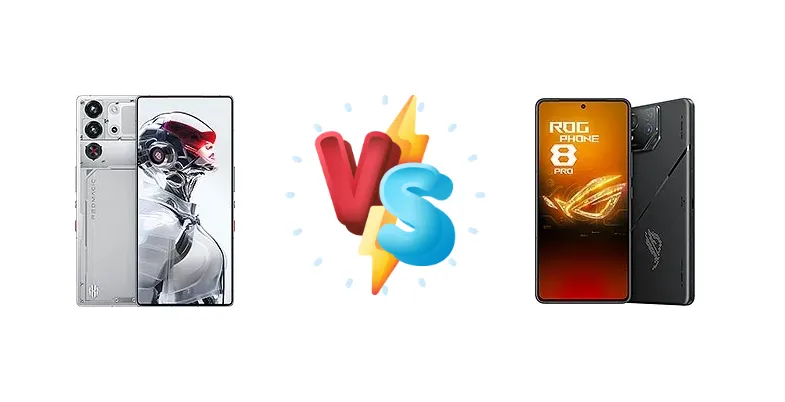
The ZTE nubia RedMagic 10S Pro+ and the Asus ROG Phone 8 Pro represent the pinnacle of Android gaming phone design. While both aim to deliver an unparalleled mobile gaming experience, they take drastically different approaches. The RedMagic prioritizes raw processing power and aggressive cooling, while the ROG Phone 8 Pro focuses on a more refined, all-around experience with a superior display and versatile features.
🏆 Quick Verdict
For the hardcore gamer prioritizing absolute CPU performance and sustained frame rates, the RedMagic 10S Pro+ is the clear winner. However, the Asus ROG Phone 8 Pro offers a more balanced package with a significantly brighter display, better camera capabilities, and more convenient charging options, making it the better choice for the average user.
| Network |
|---|
| 2G bands | GSM 850 / 900 / 1800 / 1900 | GSM 850 / 900 / 1800 / 1900 |
| 3G bands | HSDPA 850 / 900 / 1700(AWS) / 1900 / 2100 | HSDPA 850 / 900 / 1700(AWS) / 1800 / 1900 / 2100 - International |
| 4G bands | LTE | 1, 2, 3, 4, 5, 7, 8, 12, 17, 18, 19, 20, 25, 26, 28, 32, 34, 38, 39, 40, 41, 42, 43, 48, 66 - International |
| 5G bands | SA/NSA | 1, 2, 3, 5, 7, 8, 12, 18, 20, 25, 26, 28, 38, 40, 41, 48, 66, 77, 78, 79 SA/NSA/Sub6 - International |
| Speed | HSPA, LTE, 5G | HSPA, LTE (Up to 7CA), 5G |
| Technology | GSM / CDMA / HSPA / EVDO / LTE / 5G | GSM / CDMA / HSPA / LTE / 5G |
| Launch |
|---|
| Announced | 2025, May 26 | 2024, January 08 |
| Status | Available. Released 2025, May 26 | Available. Released 2024, January 18 |
| Body |
|---|
| Build | Glass front, aluminum frame, glass back | Glass front (Gorilla Glass Victus 2), glass back (Gorilla Glass), aluminum frame |
| Dimensions | 163.4 x 76.1 x 8.9 mm (6.43 x 3.00 x 0.35 in) | 163.8 x 76.8 x 8.9 mm (6.45 x 3.02 x 0.35 in) |
| SIM | Nano-SIM + Nano-SIM | Nano-SIM + Nano-SIM |
| Weight | 229 g (8.08 oz) | 225 g (7.94 oz) |
| Display |
|---|
| Protection | Mohs level 4 | Corning Gorilla Glass Victus 2 |
| Resolution | 1216 x 2688 pixels (~431 ppi density) | 1080 x 2400 pixels, 20:9 ratio (~388 ppi density) |
| Size | 6.85 inches, 113.7 cm2 (~91.4% screen-to-body ratio) | 6.78 inches, 111.0 cm2 (~88.2% screen-to-body ratio) |
| Type | AMOLED, 1B colors, 144Hz, 2000 nits (peak) | LTPO AMOLED, 1B colors, 165Hz, HDR10, 1600 nits (HBM), 2500 nits (peak) |
| Platform |
|---|
| CPU | Octa-core (2x4.47 GHz Oryon V2 Phoenix L + 6x3.53 GHz Oryon V2 Phoenix M) | Octa-core (1x3.3 GHz Cortex-X4 & 3x3.2 GHz Cortex-A720 & 2x3.0 GHz Cortex-A720 & 2x2.3 GHz Cortex-A520) |
| Chipset | Qualcomm SM8750-AC Snapdragon 8 Elite (3 nm) | Qualcomm SM8650-AB Snapdragon 8 Gen 3 (4 nm) |
| GPU | Adreno 830 (1200 MHz) | Adreno 750 |
| OS | Android 15, Redmagic OS 10.5 | Android 14, up to 2 major Android upgrades |
| Memory |
|---|
| Card slot | No | No |
| Internal | 512GB 16GB RAM, 1TB 24GB RAM | 512GB 16GB RAM, 1TB 24GB RAM |
| Main Camera |
|---|
| Dual | 50 MP, f/1.9, 23mm (wide), 1/1.55", 1.0µm, PDAF, OIS
50 MP, f/2.0, 13mm (ultrawide), 1/2.88", 0.61µm, AF
Auxiliary lens | - |
| Features | LED flash, HDR, panorama | LED flash, HDR, panorama |
| Triple | - | 50 MP, f/1.9, 24mm (wide), 1/1.56", 1.0µm, PDAF, gimbal OIS
32 MP, f/2.4, (telephoto), 1/3.2", 0.7µm, PDAF, OIS, 3x optical zoom
13 MP, f/2.2, 13mm, 120˚ (ultrawide) |
| Video | 8K@30fps, 4K@30/60fps, 1080p@30/60/120/240fps | 8K@24fps, 4K@30/60fps, 1080p@30/60/120/240fps, 720p@480fps; gyro-EIS, HDR10+ |
| Selfie camera |
|---|
| Features | HDR | Panorama, HDR |
| Single | 16 MP, f/2.0, (wide), 1/2.77", 1.0µm, under display | 32 MP, f/2.5, 22mm (wide), 1/3.2", 0.7µm |
| Video | 1080p@30/60fps | 1080p@30fps |
| Sound |
|---|
| 35mm jack | Yes | Yes |
| Loudspeaker | Yes, with stereo speakers | Yes, with stereo speakers |
| Comms |
|---|
| Bluetooth | 5.4, A2DP, LE | 5.4, A2DP, LE, aptX HD, aptX Adaptive, aptX Lossless |
| Infrared port | Yes | - |
| NFC | Yes | Yes |
| Positioning | GPS (L1+L2+L5), GLONASS, BDS, GALILEO | GPS (L1+L5), BDS (B1I+B1c+B2a), GALILEO (E1+E5a), QZSS (L1+L5), NavIC (L5), GLONASS |
| Radio | No | No |
| USB | USB Type-C 3.2 Gen 2, OTG, accessory connector, DisplayPort | USB Type-C (side), DisplayPort 1.4; USB Type-C (bottom), OTG |
| WLAN | Wi-Fi 802.11 a/b/g/n/ac/6e/7, tri-band, Wi-Fi Direct | Wi-Fi 802.11 a/b/g/n/ac/6e/7, tri-band, Wi-Fi Direct |
| Features |
|---|
| Sensors | Fingerprint (under display, optical), accelerometer, gyro, proximity, compass | Fingerprint (under display, optical), accelerometer, gyro, proximity, compass |
| Battery |
|---|
| Charging | 120W wired, 100% in 35 min | 65W wired, PD3.0, PPS, QC5, 100% in 39 min - International
30W wired, PD3.0, PPS - India
15W wireless (Qi)
10W reverse wired |
| Type | Si/C Li-Ion 7500 mAh | 5500 mAh |
| Misc |
|---|
| Colors | Dark Knight, White Knight, Transparent Silver Deuterium, Transparent Dark Knight | Phantom Black |
| Models | NX789J | AI2401, AI2401_A, AI2401_D |
| Price | About 730 EUR | $ 1,157.98 / £ 1,693.75 / € 632.66 |
| EU LABEL |
|---|
| Battery | 80:12h endurance, 1200 cycles | - |
| Energy | Class A | - |
| Free fall | Class C (90 falls) | - |
| Repairability | Class C | - |
ZTE nubia RedMagic 10SPro+
- Unmatched CPU performance with Snapdragon 8 Elite
- Extremely fast 120W charging
- Long battery lifespan (1200 cycles)
- Camera specifications are unknown and likely inferior
- Display brightness likely lower than ROG Phone 8 Pro
Asus ROG Phone 8 Pro
- Superior display brightness (1765 nits)
- More versatile camera system
- Wireless and reverse wired charging
- Slower wired charging speed (65W/30W)
- Less raw CPU power compared to RedMagic 10S Pro+
Display Comparison
The Asus ROG Phone 8 Pro immediately distinguishes itself with a measured peak brightness of 1765 nits, offering superior visibility in bright sunlight compared to the RedMagic 10S Pro+, whose brightness is not specified. While the RedMagic likely has a high brightness, the ROG Phone’s figure is concrete. Both devices likely employ high refresh rate AMOLED panels, but the ROG Phone’s brightness advantage is a significant win for outdoor use. Details on the RedMagic’s panel technology (LTPO, PWM dimming) are missing, but the ROG Phone’s display is known for its color accuracy and responsiveness.
Camera Comparison
The context data for the RedMagic 10S Pro+ is silent on camera specifications, suggesting it’s not a primary focus. The Asus ROG Phone 8 Pro, while not a camera-centric phone, offers a more comprehensive camera system with photo and video capabilities. Without specific details on the RedMagic’s sensors and image processing, it’s safe to assume the ROG Phone 8 Pro will deliver superior image quality and versatility. The ROG Phone’s camera likely features OIS and a larger main sensor, resulting in better low-light performance and dynamic range.
Performance
The core difference lies in the chipsets. The RedMagic 10S Pro+ utilizes the Qualcomm SM8750-AC Snapdragon 8 Elite (3nm), featuring an octa-core configuration with high clock speeds (2x4.47 GHz Oryon V2 Phoenix L + 6x3.53 GHz Oryon V2 Phoenix M). This architecture is designed for peak performance. Conversely, the ROG Phone 8 Pro employs the Snapdragon 8 Gen 3 (4nm) with a more conventional octa-core setup (1x3.3 GHz Cortex-X4 & 3x3.2 GHz Cortex-A720 & 2x3.0 GHz Cortex-A720 & 2x2.3 GHz Cortex-A520). The 3nm process of the Snapdragon 8 Elite *should* offer better power efficiency at similar performance levels, but the ROG Phone’s Gen 3 benefits from Qualcomm’s optimizations. The RedMagic’s Oryon cores are custom designs, potentially offering a performance edge in specific workloads. The ROG Phone 8 Pro’s thermal design is also likely more refined, preventing significant throttling during extended gaming sessions.
Battery Life
The RedMagic 10S Pro+ boasts an impressive 80:12h endurance rating and supports 120W wired charging, achieving a 100% charge in just 35 minutes. The ROG Phone 8 Pro, with a 14:43h active use score, demonstrates excellent battery life, but its 65W wired charging (international) or 30W (India) is slower. The RedMagic’s 1200 charge cycles suggest a longer battery lifespan. While the ROG Phone 8 Pro offers 15W wireless and 10W reverse wired charging, the RedMagic lacks these features. The RedMagic’s faster charging speed is a significant advantage for users who need to quickly top up their battery.
Buying Guide
Buy the ZTE nubia RedMagic 10S Pro+ if you absolutely need the fastest possible CPU performance for demanding games and emulation, and are willing to trade off camera quality and display brightness for it. Buy the Asus ROG Phone 8 Pro if you value a stunning display, a more versatile camera system, and a more polished software experience alongside excellent gaming performance.
Frequently Asked Questions
❓ Does the Snapdragon 8 Elite in the RedMagic 10S Pro+ generate excessive heat during prolonged gaming sessions?
The Snapdragon 8 Elite is a powerful chip, and heat generation is a concern. However, the RedMagic 10S Pro+ features an advanced cooling system designed to mitigate thermal throttling. While some heat is inevitable, the cooling solution should allow for sustained performance during extended gaming sessions, potentially better than the ROG Phone 8 Pro under similar load.
❓ What real-world gaming performance differences can I expect between the Snapdragon 8 Elite and the Snapdragon 8 Gen 3?
In most games, the difference will be subtle. The Snapdragon 8 Elite excels in CPU-bound tasks, potentially leading to higher frame rates in titles that heavily rely on processor power. The Snapdragon 8 Gen 3, however, is optimized for overall gaming performance and may offer a smoother experience in graphically demanding games. The ROG Phone 8 Pro’s software optimizations also play a role.
❓ Is the lack of wireless charging on the RedMagic 10S Pro+ a significant drawback?
For users who frequently utilize wireless charging, the absence of this feature on the RedMagic 10S Pro+ is a notable omission. However, the incredibly fast 120W wired charging largely compensates for this, allowing for a full charge in just 35 minutes. If convenience is paramount, the ROG Phone 8 Pro’s 15W wireless charging is a benefit.