
ZTE RedMagic 10S Pro vs. vivo iQOO 12 Pro: A Deep Dive into Gaming and Charging Supremacy
| Phones Images | |||||
|---|---|---|---|---|---|
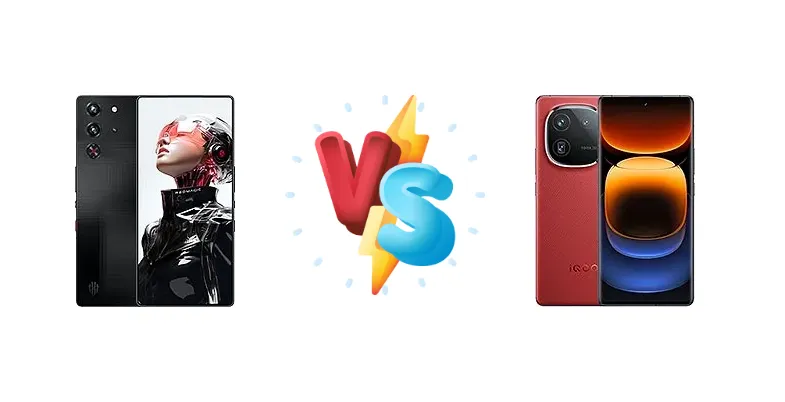
|
🏆 Quick Verdict
For dedicated mobile gamers prioritizing sustained performance and battery longevity, the ZTE nubia RedMagic 10S Pro is the clear winner. Its Snapdragon 8 Elite chipset and 80W charging, coupled with a focus on cooling, provide a superior gaming experience. However, the vivo iQOO 12 Pro offers a more versatile package with faster 120W wired and 50W wireless charging, making it ideal for users who value convenience and all-around performance.
| PHONES | ||
|---|---|---|
| Phone Names | ZTE nubia RedMagic 10S Pro | vivo iQOO 12 Pro |
| Network | ||
|---|---|---|
| 2G bands | GSM 850 / 900 / 1800 / 1900 | GSM 850 / 900 / 1800 / 1900 |
| 3G bands | HSDPA 800 / 850 / 900 / 1700(AWS) / 1900 / 2100 | HSDPA 800 / 850 / 900 / 1700(AWS) / 1900 / 2100 |
| 4G bands | 1, 2, 3, 4, 5, 7, 8, 12, 17, 18, 19, 20, 26, 28, 34, 38, 39, 40, 41, 42, 66 | 1, 2, 3, 4, 5, 7, 8, 12, 17, 18, 19, 20, 25, 26, 28, 34, 38, 39, 40, 41, 42, 66 |
| 5G bands | 1, 2, 3, 5, 7, 8, 20, 26, 28, 38, 40, 41, 66, 71, 77, 78 SA/NSA | 1, 2, 3, 5, 7, 8, 12, 20, 25, 26, 28, 66, 38, 40, 41, 77, 78 SA/NSA |
| Speed | HSPA, LTE, 5G | HSPA, LTE, 5G |
| Technology | GSM / CDMA / HSPA / EVDO / LTE / 5G | GSM / CDMA / HSPA / CDMA2000 / LTE / 5G |
| Launch | ||
|---|---|---|
| Announced | 2025, May 26 | 2023, November 07 |
| Status | Available. Released 2025, May 26 | Available. Released 2023, November 14 |
| Body | ||
|---|---|---|
| Build | Glass front, aluminum frame, glass back | - |
| Dimensions | 163.4 x 76.1 x 8.9 mm (6.43 x 3.00 x 0.35 in) | 164.6 x 75.4 x 8.6 mm or 8.8 mm |
| SIM | Nano-SIM + Nano-SIM | Nano-SIM + Nano-SIM |
| Weight | 229 g (8.08 oz) | 205 g or 210 g (7.23 oz) |
| Display | ||
|---|---|---|
| Protection | Corning Gorilla Glass (unspecified version), Mohs level 4 | - |
| Resolution | 1216 x 2688 pixels (~431 ppi density) | 1440 x 3200 pixels, 20:9 ratio (~518 ppi density) |
| Size | 6.85 inches, 113.7 cm2 (~91.4% screen-to-body ratio) | 6.78 inches, 111.0 cm2 (~89.4% screen-to-body ratio) |
| Type | AMOLED, 1B colors, 144Hz, 2592Hz PWM, 2000 nits (peak) | LTPO AMOLED, 1B colors, 144Hz, HDR10+, 1600 nits (HBM), 3000 nits (peak) |
| Platform | ||
|---|---|---|
| CPU | Octa-core (2x4.47 GHz Oryon V2 Phoenix L + 6x3.53 GHz Oryon V2 Phoenix M) | Octa-core (1x3.3 GHz Cortex-X4 & 3x3.2 GHz Cortex-A720 & 2x3.0 GHz Cortex-A720 & 2x2.3 GHz Cortex-A520) |
| Chipset | Qualcomm SM8750-AC Snapdragon 8 Elite (3 nm) | Qualcomm SM8650-AB Snapdragon 8 Gen 3 (4 nm) |
| GPU | Adreno 830 (1200 MHz) | Adreno 750 |
| OS | Android 15, Redmagic OS 10.5 | Android 14, up to 2 major Android upgrades, Funtouch 14 (International), OriginOS 4 (China) |
| Memory | ||
|---|---|---|
| Card slot | No | No |
| Internal | 256GB 12GB RAM, 512GB 16GB RAM, 1TB 24GB RAM | 256GB 16GB RAM, 512GB 16GB RAM, 1TB 16GB RAM |
| Main Camera | ||
|---|---|---|
| Dual | 50 MP, f/1.9, 23mm (wide), 1/1.55", 1.0µm, PDAF, OIS 50 MP, f/2.0, 13mm (ultrawide), 1/2.88", 0.61µm, AF Auxiliary lens | - |
| Features | LED flash, HDR, panorama | Color spectrum sensor, Dual-LED flash, HDR, panorama |
| Triple | - | 50 MP, f/1.7, 23mm (wide), 1/1.3", 1.2µm, ulti-directional PDAF, OIS 64 MP, f/2.6, 70mm (periscope telephoto), 1/2.0", PDAF, OIS, 3x optical zoom 50 MP, f/2.0, 15mm, 119˚ (ultrawide), AF |
| Video | 8K@30fps, 4K@30/60fps, 1080p@30/60/120/240fps | 8K@30fps, 4K@24/30/60fps, 1080p@30/60/120/240fps, gyro-EIS |
| Selfie camera | ||
|---|---|---|
| Features | HDR | HDR |
| Single | 16 MP, f/2.0, (wide), 1/2.77", 1.0µm, under display | 16 MP, f/2.5, (wide) |
| Video | 1080p@30/60fps | 1080p@30fps, gyro-EIS |
| Sound | ||
|---|---|---|
| 35mm jack | Yes | No |
| Loudspeaker | Yes, with stereo speakers | Yes, with stereo speakers |
| Comms | ||
|---|---|---|
| Bluetooth | 5.4, A2DP, LE | 5.4, A2DP, LE, aptX HD, aptX Adaptive, aptX Lossless |
| Infrared port | Yes | Yes |
| NFC | Yes | Yes |
| Positioning | GPS (L1+L2+L5), GLONASS, BDS, GALILEO | GPS (L1+L5), GLONASS (G1), BDS (B1I+B1c+B2a), GALILEO (E1+E5a), QZSS (L1+L5) |
| Radio | No | No |
| USB | USB Type-C 3.2 Gen 2, OTG, accessory connector, DisplayPort | USB Type-C 2.0, OTG |
| WLAN | Wi-Fi 802.11 a/b/g/n/ac/6e/7, tri-band, Wi-Fi Direct | Wi-Fi 802.11 a/b/g/n/ac/6/7, tri-band, Wi-Fi Direct |
| Features | ||
|---|---|---|
| Sensors | Fingerprint (under display, optical), accelerometer, gyro, proximity, compass | Fingerprint (under display, ultrasonic), accelerometer, gyro, proximity, compass |
| Battery | ||
|---|---|---|
| Charging | 80W wired | 120W wired 50W wireless 10W reverse wireless |
| Type | Si/C Li-Ion 7050 mAh | 5100 mAh |
| Misc | ||
|---|---|---|
| Colors | Nightfall (Matt Black), Moonlight (Silver Transparent), Dusk (Black Transparent) | Black, Red, White (BMW M branding) |
| Models | NX789J | V2329A |
| Price | About 650 EUR | About 650 EUR |
| EU LABEL | ||
|---|---|---|
| Battery | 80:12h endurance, 1200 cycles | - |
| Energy | Class A | - |
| Free fall | Class C (90 falls) | - |
| Repairability | Class C | - |
ZTE nubia RedMagic 10S Pro
- Superior sustained gaming performance due to Snapdragon 8 Elite and thermal design
- Longer battery lifespan with 1200 charge cycles
- Potentially optimized display for gaming
- Slower charging speed compared to iQOO 12 Pro
- Likely less versatile camera system
- Gamer-centric design may not appeal to all
vivo iQOO 12 Pro
- Incredibly fast 120W wired and 50W wireless charging
- More versatile camera system (likely)
- Broader appeal design
- Snapdragon 8 Gen 3 may throttle more under sustained load
- Potentially shorter battery lifespan compared to RedMagic
- Higher price point (potentially)
Display Comparison
While both devices likely feature high refresh rate AMOLED displays (data not provided), the core difference lies in their underlying priorities. The RedMagic 10S Pro’s display is optimized for gaming, potentially prioritizing response time and color accuracy within gaming profiles. The iQOO 12 Pro, given vivo’s history, likely emphasizes color vibrancy and peak brightness for multimedia consumption. The absence of display specs necessitates assuming a focus on gaming-centric calibration for the RedMagic and a more general-purpose approach for the iQOO.
Camera Comparison
Without detailed camera specifications, a direct comparison is difficult. However, vivo iQOO phones typically prioritize camera capabilities, often incorporating large sensors and advanced image processing. The RedMagic line, while improving, traditionally focuses less on camera performance. We can assume the iQOO 12 Pro will offer a more versatile and feature-rich camera experience, potentially with superior low-light performance and video recording capabilities. The RedMagic will likely suffice for casual photography but won’t compete at the high end.
Performance
The chipset battle is central here. The RedMagic 10S Pro’s Snapdragon 8 Elite (3nm) utilizes Oryon V2 Phoenix cores, designed for sustained peak performance. This contrasts with the iQOO 12 Pro’s Snapdragon 8 Gen 3 (4nm). While the Gen 3 is a powerful chip, the 3nm process of the 8 Elite *should* translate to better thermal efficiency, reducing throttling during prolonged gaming. The RedMagic’s architecture (2x4.47GHz + 6x3.53GHz) suggests a focus on high clock speeds for demanding tasks, while the iQOO’s (1x3.3GHz + 3x3.2GHz + 2x3.0GHz + 2x2.3GHz) is more traditionally structured. The iQOO 12 Pro benefits from the newer architecture of the Gen 3, but the RedMagic’s thermal design and chipset choice are geared towards maximizing sustained performance.
Battery Life
The RedMagic 10S Pro boasts an 80:12h endurance rating and a claimed 1200 charge cycles, indicating a focus on long-term battery health and usability. The iQOO 12 Pro counters with significantly faster charging: 120W wired, 50W wireless, and 10W reverse wireless. While the RedMagic’s 80W is respectable, the iQOO’s 120W can dramatically reduce downtime. The iQOO’s wireless charging is a significant advantage, offering convenience the RedMagic lacks. The RedMagic’s 1200 cycle claim suggests a more durable battery over the long run, mitigating concerns about capacity degradation.
Buying Guide
Buy the ZTE nubia RedMagic 10S Pro if you need uncompromising gaming performance, extended battery life during intense sessions, and are willing to accept a more gamer-centric aesthetic. Buy the vivo iQOO 12 Pro if you prefer a more balanced smartphone experience with incredibly fast charging, a versatile camera system, and a design that doesn’t scream ‘gaming phone.’