
ZTE nubia RedMagic 10S Pro vs. Samsung Galaxy S24 Ultra: A Deep Dive Comparison
| Phones Images | |||||
|---|---|---|---|---|---|
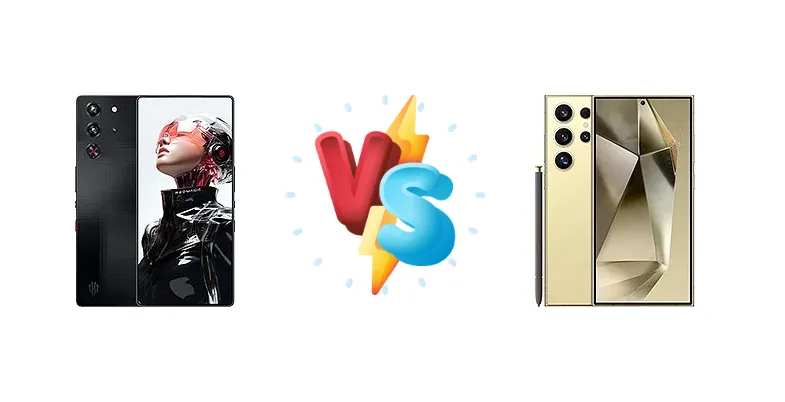
|
🏆 Quick Verdict
For the average user prioritizing camera quality, software support, and a polished ecosystem, the Samsung Galaxy S24 Ultra is the superior choice. However, gamers and power users who demand sustained performance and exceptional battery life will find the RedMagic 10S Pro a more compelling option.
| PHONES | ||
|---|---|---|
| Phone Names | ZTE nubia RedMagic 10S Pro | Samsung Galaxy S24 Ultra |
| Network | ||
|---|---|---|
| 2G bands | GSM 850 / 900 / 1800 / 1900 | GSM 850 / 900 / 1800 / 1900 |
| 3G bands | HSDPA 800 / 850 / 900 / 1700(AWS) / 1900 / 2100 | HSDPA 850 / 900 / 1700(AWS) / 1900 / 2100 |
| 4G bands | 1, 2, 3, 4, 5, 7, 8, 12, 17, 18, 19, 20, 26, 28, 34, 38, 39, 40, 41, 42, 66 | 1, 2, 3, 4, 5, 7, 8, 12, 13, 17, 18, 19, 20, 25, 26, 28, 32, 38, 39, 40, 41, 66 - International |
| 5G bands | 1, 2, 3, 5, 7, 8, 20, 26, 28, 38, 40, 41, 66, 71, 77, 78 SA/NSA | 1, 2, 3, 5, 7, 8, 12, 20, 25, 26, 28, 38, 40, 41, 66, 75, 77, 78 SA/NSA/Sub6 - International |
| Speed | HSPA, LTE, 5G | HSPA, LTE (up to 7CA), 5G |
| Technology | GSM / CDMA / HSPA / EVDO / LTE / 5G | GSM / CDMA / HSPA / EVDO / LTE / 5G |
| Launch | ||
|---|---|---|
| Announced | 2025, May 26 | 2024, January 17 |
| Status | Available. Released 2025, May 26 | Available. Released 2024, January 24 |
| Body | ||
|---|---|---|
| Build | Glass front, aluminum frame, glass back | Glass front (Corning Gorilla Armor), glass back (Corning Gorilla Armor), titanium frame (grade 2) |
| Dimensions | 163.4 x 76.1 x 8.9 mm (6.43 x 3.00 x 0.35 in) | 162.3 x 79 x 8.6 mm (6.39 x 3.11 x 0.34 in) |
| SIM | Nano-SIM + Nano-SIM | · Nano-SIM + Nano-SIM + eSIM + eSIM (max 2 at a time) - INT· Nano-SIM + eSIM + eSIM (max 2 at a time) - USA· Nano-SIM + Nano-SIM - CN |
| Weight | 229 g (8.08 oz) | 232 g or 233 g (8.18 oz) |
| Display | ||
|---|---|---|
| Protection | Corning Gorilla Glass (unspecified version), Mohs level 4 | Corning Gorilla Armor |
| Resolution | 1216 x 2688 pixels (~431 ppi density) | 1440 x 3120 pixels, 19.5:9 ratio (~505 ppi density) |
| Size | 6.85 inches, 113.7 cm2 (~91.4% screen-to-body ratio) | 6.8 inches, 113.5 cm2 (~88.5% screen-to-body ratio) |
| Type | AMOLED, 1B colors, 144Hz, 2592Hz PWM, 2000 nits (peak) | Dynamic LTPO AMOLED 2X, 120Hz, HDR10+, 2600 nits (peak) |
| Platform | ||
|---|---|---|
| CPU | Octa-core (2x4.47 GHz Oryon V2 Phoenix L + 6x3.53 GHz Oryon V2 Phoenix M) | 8-core (1x3.39GHz Cortex-X4 & 3x3.1GHz Cortex-A720 & 2x2.9GHz Cortex-A720 & 2x2.2GHz Cortex-A520) |
| Chipset | Qualcomm SM8750-AC Snapdragon 8 Elite (3 nm) | Qualcomm SM8650-AC Snapdragon 8 Gen 3 (4 nm) |
| GPU | Adreno 830 (1200 MHz) | Adreno 750 (1 GHz) |
| OS | Android 15, Redmagic OS 10.5 | Android 14, up to 7 major Android upgrades, One UI 8.0 |
| Memory | ||
|---|---|---|
| Card slot | No | No |
| Internal | 256GB 12GB RAM, 512GB 16GB RAM, 1TB 24GB RAM | 256GB 12GB RAM, 512GB 12GB RAM, 1TB 12GB RAM |
| Main Camera | ||
|---|---|---|
| Dual | 50 MP, f/1.9, 23mm (wide), 1/1.55", 1.0µm, PDAF, OIS 50 MP, f/2.0, 13mm (ultrawide), 1/2.88", 0.61µm, AF Auxiliary lens | - |
| Features | LED flash, HDR, panorama | Laser AF, LED flash, auto-HDR, panorama |
| Quad | - | 200 MP, f/1.7, 24mm (wide), 1/1.3", 0.6µm, multi-directional PDAF, OIS 10 MP, f/2.4, 67mm (telephoto), 1/3.52", 1.12µm, PDAF, OIS, 3x optical zoom 50 MP, f/3.4, 111mm (periscope telephoto), 1/2.52", 0.7µm, PDAF, OIS, 5x optical zoom 12 MP, f/2.2, 13mm, 120˚ (ultrawide), 1/2.55", 1.4µm, dual pixel PDAF, Super Steady video |
| Video | 8K@30fps, 4K@30/60fps, 1080p@30/60/120/240fps | 8K@24/30fps, 4K@30/60/120fps, 1080p@30/60/120/240fps, HDR10+, stereo sound rec., gyro-EIS |
| Selfie camera | ||
|---|---|---|
| Features | HDR | HDR, HDR10+ |
| Single | 16 MP, f/2.0, (wide), 1/2.77", 1.0µm, under display | 12 MP, f/2.2, 26mm (wide), 1/3.2", 1.12µm, dual pixel PDAF |
| Video | 1080p@30/60fps | 4K@30/60fps, 1080p@30fps |
| Sound | ||
|---|---|---|
| 35mm jack | Yes | No |
| Loudspeaker | Yes, with stereo speakers | Yes, with stereo speakers |
| Comms | ||
|---|---|---|
| Bluetooth | 5.4, A2DP, LE | 5.3, A2DP, LE |
| Infrared port | Yes | - |
| NFC | Yes | Yes |
| Positioning | GPS (L1+L2+L5), GLONASS, BDS, GALILEO | GPS, GLONASS, BDS, GALILEO, QZSS |
| Radio | No | No |
| USB | USB Type-C 3.2 Gen 2, OTG, accessory connector, DisplayPort | USB Type-C 3.2, DisplayPort 1.2, OTG |
| WLAN | Wi-Fi 802.11 a/b/g/n/ac/6e/7, tri-band, Wi-Fi Direct | Wi-Fi 802.11 a/b/g/n/ac/6e/7, tri-band, Wi-Fi Direct |
| Features | ||
|---|---|---|
| Sensors | Fingerprint (under display, optical), accelerometer, gyro, proximity, compass | Fingerprint (under display, ultrasonic), accelerometer, gyro, proximity, compass, barometer |
| Battery | ||
|---|---|---|
| Charging | 80W wired | 45W wired, PD3.0, 65% in 30 min 15W wireless (Qi) 4.5W reverse wireless |
| Type | Si/C Li-Ion 7050 mAh | Li-Ion 5000 mAh |
| Misc | ||
|---|---|---|
| Colors | Nightfall (Matt Black), Moonlight (Silver Transparent), Dusk (Black Transparent) | Titanium Black, Titanium Gray, Titanium Violet, Titanium Yellow, Titanium Blue, Titanium Green, Titanium Orange |
| Models | NX789J | SM-S928B, SM-S928B/DS, SM-S928U, SM-S928U1, SM-S928W, SM-S928N, SM-S9280, SM-S928E, SM-S928E/DS |
| Price | About 650 EUR | $ 514.94 / C$ 929.99 / £ 630.00 / € 658.53 / ₹ 84,999 |
| SAR | - | 1.26 W/kg (head) 0.62 W/kg (body) |
| SAR EU | - | 1.06 W/kg (head) 1.30 W/kg (body) |
| EU LABEL | ||
|---|---|---|
| Battery | 80:12h endurance, 1200 cycles | - |
| Energy | Class A | - |
| Free fall | Class C (90 falls) | - |
| Repairability | Class C | - |
ZTE nubia RedMagic 10S Pro
- Exceptional battery life and longevity (1200 cycles)
- Faster 80W wired charging
- Potentially superior sustained gaming performance due to 3nm Snapdragon 8 Elite and advanced cooling
- Likely inferior camera system compared to the S24 Ultra
- Less refined software experience and ecosystem
Samsung Galaxy S24 Ultra
- Versatile and high-quality camera system
- Brighter and more color-accurate display
- Wireless and reverse wireless charging
- Mature software ecosystem and long-term support
- Slower 45W wired charging
- Potentially more thermal throttling under sustained load
Display Comparison
The Samsung Galaxy S24 Ultra boasts a significantly brighter display, peaking at 1447 nits, ensuring excellent visibility even in direct sunlight. While the RedMagic 10S Pro’s display specs are not provided, it’s likely to prioritize refresh rate and touch sampling for gaming. The S24 Ultra’s panel likely utilizes LTPO technology for adaptive refresh rates, conserving battery life. The S24 Ultra’s superior brightness and color accuracy make it ideal for content consumption and creative work, while the RedMagic likely focuses on responsiveness.
Camera Comparison
The Samsung Galaxy S24 Ultra is expected to feature a sophisticated camera system with multiple lenses and advanced image processing capabilities. While specific details are missing, Samsung’s history suggests a focus on versatility, offering excellent performance in various lighting conditions. The RedMagic 10S Pro, geared towards gaming, likely prioritizes camera functionality less, potentially offering a more basic setup. The S24 Ultra’s larger sensor and advanced OIS will result in superior low-light performance and video stabilization. The RedMagic’s camera is likely adequate for casual use but won’t compete with the S24 Ultra’s photographic prowess.
Performance
The nubia RedMagic 10S Pro’s Qualcomm SM8750-AC Snapdragon 8 Elite, built on a 3nm process, features a unique octa-core configuration with Oryon V2 Phoenix cores (2x4.47 GHz + 6x3.53 GHz). This architecture is designed for sustained peak performance, potentially outperforming the S24 Ultra’s Snapdragon 8 Gen 3 (4nm) in demanding gaming scenarios. The S24 Ultra’s CPU (1x3.39GHz Cortex-X4 & 3x3.1GHz Cortex-A720 & 2x2.9GHz Cortex-A720 & 2x2.2GHz Cortex-A520) offers a more traditional core arrangement. The 3nm node of the Snapdragon 8 Elite should provide better thermal efficiency, reducing throttling during extended gaming. However, the S24 Ultra benefits from Samsung’s software optimizations and potentially more efficient memory management.
Battery Life
The ZTE nubia RedMagic 10S Pro boasts an impressive 80:12h endurance rating and a claimed 1200 charge cycles, indicating exceptional battery life and longevity. Its 80W wired charging is significantly faster than the S24 Ultra’s 45W charging (65% in 30 minutes). The S24 Ultra offers wireless charging (15W) and reverse wireless charging (4.5W), features absent on the RedMagic. While the S24 Ultra achieves a respectable 13:49h active use score, the RedMagic’s endurance suggests it can easily last a full day of heavy gaming and usage, and potentially two days with moderate use.
Buying Guide
Buy the ZTE nubia RedMagic 10S Pro if you need uncompromising gaming performance, extended battery life for marathon sessions, and a cooling system designed to prevent throttling. Buy the Samsung Galaxy S24 Ultra if you prefer a versatile camera system, a brighter and more color-accurate display, and the broader ecosystem benefits of Samsung's software and services.