
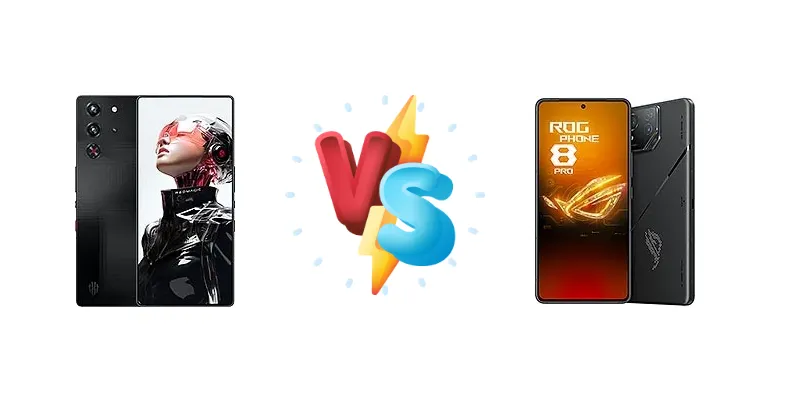
RedMagic 10S Pro vs Asus ROG Phone 8 Pro: A Deep Dive into Gaming Powerhouses
| Phones Images | |||||
|---|---|---|---|---|---|
|
🏆 Quick Verdict
For the hardcore gamer prioritizing absolute performance and sustained frame rates, the RedMagic 10S Pro is the clear winner. Its Snapdragon 8 Elite chipset and focus on cooling provide a noticeable edge. However, the ROG Phone 8 Pro offers a more refined experience with a significantly brighter display and more flexible charging options, making it ideal for users who value versatility.
| PHONES | ||
|---|---|---|
| Phone Names | ZTE nubia RedMagic 10S Pro | Asus ROG Phone 8 Pro |
| Network | ||
|---|---|---|
| 2G bands | GSM 850 / 900 / 1800 / 1900 | GSM 850 / 900 / 1800 / 1900 |
| 3G bands | HSDPA 800 / 850 / 900 / 1700(AWS) / 1900 / 2100 | HSDPA 850 / 900 / 1700(AWS) / 1800 / 1900 / 2100 - International |
| 4G bands | 1, 2, 3, 4, 5, 7, 8, 12, 17, 18, 19, 20, 26, 28, 34, 38, 39, 40, 41, 42, 66 | 1, 2, 3, 4, 5, 7, 8, 12, 17, 18, 19, 20, 25, 26, 28, 32, 34, 38, 39, 40, 41, 42, 43, 48, 66 - International |
| 5G bands | 1, 2, 3, 5, 7, 8, 20, 26, 28, 38, 40, 41, 66, 71, 77, 78 SA/NSA | 1, 2, 3, 5, 7, 8, 12, 18, 20, 25, 26, 28, 38, 40, 41, 48, 66, 77, 78, 79 SA/NSA/Sub6 - International |
| Speed | HSPA, LTE, 5G | HSPA, LTE (Up to 7CA), 5G |
| Technology | GSM / CDMA / HSPA / EVDO / LTE / 5G | GSM / CDMA / HSPA / LTE / 5G |
| Launch | ||
|---|---|---|
| Announced | 2025, May 26 | 2024, January 08 |
| Status | Available. Released 2025, May 26 | Available. Released 2024, January 18 |
| Body | ||
|---|---|---|
| Build | Glass front, aluminum frame, glass back | Glass front (Gorilla Glass Victus 2), glass back (Gorilla Glass), aluminum frame |
| Dimensions | 163.4 x 76.1 x 8.9 mm (6.43 x 3.00 x 0.35 in) | 163.8 x 76.8 x 8.9 mm (6.45 x 3.02 x 0.35 in) |
| SIM | Nano-SIM + Nano-SIM | Nano-SIM + Nano-SIM |
| Weight | 229 g (8.08 oz) | 225 g (7.94 oz) |
| Display | ||
|---|---|---|
| Protection | Corning Gorilla Glass (unspecified version), Mohs level 4 | Corning Gorilla Glass Victus 2 |
| Resolution | 1216 x 2688 pixels (~431 ppi density) | 1080 x 2400 pixels, 20:9 ratio (~388 ppi density) |
| Size | 6.85 inches, 113.7 cm2 (~91.4% screen-to-body ratio) | 6.78 inches, 111.0 cm2 (~88.2% screen-to-body ratio) |
| Type | AMOLED, 1B colors, 144Hz, 2592Hz PWM, 2000 nits (peak) | LTPO AMOLED, 1B colors, 165Hz, HDR10, 1600 nits (HBM), 2500 nits (peak) |
| Platform | ||
|---|---|---|
| CPU | Octa-core (2x4.47 GHz Oryon V2 Phoenix L + 6x3.53 GHz Oryon V2 Phoenix M) | Octa-core (1x3.3 GHz Cortex-X4 & 3x3.2 GHz Cortex-A720 & 2x3.0 GHz Cortex-A720 & 2x2.3 GHz Cortex-A520) |
| Chipset | Qualcomm SM8750-AC Snapdragon 8 Elite (3 nm) | Qualcomm SM8650-AB Snapdragon 8 Gen 3 (4 nm) |
| GPU | Adreno 830 (1200 MHz) | Adreno 750 |
| OS | Android 15, Redmagic OS 10.5 | Android 14, up to 2 major Android upgrades |
| Memory | ||
|---|---|---|
| Card slot | No | No |
| Internal | 256GB 12GB RAM, 512GB 16GB RAM, 1TB 24GB RAM | 512GB 16GB RAM, 1TB 24GB RAM |
| Main Camera | ||
|---|---|---|
| Dual | 50 MP, f/1.9, 23mm (wide), 1/1.55", 1.0µm, PDAF, OIS 50 MP, f/2.0, 13mm (ultrawide), 1/2.88", 0.61µm, AF Auxiliary lens | - |
| Features | LED flash, HDR, panorama | LED flash, HDR, panorama |
| Triple | - | 50 MP, f/1.9, 24mm (wide), 1/1.56", 1.0µm, PDAF, gimbal OIS 32 MP, f/2.4, (telephoto), 1/3.2", 0.7µm, PDAF, OIS, 3x optical zoom 13 MP, f/2.2, 13mm, 120˚ (ultrawide) |
| Video | 8K@30fps, 4K@30/60fps, 1080p@30/60/120/240fps | 8K@24fps, 4K@30/60fps, 1080p@30/60/120/240fps, 720p@480fps; gyro-EIS, HDR10+ |
| Selfie camera | ||
|---|---|---|
| Features | HDR | Panorama, HDR |
| Single | 16 MP, f/2.0, (wide), 1/2.77", 1.0µm, under display | 32 MP, f/2.5, 22mm (wide), 1/3.2", 0.7µm |
| Video | 1080p@30/60fps | 1080p@30fps |
| Sound | ||
|---|---|---|
| 35mm jack | Yes | Yes |
| Loudspeaker | Yes, with stereo speakers | Yes, with stereo speakers |
| Comms | ||
|---|---|---|
| Bluetooth | 5.4, A2DP, LE | 5.4, A2DP, LE, aptX HD, aptX Adaptive, aptX Lossless |
| Infrared port | Yes | - |
| NFC | Yes | Yes |
| Positioning | GPS (L1+L2+L5), GLONASS, BDS, GALILEO | GPS (L1+L5), BDS (B1I+B1c+B2a), GALILEO (E1+E5a), QZSS (L1+L5), NavIC (L5), GLONASS |
| Radio | No | No |
| USB | USB Type-C 3.2 Gen 2, OTG, accessory connector, DisplayPort | USB Type-C (side), DisplayPort 1.4; USB Type-C (bottom), OTG |
| WLAN | Wi-Fi 802.11 a/b/g/n/ac/6e/7, tri-band, Wi-Fi Direct | Wi-Fi 802.11 a/b/g/n/ac/6e/7, tri-band, Wi-Fi Direct |
| Features | ||
|---|---|---|
| Sensors | Fingerprint (under display, optical), accelerometer, gyro, proximity, compass | Fingerprint (under display, optical), accelerometer, gyro, proximity, compass |
| Battery | ||
|---|---|---|
| Charging | 80W wired | 65W wired, PD3.0, PPS, QC5, 100% in 39 min - International 30W wired, PD3.0, PPS - India 15W wireless (Qi) 10W reverse wired |
| Type | Si/C Li-Ion 7050 mAh | 5500 mAh |
| Misc | ||
|---|---|---|
| Colors | Nightfall (Matt Black), Moonlight (Silver Transparent), Dusk (Black Transparent) | Phantom Black |
| Models | NX789J | AI2401, AI2401_A, AI2401_D |
| Price | About 650 EUR | $ 1,157.98 / £ 1,693.75 / € 632.66 |
| EU LABEL | ||
|---|---|---|
| Battery | 80:12h endurance, 1200 cycles | - |
| Energy | Class A | - |
| Free fall | Class C (90 falls) | - |
| Repairability | Class C | - |
ZTE nubia RedMagic 10S Pro
- Unmatched CPU/GPU performance with Snapdragon 8 Elite
- Exceptional battery endurance (80:12h)
- High battery cycle count (1200 cycles)
- Limited camera details suggest a weaker camera system
- Less versatile charging options
Asus ROG Phone 8 Pro
- Significantly brighter display (1765 nits)
- Versatile charging options (wired, wireless, reverse)
- More balanced overall experience
- Slightly less raw processing power than RedMagic 10S Pro
- Lower battery endurance compared to RedMagic 10S Pro
Display Comparison
The Asus ROG Phone 8 Pro boasts a significant advantage in display technology, achieving a measured peak brightness of 1765 nits. This translates to superior visibility in direct sunlight, a crucial factor for outdoor gaming. While the RedMagic 10S Pro’s display specifications are not provided, it’s unlikely to match the ROG Phone’s brightness. The ROG Phone’s panel likely utilizes LTPO technology for adaptive refresh rates, further enhancing power efficiency and smoothness. Bezels are expected to be minimal on both devices, but the ROG Phone’s overall display quality is a clear differentiator.
Camera Comparison
The context data for the RedMagic 10S Pro lacks camera details, suggesting it’s not a primary focus. The Asus ROG Phone 8 Pro is described as having a capable Photo/Video camera, but specific sensor details are missing. Given the ROG Phone’s broader appeal, it’s likely to feature a more versatile camera system with features like OIS and a larger main sensor. The absence of camera specifics for the RedMagic suggests a more basic implementation geared towards casual use, prioritizing gaming features over photographic prowess.
Performance
The core of the performance difference lies in the chipsets. The RedMagic 10S Pro utilizes the Qualcomm SM8750-AC Snapdragon 8 Elite (3nm), featuring a unique octa-core configuration with Oryon V2 Phoenix cores clocked up to 4.47 GHz. This architecture is designed for maximum single-core and multi-core performance. The ROG Phone 8 Pro, conversely, employs the Snapdragon 8 Gen 3 (4nm) with a more conventional core arrangement, peaking at 3.3 GHz. While the Gen 3 is a powerful chip, the 3nm process and Oryon cores of the 8 Elite give the RedMagic a theoretical advantage in raw processing power. However, the ROG Phone 8 Pro benefits from optimized software and potentially more efficient thermal management, mitigating the performance gap. The RedMagic’s cooling system will be critical to sustaining those peak speeds.
Battery Life
The RedMagic 10S Pro offers an 80W wired charging solution and boasts an impressive 80:12h endurance rating, alongside a claimed 1200 charge cycles. The ROG Phone 8 Pro, while offering a slightly lower endurance score of 14:43h in active use, provides more charging flexibility with 65W wired (international), 30W (India), 15W wireless (Qi), and 10W reverse wired charging. The ROG Phone’s faster charging time of 39 minutes to 100% (international) is also a benefit. The RedMagic’s longer endurance suggests a more efficient power draw, but the ROG Phone’s charging versatility caters to a wider range of user preferences.
Buying Guide
Buy the ZTE nubia RedMagic 10S Pro if you need uncompromising CPU and GPU performance for demanding games, and prioritize sustained high frame rates over all else. You’ll benefit from the advanced cooling system and are willing to accept a less versatile camera and charging experience. Buy the Asus ROG Phone 8 Pro if you prefer a balanced experience with a stunningly bright display, faster and more versatile charging options (including wireless), and a more polished software experience, even if it means sacrificing a small amount of raw processing power.