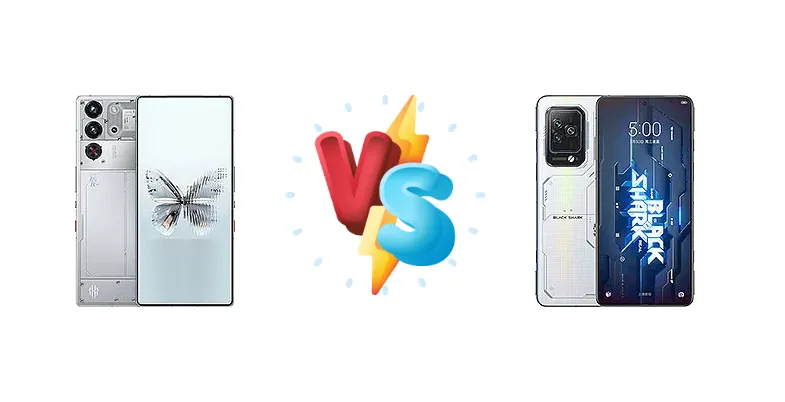
The gaming phone market is heating up, with the ZTE nubia RedMagic 10 Pro+ entering the fray with Qualcomm’s latest Snapdragon 8 Elite chipset. This puts it directly against established players like the Xiaomi Black Shark 5 Pro, which leverages the Snapdragon 8 Gen 1. We’re dissecting these two devices to determine which offers the best experience for mobile gamers and power users.
🏆 Quick Verdict
For the enthusiast gamer prioritizing raw performance and future-proofing, the RedMagic 10 Pro+ is the clear winner. Its Snapdragon 8 Elite chipset, built on a 3nm process, delivers a significant leap in CPU and GPU capabilities. However, the Black Shark 5 Pro remains a compelling option for those seeking a balanced package with fast charging and a proven track record.
| Network |
|---|
| 2G bands | GSM 850 / 900 / 1800 / 1900 | GSM 850 / 900 / 1800 / 1900 |
| 3G bands | HSDPA 850 / 900 / 1700(AWS) / 1900 / 2100 | HSDPA 800 / 850 / 900 / 1700(AWS) / 1900 / 2100 |
| 4G bands | LTE | 1, 2, 3, 4, 5, 7, 8, 12, 17, 18, 19, 26, 28, 34, 38, 39, 40, 41 |
| 5G bands | SA/NSA | 1, 3, 8, 28, 41, 77, 78, 79 SA/NSA |
| Speed | HSPA, LTE, 5G | HSPA, LTE, 5G |
| Technology | GSM / CDMA / HSPA / EVDO / LTE / 5G | GSM / CDMA / HSPA / EVDO / LTE / 5G |
| Launch |
|---|
| Announced | 2024, November 13 | 2022, March 30 |
| Status | Available. Released 2024, November 18 | Available. Released 2022, April 04 |
| Body |
|---|
| Build | Glass front, aluminum frame, glass back | - |
| Dimensions | 163.4 x 76.1 x 8.9 mm (6.43 x 3.00 x 0.35 in) | 163.9 x 76.5 x 9.5 mm (6.45 x 3.01 x 0.37 in) |
| SIM | Nano-SIM + Nano-SIM | Nano-SIM + Nano-SIM |
| Weight | 229 g (8.08 oz) | 220 g (7.76 oz) |
| Display |
|---|
| Protection | Unspecified | - |
| Resolution | 1216 x 2688 pixels (~431 ppi density) | 1080 x 2400 pixels, 20:9 ratio (~395 ppi density) |
| Size | 6.85 inches, 113.7 cm2 (~91.4% screen-to-body ratio) | 6.67 inches, 107.4 cm2 (~85.7% screen-to-body ratio) |
| Type | AMOLED, 1B colors, 144Hz, 2000 nits (peak) | OLED, 1B colors, 144Hz, HDR10+ |
| Platform |
|---|
| CPU | Octa-core (2x4.32 GHz Oryon V2 Phoenix L + 6x3.53 GHz Oryon V2 Phoenix M) | Octa-core (1x3.00 GHz Cortex-X2 & 3x2.50 GHz Cortex-A710 & 4x1.80 GHz Cortex-A510) |
| Chipset | Qualcomm SM8750-AB Snapdragon 8 Elite (3 nm) | Qualcomm SM8450 Snapdragon 8 Gen 1 (4 nm) |
| GPU | Adreno 830 | Adreno 730 |
| OS | Android 15, Redmagic OS 10 | Android 12, Joy UI 13 |
| Memory |
|---|
| Card slot | No | No |
| Internal | 512GB 16GB RAM, 1TB 24GB RAM | 128GB 8GB RAM, 256GB 8GB RAM, 256GB 12GB RAM, 512GB 16GB RAM |
| Main Camera |
|---|
| Features | LED flash, HDR, panorama | LED flash, HDR, panorama |
| Single | - | 16 MP, (wide), 1/3.06", 1.0µm |
| Triple | 50 MP, f/1.9, (wide), 1/1.5", 1.0µm, PDAF, OIS
50 MP, f/2.2, (ultrawide), 1/2.88", 0.61µm
2 MP (macro) | 108 MP, f/1.8, (wide), 1/1.52", 0.7µm, PDAF
13 MP, f/2.4, 120˚ (ultrawide), 1/3.06", 1.12µm
5 MP, f/2.4, (telephoto macro), AF |
| Video | 8K@30fps, 4K@30/60fps, 1080p@30/60/120/240fps | 4K@30/60fps, 1080p@30/60/240fps, 1080p@960fps; HDR10+ |
| Selfie camera |
|---|
| Features | HDR | HDR |
| Single | 16 MP, f/2.0, (wide), under display | 16 MP, (wide), 1/3.06", 1.0µm |
| Video | 1080p@30/60fps | 1080p@30fps |
| Sound |
|---|
| 3.5mm jack | - | No |
| 35mm jack | Yes | No |
| Loudspeaker | Yes, with stereo speakers | Yes, with stereo speakers |
| Comms |
|---|
| Bluetooth | 5.4, A2DP, LE | 5.2, A2DP, LE, aptX HD, aptX Adaptive |
| Infrared port | Yes | - |
| NFC | Yes (market/region dependent) | Yes |
| Positioning | GPS (L1+L5), GLONASS, BDS, GALILEO | GPS, GLONASS, GALILEO, QZSS, BDS |
| Radio | No | No |
| USB | USB Type-C 3.2 Gen 2, OTG, accessory connector, DisplayPort | USB Type-C 2.0, video output |
| WLAN | Wi-Fi 802.11 a/b/g/n/ac/6e/7, tri-band, Wi-Fi Direct | Wi-Fi 802.11 a/b/g/n/ac/6, dual-band, Wi-Fi Direct |
| Features |
|---|
| Sensors | Fingerprint (under display, optical), accelerometer, gyro, proximity, compass | Fingerprint (side-mounted), accelerometer, gyro, proximity, compass, barometer (China only) |
| Battery |
|---|
| Charging | 120W wired, 50% in 11 min, 100% in 30 min | 120W wired, 100% in 15 min |
| Type | Si/C Li-Ion 7050 mAh | Li-Po 4650 mAh |
| Misc |
|---|
| Colors | Dark Knight, White Knight, Transparent Silver Deuterium, Transparent Dark Knight | Black, White |
| Models | - | SHARK KTUS-H0 |
| Price | About 780 EUR | About 720 EUR |
| Tests |
|---|
| Battery life | - |
Endurance rating 83h
|
| Camera | - |
Photo / Video |
| Display | - |
Contrast ratio: Infinite (nominal) |
| Performance | - |
AnTuTu: 876704 (v8), 1007133 (v9)
GeekBench: 3665 (v5.1)
GFXBench: 82fps (ES 3.1 onscreen) |
ZTE nubia RedMagic 10 Pro+
- Significantly more powerful Snapdragon 8 Elite chipset
- Potentially better thermal management due to 3nm process
- Likely future-proofed for demanding games
- Slower charging speed (30 minutes vs 15 minutes)
- Camera performance is currently unknown
- Potentially higher price point
Xiaomi Black Shark 5 Pro
- Extremely fast 120W charging (15 minutes to full)
- Proven gaming ecosystem and features
- Established brand reputation in the gaming phone market
- Older Snapdragon 8 Gen 1 chipset
- Less efficient 4nm process
- May exhibit more thermal throttling under sustained load
Display Comparison
The Black Shark 5 Pro boasts a measured peak brightness of 682 nits, a respectable figure, but the RedMagic 10 Pro+’s display specifications are currently unavailable. Given RedMagic’s focus on immersive gaming, we anticipate a comparable or superior brightness level. Both devices feature an 'Infinite' contrast ratio, a common marketing term for OLED panels. Without further data on the RedMagic 10 Pro+'s panel technology (LTPO, PWM dimming rate), it’s difficult to definitively declare a winner, but the Black Shark 5 Pro’s brightness is a known quantity.
Camera Comparison
Both phones offer photo and video capabilities, but detailed camera specifications are limited. The Black Shark 5 Pro’s camera system is likely focused on providing adequate image quality for social media and casual use, while the RedMagic series historically prioritizes gaming features over camera prowess. Without sensor size, aperture, or image processing details for the RedMagic 10 Pro+, it’s difficult to assess its camera performance relative to the Black Shark 5 Pro. We can assume the Black Shark 5 Pro has a more mature camera software stack given its longer market presence.
Performance
The core difference lies in the chipsets. The RedMagic 10 Pro+ utilizes the Qualcomm SM8750-AB Snapdragon 8 Elite (3nm), featuring an octa-core CPU with Oryon V2 Phoenix cores clocked up to 4.32 GHz. This represents a substantial architectural upgrade over the Black Shark 5 Pro’s Snapdragon 8 Gen 1 (4nm) and its Cortex-X2 based CPU clocked at 3.00 GHz. The 3nm process of the Snapdragon 8 Elite promises significantly improved power efficiency and thermal management, translating to less throttling during extended gaming sessions. While the Black Shark 5 Pro’s Snapdragon 8 Gen 1 is still a powerful chip, the RedMagic 10 Pro+ is expected to deliver a noticeable performance advantage, particularly in sustained workloads.
Battery Life
Both devices feature 120W wired charging, but the implementation differs. The Black Shark 5 Pro achieves a full charge in 15 minutes, while the RedMagic 10 Pro+ takes 30 minutes. This suggests a potentially larger battery capacity in the RedMagic 10 Pro+, or a more conservative charging curve to preserve battery health. Both phones share an endurance rating of 83 hours, indicating similar real-world battery life despite the charging speed difference. The faster charging of the Black Shark 5 Pro is a clear convenience advantage, but the RedMagic 10 Pro+ may offer longer overall battery longevity.
Buying Guide
Buy the ZTE nubia RedMagic 10 Pro+ if you demand the absolute best performance for demanding games, need the latest chipset technology, and prioritize sustained performance over all else. Buy the Xiaomi Black Shark 5 Pro if you value a more established gaming ecosystem, prioritize extremely fast charging (15 minutes to full), and are looking for a slightly more affordable high-performance gaming experience.
Frequently Asked Questions
❓ Will the Snapdragon 8 Elite in the RedMagic 10 Pro+ significantly improve frame rates in demanding games like Genshin Impact?
Yes, the Snapdragon 8 Elite's Oryon V2 Phoenix cores and improved GPU architecture are expected to deliver a noticeable increase in frame rates and smoother gameplay in graphically intensive titles like Genshin Impact, especially at higher settings. The 3nm process also contributes to better sustained performance by reducing thermal throttling.
❓ Does the Black Shark 5 Pro's 120W charging degrade the battery health faster than the RedMagic 10 Pro+'s slower charging?
While 120W charging is incredibly fast, Xiaomi likely incorporates battery health management features to mitigate potential degradation. However, consistently using extremely fast charging *can* contribute to faster battery wear over the long term compared to slower charging speeds. The RedMagic 10 Pro+'s 30-minute charge time may offer a slightly longer battery lifespan, but the difference is likely to be minimal for most users.
❓ Are the shoulder triggers on the Black Shark 5 Pro compatible with all Android games?
No, the Black Shark 5 Pro's shoulder triggers require game developers to specifically integrate support for them. While many popular titles offer native trigger support, you may need to use Xiaomi's FunTouch OS mapping features to customize trigger functionality for games that don't have built-in support. This can sometimes be clunky or unreliable.