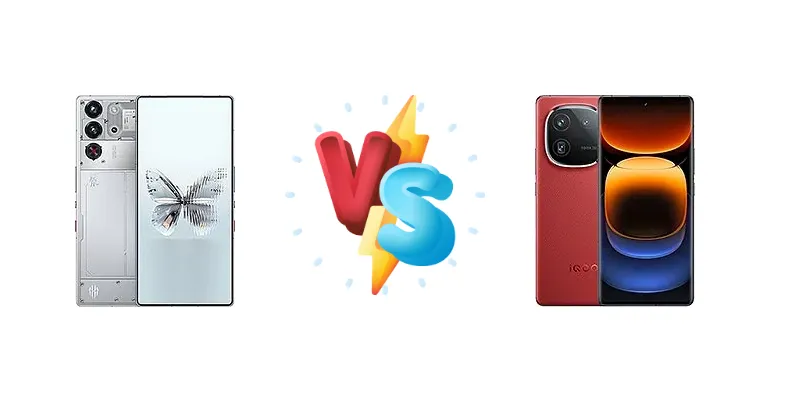
The ZTE nubia RedMagic 10 Pro+ and vivo iQOO 12 Pro represent two distinct approaches to the high-end Android smartphone market. The RedMagic prioritizes raw gaming performance with Qualcomm’s new Snapdragon 8 Elite, while the iQOO 12 Pro leverages the widely available Snapdragon 8 Gen 3, adding wireless charging and a broader feature set. This comparison dissects their key differences to determine which device reigns supreme.
🏆 Quick Verdict
For dedicated mobile gamers prioritizing sustained performance, the RedMagic 10 Pro+ edges out the iQOO 12 Pro thanks to the Snapdragon 8 Elite’s Oryon CPU cores and likely superior thermal design. However, the iQOO 12 Pro offers a more well-rounded experience with wireless charging and a potentially more refined software experience for the average user.
| Network |
|---|
| 2G bands | GSM 850 / 900 / 1800 / 1900 | GSM 850 / 900 / 1800 / 1900 |
| 3G bands | HSDPA 850 / 900 / 1700(AWS) / 1900 / 2100 | HSDPA 800 / 850 / 900 / 1700(AWS) / 1900 / 2100 |
| 4G bands | LTE | 1, 2, 3, 4, 5, 7, 8, 12, 17, 18, 19, 20, 25, 26, 28, 34, 38, 39, 40, 41, 42, 66 |
| 5G bands | SA/NSA | 1, 2, 3, 5, 7, 8, 12, 20, 25, 26, 28, 66, 38, 40, 41, 77, 78 SA/NSA |
| Speed | HSPA, LTE, 5G | HSPA, LTE, 5G |
| Technology | GSM / CDMA / HSPA / EVDO / LTE / 5G | GSM / CDMA / HSPA / CDMA2000 / LTE / 5G |
| Launch |
|---|
| Announced | 2024, November 13 | 2023, November 07 |
| Status | Available. Released 2024, November 18 | Available. Released 2023, November 14 |
| Body |
|---|
| Build | Glass front, aluminum frame, glass back | - |
| Dimensions | 163.4 x 76.1 x 8.9 mm (6.43 x 3.00 x 0.35 in) | 164.6 x 75.4 x 8.6 mm or 8.8 mm |
| SIM | Nano-SIM + Nano-SIM | Nano-SIM + Nano-SIM |
| Weight | 229 g (8.08 oz) | 205 g or 210 g (7.23 oz) |
| Display |
|---|
| Protection | Unspecified | - |
| Resolution | 1216 x 2688 pixels (~431 ppi density) | 1440 x 3200 pixels, 20:9 ratio (~518 ppi density) |
| Size | 6.85 inches, 113.7 cm2 (~91.4% screen-to-body ratio) | 6.78 inches, 111.0 cm2 (~89.4% screen-to-body ratio) |
| Type | AMOLED, 1B colors, 144Hz, 2000 nits (peak) | LTPO AMOLED, 1B colors, 144Hz, HDR10+, 1600 nits (HBM), 3000 nits (peak) |
| Platform |
|---|
| CPU | Octa-core (2x4.32 GHz Oryon V2 Phoenix L + 6x3.53 GHz Oryon V2 Phoenix M) | Octa-core (1x3.3 GHz Cortex-X4 & 3x3.2 GHz Cortex-A720 & 2x3.0 GHz Cortex-A720 & 2x2.3 GHz Cortex-A520) |
| Chipset | Qualcomm SM8750-AB Snapdragon 8 Elite (3 nm) | Qualcomm SM8650-AB Snapdragon 8 Gen 3 (4 nm) |
| GPU | Adreno 830 | Adreno 750 |
| OS | Android 15, Redmagic OS 10 | Android 14, up to 2 major Android upgrades, Funtouch 14 (International), OriginOS 4 (China) |
| Memory |
|---|
| Card slot | No | No |
| Internal | 512GB 16GB RAM, 1TB 24GB RAM | 256GB 16GB RAM, 512GB 16GB RAM, 1TB 16GB RAM |
| Main Camera |
|---|
| Features | LED flash, HDR, panorama | Color spectrum sensor, Dual-LED flash, HDR, panorama |
| Triple | 50 MP, f/1.9, (wide), 1/1.5", 1.0µm, PDAF, OIS
50 MP, f/2.2, (ultrawide), 1/2.88", 0.61µm
2 MP (macro) | 50 MP, f/1.7, 23mm (wide), 1/1.3", 1.2µm, ulti-directional PDAF, OIS
64 MP, f/2.6, 70mm (periscope telephoto), 1/2.0", PDAF, OIS, 3x optical zoom
50 MP, f/2.0, 15mm, 119˚ (ultrawide), AF |
| Video | 8K@30fps, 4K@30/60fps, 1080p@30/60/120/240fps | 8K@30fps, 4K@24/30/60fps, 1080p@30/60/120/240fps, gyro-EIS |
| Selfie camera |
|---|
| Features | HDR | HDR |
| Single | 16 MP, f/2.0, (wide), under display | 16 MP, f/2.5, (wide) |
| Video | 1080p@30/60fps | 1080p@30fps, gyro-EIS |
| Sound |
|---|
| 35mm jack | Yes | No |
| Loudspeaker | Yes, with stereo speakers | Yes, with stereo speakers |
| Comms |
|---|
| Bluetooth | 5.4, A2DP, LE | 5.4, A2DP, LE, aptX HD, aptX Adaptive, aptX Lossless |
| Infrared port | Yes | Yes |
| NFC | Yes (market/region dependent) | Yes |
| Positioning | GPS (L1+L5), GLONASS, BDS, GALILEO | GPS (L1+L5), GLONASS (G1), BDS (B1I+B1c+B2a), GALILEO (E1+E5a), QZSS (L1+L5) |
| Radio | No | No |
| USB | USB Type-C 3.2 Gen 2, OTG, accessory connector, DisplayPort | USB Type-C 2.0, OTG |
| WLAN | Wi-Fi 802.11 a/b/g/n/ac/6e/7, tri-band, Wi-Fi Direct | Wi-Fi 802.11 a/b/g/n/ac/6/7, tri-band, Wi-Fi Direct |
| Features |
|---|
| Sensors | Fingerprint (under display, optical), accelerometer, gyro, proximity, compass | Fingerprint (under display, ultrasonic), accelerometer, gyro, proximity, compass |
| Battery |
|---|
| Charging | 120W wired, 50% in 11 min, 100% in 30 min | 120W wired
50W wireless
10W reverse wireless |
| Type | Si/C Li-Ion 7050 mAh | 5100 mAh |
| Misc |
|---|
| Colors | Dark Knight, White Knight, Transparent Silver Deuterium, Transparent Dark Knight | Black, Red, White (BMW M branding) |
| Models | - | V2329A |
| Price | About 780 EUR | About 650 EUR |
ZTE nubia RedMagic 10 Pro+
- Snapdragon 8 Elite offers potentially higher sustained gaming performance.
- 3nm process should result in better thermal efficiency.
- Likely optimized for hardcore gaming with dedicated features.
- Lacks wireless charging.
- Potentially less refined camera system.
- Software may be less polished than iQOO.
vivo iQOO 12 Pro
- Fast 120W wired charging *and* 50W wireless charging.
- Potentially superior camera system with advanced image processing.
- More balanced feature set for everyday use.
- Snapdragon 8 Gen 3 may throttle more under sustained load.
- 4nm process is less efficient than the RedMagic's 3nm.
- Gaming performance may be slightly lower.
Display Comparison
While both devices likely feature high-refresh-rate AMOLED displays, the specifics are missing. However, the RedMagic series historically focuses on maximizing screen real estate for gaming, potentially resulting in a slightly larger display. The iQOO 12 Pro, benefiting from vivo’s display expertise, may offer superior color accuracy and brightness. The absence of LTPO information is notable; its presence would significantly impact power efficiency and adaptive refresh rate capabilities on either device.
Camera Comparison
Without detailed camera specifications, a direct comparison is difficult. However, both brands typically prioritize camera performance in their flagship models. The iQOO 12 Pro, given vivo’s strong camera reputation, likely features a more sophisticated image processing pipeline and potentially larger sensor sizes. The RedMagic, while capable, often focuses more on gaming features, potentially resulting in a less refined camera experience. We can assume both will offer capable main sensors, but details regarding OIS and lens apertures are crucial for a definitive assessment.
Performance
The core difference lies in the chipsets. The RedMagic 10 Pro+ utilizes the Qualcomm SM8750-AB Snapdragon 8 Elite, featuring a unique octa-core configuration with Oryon V2 Phoenix cores clocked up to 4.32 GHz. This architecture, designed by Nuvia, prioritizes single-core performance and efficiency. Conversely, the iQOO 12 Pro employs the Snapdragon 8 Gen 3 (4nm), a more conventional design with Cortex-X4 and Cortex-A720 cores peaking at 3.3 GHz. The 3nm process of the Snapdragon 8 Elite should translate to better thermal efficiency, potentially allowing for higher sustained clock speeds during prolonged gaming sessions. The iQOO 12 Pro’s 4nm node, while still excellent, will likely generate more heat under similar loads. Both devices will benefit from LPDDR5x RAM, but the RedMagic’s thermal advantage could be the deciding factor for demanding gamers.
Battery Life
Both phones offer 120W wired charging, promising a full charge in approximately 30 minutes. However, the iQOO 12 Pro adds 50W wireless charging and 10W reverse wireless charging, providing greater versatility. While the battery capacity isn’t specified, the iQOO 12 Pro’s wireless charging capabilities suggest a focus on convenience, potentially at the expense of slightly lower overall battery life compared to a device solely focused on maximizing wired charging efficiency like the RedMagic.
Buying Guide
Buy the ZTE nubia RedMagic 10 Pro+ if you absolutely need the highest possible sustained gaming frame rates and are willing to sacrifice features like wireless charging for that performance. Buy the vivo iQOO 12 Pro if you prefer a more balanced flagship experience with fast wired *and* wireless charging, a broader feature set, and a more mainstream software experience, even if it means slightly lower peak gaming performance.
Frequently Asked Questions
❓ Will the Snapdragon 8 Elite in the RedMagic 10 Pro+ overheat during extended gaming sessions?
The Snapdragon 8 Elite's 3nm process and likely advanced cooling system are designed to mitigate thermal throttling. While no phone is immune to heat, the RedMagic 10 Pro+ is positioned to offer superior sustained performance compared to devices with the Snapdragon 8 Gen 3, which may experience more noticeable throttling under prolonged heavy load.
❓ Does the iQOO 12 Pro support high frame rate gaming like 90fps or 120fps in popular titles?
The Snapdragon 8 Gen 3 is capable of supporting high frame rates in many games. However, achieving consistent 90fps or 120fps will depend on the game's optimization and graphics settings. The iQOO 12 Pro’s thermal management will play a crucial role in maintaining these frame rates over extended periods.
❓ How does the charging speed of 120W translate to real-world usage on both devices?
Both phones claim a full charge in around 30 minutes with 120W wired charging. However, charging speed typically slows down as the battery approaches full capacity. The iQOO 12 Pro’s 50W wireless charging offers a convenient alternative, though it will take considerably longer to fully charge.