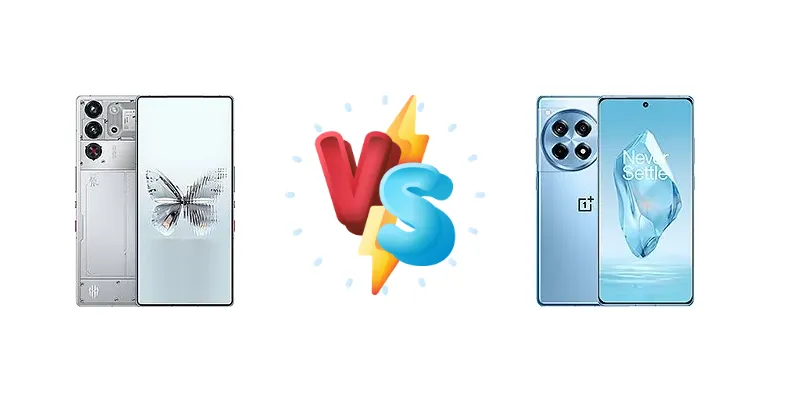
The ZTE nubia RedMagic 10 Pro+ and the OnePlus 12R represent distinct approaches to the Android flagship space. The RedMagic aggressively targets mobile gamers with cutting-edge processing power and cooling, while the OnePlus 12R aims for a more balanced experience, prioritizing battery life and everyday usability alongside strong performance. This comparison dissects their key differences to help you choose the right device.
🏆 Quick Verdict
For dedicated mobile gamers, the ZTE nubia RedMagic 10 Pro+ is the clear winner, leveraging the Snapdragon 8 Elite's superior CPU performance and likely more robust thermal design. However, the OnePlus 12R provides excellent value with its Snapdragon 8 Gen 2, impressive 14:32 hour battery life, and faster charging for the average user.
| Network |
|---|
| 2G bands | GSM 850 / 900 / 1800 / 1900 | GSM 850 / 900 / 1800 / 1900 |
| 3G bands | HSDPA 850 / 900 / 1700(AWS) / 1900 / 2100 | HSDPA 850 / 900 / 1700(AWS) / 1900 / 2100 |
| 4G bands | LTE | 1, 2, 3, 4, 5, 7, 8, 12, 17, 18, 19, 20, 26, 28, 32, 38, 39, 40, 41, 66 |
| 5G bands | SA/NSA | 1, 2, 3, 5, 7, 8, 12, 20, 28, 38, 40, 41, 66, 77, 78 SA/NSA |
| Speed | HSPA, LTE, 5G | HSPA, LTE, 5G |
| Technology | GSM / CDMA / HSPA / EVDO / LTE / 5G | GSM / CDMA / HSPA / LTE / 5G |
| Launch |
|---|
| Announced | 2024, November 13 | 2024, January 23 |
| Status | Available. Released 2024, November 18 | Available. Released 2024, February 06 |
| Body |
|---|
| Build | Glass front, aluminum frame, glass back | Glass front (Gorilla Glass Victus 2), aluminum frame, glass back |
| Dimensions | 163.4 x 76.1 x 8.9 mm (6.43 x 3.00 x 0.35 in) | 163.3 x 75.3 x 8.8 mm (6.43 x 2.96 x 0.35 in) |
| SIM | Nano-SIM + Nano-SIM | · Nano-SIM + Nano-SIM + eSIM (max 2 at a time)· Nano-SIM + Nano-SIM |
| Weight | 229 g (8.08 oz) | 207 g (7.30 oz) |
| Display |
|---|
| Protection | Unspecified | Corning Gorilla Glass Victus 2 |
| Resolution | 1216 x 2688 pixels (~431 ppi density) | 1264 x 2780 pixels (~450 ppi density) |
| Size | 6.85 inches, 113.7 cm2 (~91.4% screen-to-body ratio) | 6.78 inches, 111.7 cm2 (~90.9% screen-to-body ratio) |
| Type | AMOLED, 1B colors, 144Hz, 2000 nits (peak) | LTPO4 AMOLED, 1B colors, 120Hz, HDR10+, Dolby Vision, 1600 nits (HBM), 4500 nits (peak) |
| Platform |
|---|
| CPU | Octa-core (2x4.32 GHz Oryon V2 Phoenix L + 6x3.53 GHz Oryon V2 Phoenix M) | Octa-core (1x3.2 GHz Cortex-X3 & 2x2.8 GHz Cortex-A715 & 2x2.8 GHz Cortex-A710 & 3x2.0 GHz Cortex-A510) |
| Chipset | Qualcomm SM8750-AB Snapdragon 8 Elite (3 nm) | Qualcomm SM8550-AB Snapdragon 8 Gen 2 (4 nm) |
| GPU | Adreno 830 | Adreno 740 |
| OS | Android 15, Redmagic OS 10 | Android 14, up to 3 major Android upgrades, OxygenOS 15 |
| Memory |
|---|
| Card slot | No | No |
| Internal | 512GB 16GB RAM, 1TB 24GB RAM | 128GB 8GB RAM, 256GB 8GB RAM, 256GB 12GB RAM, 256GB 16GB RAM |
| Main Camera |
|---|
| Features | LED flash, HDR, panorama | Laser AF, color spectrum sensor, LED flash, HDR, panorama |
| Triple | 50 MP, f/1.9, (wide), 1/1.5", 1.0µm, PDAF, OIS
50 MP, f/2.2, (ultrawide), 1/2.88", 0.61µm
2 MP (macro) | 50 MP, f/1.8, 24mm (wide), 1/1.56", 1.0µm, multi-directional PDAF, OIS
8 MP, f/2.2, 16mm, 112˚ (ultrawide), 1/4.0", 1.12µm
2 MP (macro) |
| Video | 8K@30fps, 4K@30/60fps, 1080p@30/60/120/240fps | 4K@30/60fps, 1080p@30/60/120/240fps, gyro-EIS, OIS |
| Selfie camera |
|---|
| Features | HDR | HDR, panorama |
| Single | 16 MP, f/2.0, (wide), under display | 16 MP, f/2.4, 26mm (wide), 1/3", 1.0µm |
| Video | 1080p@30/60fps | 1080p@30fps, gyro-EIS |
| Sound |
|---|
| 35mm jack | Yes | No |
| Loudspeaker | Yes, with stereo speakers | Yes, with stereo speakers |
| Comms |
|---|
| Bluetooth | 5.4, A2DP, LE | 5.3, A2DP, LE, aptX HD |
| Infrared port | Yes | Yes |
| NFC | Yes (market/region dependent) | Yes |
| Positioning | GPS (L1+L5), GLONASS, BDS, GALILEO | GPS, GALILEO, GLONASS, BDS, QZSS |
| Radio | No | No |
| USB | USB Type-C 3.2 Gen 2, OTG, accessory connector, DisplayPort | USB Type-C 2.0 |
| WLAN | Wi-Fi 802.11 a/b/g/n/ac/6e/7, tri-band, Wi-Fi Direct | Wi-Fi 802.11 a/b/g/n/ac/6/7, dual-band |
| Features |
|---|
| Sensors | Fingerprint (under display, optical), accelerometer, gyro, proximity, compass | Fingerprint (under display, optical), accelerometer, gyro, proximity, compass |
| Battery |
|---|
| Charging | 120W wired, 50% in 11 min, 100% in 30 min | 100W wired, 100% in 26 min |
| Type | Si/C Li-Ion 7050 mAh | Li-Ion 5500 mAh |
| Misc |
|---|
| Colors | Dark Knight, White Knight, Transparent Silver Deuterium, Transparent Dark Knight | Iron Gray, Cool Blue, Electric Violet, Sunset Dune |
| Models | - | CPH2609, CPH2585, CPH2611 |
| Price | About 780 EUR | € 410.84 / $ 399.95 / £ 649.00 |
| SAR | - | 1.19 W/kg (head) 0.82 W/kg (body) |
ZTE nubia RedMagic 10 Pro+
- Superior CPU performance with Snapdragon 8 Elite
- Likely advanced cooling system for sustained gaming
- Faster charging speed (120W)
- Potentially shorter battery life
- Gaming-focused design may not appeal to all users
OnePlus 12R
- Excellent battery life (14:32 hours)
- Fast 100W charging
- Balanced performance for gaming and everyday use
- Less powerful CPU compared to Snapdragon 8 Elite
- May throttle under sustained heavy load
Display Comparison
While both phones likely feature high refresh rate displays, the provided data focuses on brightness. The OnePlus 12R boasts a measured peak brightness of 1181 nits, a strong figure for outdoor visibility. The RedMagic 10 Pro+’s display specifications are currently unavailable, but gaming phones often prioritize refresh rate over peak brightness. The OnePlus 12R’s brightness advantage will be noticeable in direct sunlight. We anticipate the RedMagic will focus on low-latency panel technology to enhance gaming responsiveness.
Camera Comparison
The provided data lacks detailed camera specifications for both devices. However, given the RedMagic’s gaming focus, we can expect the OnePlus 12R to offer a more comprehensive and refined camera system. The OnePlus brand historically prioritizes camera quality, and the 12R likely benefits from advanced image processing algorithms. Without specific sensor details, it’s difficult to make a definitive comparison, but the OnePlus 12R is likely to excel in image quality and versatility.
Performance
The core difference lies in the chipsets. The RedMagic 10 Pro+ utilizes the Qualcomm SM8750-AB Snapdragon 8 Elite (3nm), featuring a unique octa-core configuration with Oryon V2 Phoenix cores clocked up to 4.32 GHz. This represents a significant leap in CPU performance compared to the OnePlus 12R’s Snapdragon 8 Gen 2 (4nm). The Snapdragon 8 Gen 2, while still incredibly powerful, uses Cortex-X3 and Cortex-A715/A710 cores peaking at 3.2 GHz. The 3nm process of the Snapdragon 8 Elite should also offer improved power efficiency, though the RedMagic’s focus on sustained performance may necessitate more aggressive cooling. The RedMagic’s architecture is geared towards maximizing single-core and multi-core performance, crucial for demanding games.
Battery Life
The OnePlus 12R shines in battery performance, achieving an active use score of 14:32 hours. This suggests excellent power efficiency from the Snapdragon 8 Gen 2 and optimized software. The RedMagic 10 Pro+, while featuring a 120W charging solution (100% in 30 minutes), doesn’t have a reported battery life figure. The OnePlus 12R’s 100W charging (100% in 26 minutes) is also remarkably fast, but the longer battery life provides a significant advantage for users who don’t want to constantly reach for a charger. The RedMagic’s faster charging is beneficial for quick top-ups, but the OnePlus 12R offers greater peace of mind.
Buying Guide
Buy the ZTE nubia RedMagic 10 Pro+ if you demand the absolute highest frame rates in demanding games, prioritize a dedicated gaming experience with features like shoulder triggers, and are willing to trade some battery life for peak performance. Buy the OnePlus 12R if you value all-day battery life, fast 100W charging, a more refined software experience, and a balanced performance profile suitable for gaming and everyday tasks.
Frequently Asked Questions
❓ Will the Snapdragon 8 Elite in the RedMagic 10 Pro+ overheat during extended gaming sessions?
The Snapdragon 8 Elite is a powerful chip, and heat generation is a concern. However, RedMagic phones are known for their advanced cooling systems, often incorporating vapor chambers and active fans. While some throttling is inevitable, the RedMagic 10 Pro+ is likely to manage temperatures better than most phones, allowing for longer sustained gaming performance.
❓ Does the OnePlus 12R support high frame rate gaming, like 120fps in PUBG Mobile?
The Snapdragon 8 Gen 2 in the OnePlus 12R is capable of running PUBG Mobile at high frame rates, potentially up to 120fps depending on the graphics settings. However, achieving consistently high frame rates will depend on the phone's thermal management and the specific game settings chosen. Expect some compromises in graphics quality to maintain a smooth 120fps experience.
❓ How does the 3nm process of the Snapdragon 8 Elite impact real-world performance compared to the 4nm Snapdragon 8 Gen 2?
The 3nm process allows for a higher transistor density and improved power efficiency compared to the 4nm process. This translates to potentially higher performance at lower power consumption, or the ability to maintain higher performance for longer periods before thermal throttling occurs. While the difference may not be dramatically noticeable in all scenarios, the Snapdragon 8 Elite should offer a tangible advantage in demanding tasks like gaming.