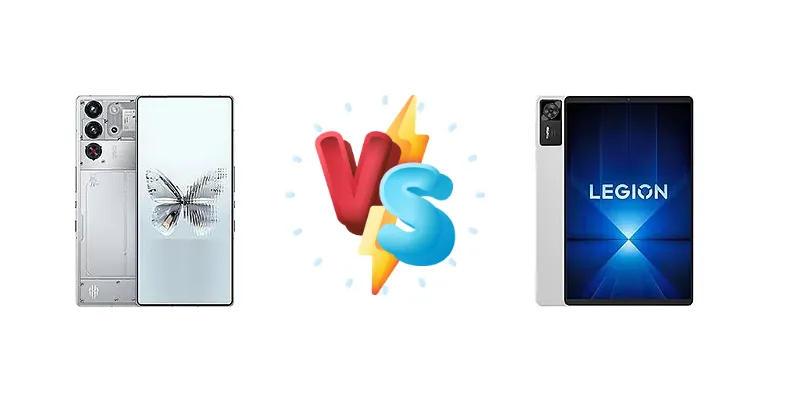
The mobile gaming landscape is fiercely competitive, and both ZTE’s RedMagic 10 Pro+ and Lenovo’s Legion Y700 (Gen 4) aim for the top spot. Both devices are powered by the cutting-edge Qualcomm Snapdragon 8 Elite (3nm), promising exceptional performance. However, their approaches to power delivery and overall user experience diverge significantly, making this a crucial comparison for serious mobile gamers.
🏆 Quick Verdict
For the user prioritizing absolute charging speed and a potentially more aggressive cooling profile, the ZTE nubia RedMagic 10 Pro+ is the clear winner. Its 120W charging dramatically reduces downtime. However, the Lenovo Legion Y700 (Gen 4) offers a more balanced approach with its 68W charging and potentially more refined power management.
| Network |
|---|
| 2G bands | GSM 850 / 900 / 1800 / 1900 | N/A |
| 3G bands | HSDPA 850 / 900 / 1700(AWS) / 1900 / 2100 | N/A |
| 4G bands | LTE | N/A |
| 5G bands | SA/NSA | - |
| EDGE | - | No |
| GPRS | - | No |
| Speed | HSPA, LTE, 5G | - |
| Technology | GSM / CDMA / HSPA / EVDO / LTE / 5G | No cellular connectivity |
| Launch |
|---|
| Announced | 2024, November 13 | 2025, May 08 |
| Status | Available. Released 2024, November 18 | Available. Released 2025, May |
| Body |
|---|
| Build | Glass front, aluminum frame, glass back | Glass front, aluminum frame, aluminum back |
| Dimensions | 163.4 x 76.1 x 8.9 mm (6.43 x 3.00 x 0.35 in) | 7 mm thickness |
| SIM | Nano-SIM + Nano-SIM | No |
| Weight | 229 g (8.08 oz) | 340 g (11.99 oz) |
| Display |
|---|
| Protection | Unspecified | - |
| Resolution | 1216 x 2688 pixels (~431 ppi density) | 1904 x 3040 pixels, 16:10 ratio (~408 ppi density) |
| Size | 6.85 inches, 113.7 cm2 (~91.4% screen-to-body ratio) | 8.8 inches, 224.8 cm2 |
| Type | AMOLED, 1B colors, 144Hz, 2000 nits (peak) | IPS LCD, 68B colors, 165Hz, HDR, 600 nits (typ) |
| Platform |
|---|
| CPU | Octa-core (2x4.32 GHz Oryon V2 Phoenix L + 6x3.53 GHz Oryon V2 Phoenix M) | Octa-core (2x4.32 GHz Oryon V2 Phoenix L + 6x3.53 GHz Oryon V2 Phoenix M) |
| Chipset | Qualcomm SM8750-AB Snapdragon 8 Elite (3 nm) | Qualcomm SM8750-AB Snapdragon 8 Elite (3 nm) |
| GPU | Adreno 830 | Adreno 830 |
| OS | Android 15, Redmagic OS 10 | Android 15 |
| Memory |
|---|
| Card slot | No | microSDXC |
| Internal | 512GB 16GB RAM, 1TB 24GB RAM | 256GB 12GB RAM, 512GB 16GB RAM, 1TB 16GB RAM |
| Main Camera |
|---|
| Features | LED flash, HDR, panorama | LED flash |
| Single | - | 50 MP, (wide), PDAF |
| Triple | 50 MP, f/1.9, (wide), 1/1.5", 1.0µm, PDAF, OIS
50 MP, f/2.2, (ultrawide), 1/2.88", 0.61µm
2 MP (macro) | - |
| Video | 8K@30fps, 4K@30/60fps, 1080p@30/60/120/240fps | Yes |
| Selfie camera |
|---|
| Features | HDR | - |
| Single | 16 MP, f/2.0, (wide), under display | 8 MP |
| Video | 1080p@30/60fps | 1080p@30fps |
| Sound |
|---|
| 35mm jack | Yes | No |
| Loudspeaker | Yes, with stereo speakers | Yes, with stereo speakers |
| Comms |
|---|
| Bluetooth | 5.4, A2DP, LE | Yes |
| Infrared port | Yes | - |
| NFC | Yes (market/region dependent) | No |
| Positioning | GPS (L1+L5), GLONASS, BDS, GALILEO | No |
| Radio | No | Unspecified |
| USB | USB Type-C 3.2 Gen 2, OTG, accessory connector, DisplayPort | 1x USB Type-C 2.0 & 1x USB Type-C 3.2 Gen2, DisplayPort 1.4 |
| WLAN | Wi-Fi 802.11 a/b/g/n/ac/6e/7, tri-band, Wi-Fi Direct | Yes |
| Features |
|---|
| Sensors | Fingerprint (under display, optical), accelerometer, gyro, proximity, compass | Unspecified |
| Battery |
|---|
| Charging | 120W wired, 50% in 11 min, 100% in 30 min | 68W wired
Bypass charging |
| Type | Si/C Li-Ion 7050 mAh | Li-Po 7600 mAh |
| Misc |
|---|
| Colors | Dark Knight, White Knight, Transparent Silver Deuterium, Transparent Dark Knight | Black, White |
| Models | - | TB322FC, ZAG40002CN |
| Price | About 780 EUR | About 400 EUR |
ZTE nubia RedMagic 10 Pro+
- Ultra-fast 120W charging for minimal downtime
- Potentially more aggressive cooling for sustained peak performance
- Gaming-focused design and features
- Potentially shorter battery lifespan due to faster charging
- Aggressive cooling may result in louder fan noise
Lenovo Legion Y700 (Gen 4)
- Bypass charging for cooler gaming and extended battery life
- Potentially more balanced thermal management
- Efficient power delivery for longer sustained performance
- Slower 68W charging compared to the RedMagic 10 Pro+
- May throttle slightly sooner under extreme load
Display Comparison
While both devices likely feature high refresh rate AMOLED displays (data not provided), the key differentiator will be panel calibration and peak brightness. The RedMagic series historically prioritizes color vibrancy for immersive gaming, while Lenovo often aims for more accurate color reproduction. The absence of specific display specs necessitates further testing, but the RedMagic’s focus on gaming suggests a higher peak brightness for better visibility in bright conditions. Bezels are also a critical factor, impacting immersion; a closer look at physical dimensions is needed to determine which device offers a more expansive viewing experience.
Camera Comparison
Given the gaming focus of both devices, camera performance is likely secondary. However, the RedMagic 10 Pro+ may incorporate a more advanced camera system to broaden its appeal beyond gaming. Without specific sensor details, it’s difficult to make a definitive comparison. The presence of Optical Image Stabilization (OIS) on the primary sensor would be a significant advantage for either device, improving low-light image quality and video stabilization. We anticipate both phones will feature multiple lenses, but the quality of the image processing algorithms will be the deciding factor.
Performance
Both the ZTE nubia RedMagic 10 Pro+ and the Lenovo Legion Y700 (Gen 4) utilize the Qualcomm SM8750-AB Snapdragon 8 Elite (3 nm) chipset, featuring an Octa-core CPU configuration (2x4.32 GHz Oryon V2 Phoenix L + 6x3.53 GHz Oryon V2 Phoenix M). This means raw CPU performance will be virtually identical. The crucial difference lies in thermal management. RedMagic phones are known for aggressive cooling solutions, potentially allowing for sustained peak performance for longer durations, but at the cost of increased fan noise. Lenovo’s Legion series typically employs a more balanced approach, prioritizing sustained performance without excessive noise. RAM speed (likely LPDDR5x in both) will also play a role, but the chipset is the primary performance bottleneck.
Battery Life
The most significant difference between these two devices is their charging capabilities. The RedMagic 10 Pro+ boasts 120W wired charging, capable of reaching 50% charge in just 11 minutes and 100% in 30 minutes. This is a substantial advantage for users who need to quickly top up their battery. The Legion Y700 (Gen 4), with its 68W wired charging, is considerably slower. However, the Legion Y700 includes 'bypass charging,' which allows the device to be powered directly from the charger while gaming, reducing heat generation and potentially extending battery life during long gaming sessions. This feature is a significant benefit for hardcore gamers.
Buying Guide
Buy the ZTE nubia RedMagic 10 Pro+ if you need the fastest possible charging speeds and are willing to potentially trade off some battery longevity for peak performance during extended gaming sessions. Buy the Lenovo Legion Y700 (Gen 4) if you prefer a more balanced experience, valuing efficient power delivery and potentially longer sustained performance due to its bypass charging feature, even if it means slower top-ups.
Frequently Asked Questions
❓ Does the RedMagic 10 Pro+'s 120W charging degrade the battery faster over time?
While 120W charging is incredibly fast, modern battery management systems mitigate much of the potential degradation. However, consistently using ultra-fast charging *can* contribute to slightly faster battery wear compared to slower charging speeds. The RedMagic 10 Pro+ likely incorporates safeguards to minimize this effect, but long-term battery health will still be a factor.
❓ How effective is the Lenovo Legion Y700 (Gen 4)'s bypass charging during demanding games like Genshin Impact?
The bypass charging feature on the Legion Y700 (Gen 4) is designed to significantly reduce heat buildup during gaming by powering the device directly from the charger. This allows the phone to maintain higher clock speeds for longer periods without thermal throttling, resulting in smoother gameplay and potentially higher frame rates in demanding titles like Genshin Impact. It also reduces stress on the internal battery.
❓ Will both phones get hot during extended gaming sessions?
Yes, both phones will generate heat during prolonged gaming. The RedMagic 10 Pro+ likely relies on aggressive cooling (fans, vapor chamber) to manage this heat, potentially resulting in noticeable fan noise. The Legion Y700 (Gen 4) aims for a more balanced approach, potentially throttling slightly sooner to maintain a comfortable temperature.