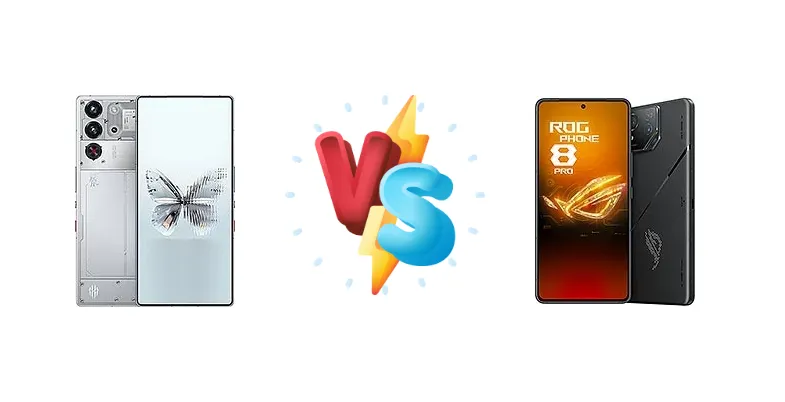
The ZTE nubia RedMagic 10 Pro+ and the Asus ROG Phone 8 Pro represent the pinnacle of Android gaming phone design. While both aim to deliver an unparalleled mobile gaming experience, they take distinctly different approaches. The RedMagic 10 Pro+ aggressively pursues peak performance with Qualcomm’s newest Snapdragon 8 Elite, while the ROG Phone 8 Pro focuses on a more holistic package, balancing power with battery endurance and usability.
🏆 Quick Verdict
For the hardcore gamer prioritizing absolute, untethered performance, the ZTE nubia RedMagic 10 Pro+ is the winner. Its Snapdragon 8 Elite chipset offers a demonstrable speed advantage. However, the Asus ROG Phone 8 Pro provides a more refined, all-around experience with superior battery life and a brighter display, making it the better choice for everyday use alongside gaming.
| Network |
|---|
| 2G bands | GSM 850 / 900 / 1800 / 1900 | GSM 850 / 900 / 1800 / 1900 |
| 3G bands | HSDPA 850 / 900 / 1700(AWS) / 1900 / 2100 | HSDPA 850 / 900 / 1700(AWS) / 1800 / 1900 / 2100 - International |
| 4G bands | LTE | 1, 2, 3, 4, 5, 7, 8, 12, 17, 18, 19, 20, 25, 26, 28, 32, 34, 38, 39, 40, 41, 42, 43, 48, 66 - International |
| 5G bands | SA/NSA | 1, 2, 3, 5, 7, 8, 12, 18, 20, 25, 26, 28, 38, 40, 41, 48, 66, 77, 78, 79 SA/NSA/Sub6 - International |
| Speed | HSPA, LTE, 5G | HSPA, LTE (Up to 7CA), 5G |
| Technology | GSM / CDMA / HSPA / EVDO / LTE / 5G | GSM / CDMA / HSPA / LTE / 5G |
| Launch |
|---|
| Announced | 2024, November 13 | 2024, January 08 |
| Status | Available. Released 2024, November 18 | Available. Released 2024, January 18 |
| Body |
|---|
| Build | Glass front, aluminum frame, glass back | Glass front (Gorilla Glass Victus 2), glass back (Gorilla Glass), aluminum frame |
| Dimensions | 163.4 x 76.1 x 8.9 mm (6.43 x 3.00 x 0.35 in) | 163.8 x 76.8 x 8.9 mm (6.45 x 3.02 x 0.35 in) |
| SIM | Nano-SIM + Nano-SIM | Nano-SIM + Nano-SIM |
| Weight | 229 g (8.08 oz) | 225 g (7.94 oz) |
| Display |
|---|
| Protection | Unspecified | Corning Gorilla Glass Victus 2 |
| Resolution | 1216 x 2688 pixels (~431 ppi density) | 1080 x 2400 pixels, 20:9 ratio (~388 ppi density) |
| Size | 6.85 inches, 113.7 cm2 (~91.4% screen-to-body ratio) | 6.78 inches, 111.0 cm2 (~88.2% screen-to-body ratio) |
| Type | AMOLED, 1B colors, 144Hz, 2000 nits (peak) | LTPO AMOLED, 1B colors, 165Hz, HDR10, 1600 nits (HBM), 2500 nits (peak) |
| Platform |
|---|
| CPU | Octa-core (2x4.32 GHz Oryon V2 Phoenix L + 6x3.53 GHz Oryon V2 Phoenix M) | Octa-core (1x3.3 GHz Cortex-X4 & 3x3.2 GHz Cortex-A720 & 2x3.0 GHz Cortex-A720 & 2x2.3 GHz Cortex-A520) |
| Chipset | Qualcomm SM8750-AB Snapdragon 8 Elite (3 nm) | Qualcomm SM8650-AB Snapdragon 8 Gen 3 (4 nm) |
| GPU | Adreno 830 | Adreno 750 |
| OS | Android 15, Redmagic OS 10 | Android 14, up to 2 major Android upgrades |
| Memory |
|---|
| Card slot | No | No |
| Internal | 512GB 16GB RAM, 1TB 24GB RAM | 512GB 16GB RAM, 1TB 24GB RAM |
| Main Camera |
|---|
| Features | LED flash, HDR, panorama | LED flash, HDR, panorama |
| Triple | 50 MP, f/1.9, (wide), 1/1.5", 1.0µm, PDAF, OIS
50 MP, f/2.2, (ultrawide), 1/2.88", 0.61µm
2 MP (macro) | 50 MP, f/1.9, 24mm (wide), 1/1.56", 1.0µm, PDAF, gimbal OIS
32 MP, f/2.4, (telephoto), 1/3.2", 0.7µm, PDAF, OIS, 3x optical zoom
13 MP, f/2.2, 13mm, 120˚ (ultrawide) |
| Video | 8K@30fps, 4K@30/60fps, 1080p@30/60/120/240fps | 8K@24fps, 4K@30/60fps, 1080p@30/60/120/240fps, 720p@480fps; gyro-EIS, HDR10+ |
| Selfie camera |
|---|
| Features | HDR | Panorama, HDR |
| Single | 16 MP, f/2.0, (wide), under display | 32 MP, f/2.5, 22mm (wide), 1/3.2", 0.7µm |
| Video | 1080p@30/60fps | 1080p@30fps |
| Sound |
|---|
| 35mm jack | Yes | Yes |
| Loudspeaker | Yes, with stereo speakers | Yes, with stereo speakers |
| Comms |
|---|
| Bluetooth | 5.4, A2DP, LE | 5.4, A2DP, LE, aptX HD, aptX Adaptive, aptX Lossless |
| Infrared port | Yes | - |
| NFC | Yes (market/region dependent) | Yes |
| Positioning | GPS (L1+L5), GLONASS, BDS, GALILEO | GPS (L1+L5), BDS (B1I+B1c+B2a), GALILEO (E1+E5a), QZSS (L1+L5), NavIC (L5), GLONASS |
| Radio | No | No |
| USB | USB Type-C 3.2 Gen 2, OTG, accessory connector, DisplayPort | USB Type-C (side), DisplayPort 1.4; USB Type-C (bottom), OTG |
| WLAN | Wi-Fi 802.11 a/b/g/n/ac/6e/7, tri-band, Wi-Fi Direct | Wi-Fi 802.11 a/b/g/n/ac/6e/7, tri-band, Wi-Fi Direct |
| Features |
|---|
| Sensors | Fingerprint (under display, optical), accelerometer, gyro, proximity, compass | Fingerprint (under display, optical), accelerometer, gyro, proximity, compass |
| Battery |
|---|
| Charging | 120W wired, 50% in 11 min, 100% in 30 min | 65W wired, PD3.0, PPS, QC5, 100% in 39 min - International
30W wired, PD3.0, PPS - India
15W wireless (Qi)
10W reverse wired |
| Type | Si/C Li-Ion 7050 mAh | 5500 mAh |
| Misc |
|---|
| Colors | Dark Knight, White Knight, Transparent Silver Deuterium, Transparent Dark Knight | Phantom Black |
| Models | - | AI2401, AI2401_A, AI2401_D |
| Price | About 780 EUR | $ 1,157.98 / £ 1,693.75 / € 632.66 |
ZTE nubia RedMagic 10 Pro+
- Unmatched CPU performance with Snapdragon 8 Elite
- Blazing-fast 120W charging
- Potentially superior thermal management due to 3nm process
- Battery life likely shorter than ROG Phone 8 Pro
- Camera specifications unknown, potentially weaker than ROG Phone
Asus ROG Phone 8 Pro
- Excellent battery life (14:43h active use)
- Brighter, more color-accurate display (1765 nits)
- Versatile camera system with OIS
- Slower charging speeds (65W/30W)
- Chipset performance lags behind Snapdragon 8 Elite
Display Comparison
The Asus ROG Phone 8 Pro boasts a significantly brighter display, reaching a measured 1765 nits, ensuring excellent visibility even in direct sunlight. While the RedMagic 10 Pro+’s display specs are not provided, it’s likely to be a high-refresh-rate panel, but it will struggle to match the ROG Phone’s peak brightness. The ROG Phone’s display technology likely incorporates LTPO for adaptive refresh rates, improving power efficiency. The ROG Phone’s superior brightness is a clear advantage for outdoor gaming and media consumption.
Camera Comparison
The context data for the RedMagic 10 Pro+ lacks camera specifications, making a direct comparison difficult. However, ROG Phones traditionally prioritize a versatile camera system. The ROG Phone 8 Pro likely features a capable photo and video setup, with a focus on image stabilization and dynamic range. Without specific details on the RedMagic’s camera, it’s reasonable to assume the ROG Phone 8 Pro offers a more refined and feature-rich camera experience. The inclusion of OIS on the ROG Phone is a likely advantage for video recording.
Performance
The core difference lies in the chipsets. The RedMagic 10 Pro+ utilizes the Qualcomm SM8750-AB Snapdragon 8 Elite (3nm), featuring a unique octa-core configuration with Oryon V2 Phoenix cores clocked up to 4.32 GHz. This architecture is designed for maximum single-core and multi-core performance. The ROG Phone 8 Pro, conversely, employs the Snapdragon 8 Gen 3 (4nm) with a more conventional core arrangement, peaking at 3.3 GHz. While the 4nm process of the Gen 3 offers good efficiency, the 3nm node of the 8 Elite provides a theoretical advantage in power efficiency and transistor density, potentially leading to higher sustained performance. The RedMagic’s chipset is expected to deliver a noticeable edge in CPU-intensive tasks and gaming.
Battery Life
The ROG Phone 8 Pro shines in battery endurance, achieving an active use score of 14 hours and 43 minutes. The RedMagic 10 Pro+ compensates for a potentially smaller battery with incredibly fast 120W wired charging, reaching 50% in just 11 minutes and 100% in 30 minutes. The ROG Phone 8 Pro’s 65W charging (international) or 30W (India) is significantly slower, taking 39 minutes for a full charge. While the RedMagic prioritizes speed, the ROG Phone offers substantially longer unplugged usage. The ROG Phone also offers 15W wireless charging and 10W reverse wired charging, features absent on the RedMagic.
Buying Guide
Buy the ZTE nubia RedMagic 10 Pro+ if you demand the highest possible frame rates in demanding games, prioritize raw CPU and GPU power, and are willing to trade some battery life for that performance. Buy the Asus ROG Phone 8 Pro if you value a balanced experience, need all-day battery life, appreciate a brighter, more color-accurate display, and want a phone that excels beyond just gaming.
Frequently Asked Questions
❓ Does the Snapdragon 8 Elite in the RedMagic 10 Pro+ generate excessive heat during prolonged gaming sessions?
While the 3nm process should improve thermal efficiency, the Snapdragon 8 Elite's aggressive clock speeds could still lead to heat generation. The RedMagic 10 Pro+ likely employs advanced cooling solutions (vapor chamber, fan) to mitigate this, but sustained peak performance may still result in some throttling.
❓ How does the charging speed difference impact daily use? Is 120W charging truly necessary?
The RedMagic 10 Pro+'s 120W charging is a game-changer for quick top-ups. If you frequently find yourself needing to charge rapidly during short breaks, it's a significant advantage. However, the ROG Phone 8 Pro's 65W charging is still respectable and sufficient for overnight charging.
❓ What gaming-specific features does the Asus ROG Phone 8 Pro offer beyond the chipset?
The ROG Phone 8 Pro includes features like AirTriggers (shoulder buttons), a customizable RGB lighting system, and dedicated gaming software (Armoury Crate) for performance optimization and game customization. These features enhance the gaming experience beyond raw processing power.
❓ Is the difference in chipset performance between the Snapdragon 8 Elite and Gen 3 noticeable in real-world gaming scenarios?
The difference will be most apparent in demanding titles at maximum settings. While both chipsets are capable, the Snapdragon 8 Elite's higher clock speeds and architectural advantages should translate to higher and more stable frame rates in graphically intensive games.