
ZTE nubia RedMagic 10 Pro vs Xiaomi 14 Pro: A Deep Dive into Gaming and Flagship Performance
| Phones Images | |||||
|---|---|---|---|---|---|
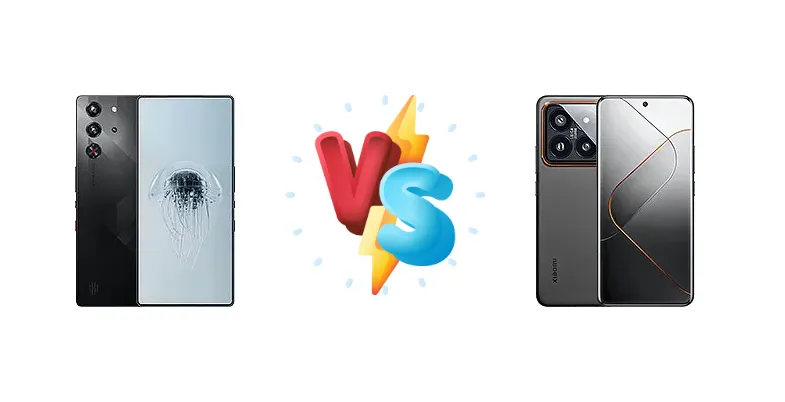
|
🏆 Quick Verdict
For dedicated mobile gamers, the ZTE nubia RedMagic 10 Pro is the clear winner, offering superior sustained performance thanks to its Snapdragon 8 Elite and advanced cooling. However, the Xiaomi 14 Pro provides a more refined all-around experience with faster charging and a potentially more versatile camera system, making it the better choice for mainstream users.
| PHONES | ||
|---|---|---|
| Phone Names | ZTE nubia RedMagic 10 Pro | Xiaomi 14 Pro |
| Network | ||
|---|---|---|
| 2G bands | GSM 850 / 900 / 1800 / 1900 | GSM 850 / 900 / 1800 / 1900 |
| 3G bands | HSDPA 800 / 850 / 900 / 1700(AWS) / 1900 / 2100 | HSDPA 800 / 850 / 900 / 1700(AWS) / 1900 / 2100 |
| 4G bands | 1, 2, 3, 4, 5, 7, 8, 12, 17, 18, 19, 20, 26, 28, 34, 38, 39, 40, 41, 42, 66 | 1, 3, 4, 5, 7, 8, 18, 19, 26, 28, 34, 38, 39, 40, 41, 42, 48, 66 |
| 5G bands | 1, 2, 3, 5, 7, 8, 20, 26, 28, 38, 40, 41, 66, 71, 77, 78 SA/NSA | 1, 3, 5, 7, 8, 28, 38, 40, 41, 48, 66, 77, 78, 79 SA/NSA |
| Speed | HSPA, LTE, 5G | HSPA, LTE, 5G |
| Technology | GSM / CDMA / HSPA / EVDO / LTE / 5G | GSM / CDMA / HSPA / CDMA2000 / LTE / 5G |
| Launch | ||
|---|---|---|
| Announced | 2024, November 13 | 2023, October 26 |
| Status | Available. Released 2024, November 18 | Available. Released 2023, November 01 |
| Body | ||
|---|---|---|
| Build | Glass front, aluminum frame, glass back | Glass front, aluminum frame or titanium frame, glass back |
| Dimensions | 163.4 x 76.1 x 8.9 mm (6.43 x 3.00 x 0.35 in) | 161.4 x 75.3 x 8.5 mm |
| SIM | Nano-SIM + Nano-SIM | Nano-SIM + Nano-SIM |
| Weight | 229 g (8.08 oz) | 223 g or 230 g (7.87 oz) |
| Display | ||
|---|---|---|
| Protection | Corning Gorilla Glass (unspecified version) | Shatterproof glass |
| Resolution | 1216 x 2688 pixels (~431 ppi density) | 1440 x 3200 pixels, 20:9 ratio (~522 ppi density) |
| Size | 6.85 inches, 113.7 cm2 (~91.4% screen-to-body ratio) | 6.73 inches, 108.9 cm2 (~89.6% screen-to-body ratio) |
| Type | AMOLED, 1B colors, 2592Hz PWM, 144Hz, 2000 nits (peak) | LTPO AMOLED, 68B colors, 120Hz, Dolby Vision, HDR10+, 3000 nits (peak) |
| Platform | ||
|---|---|---|
| CPU | Octa-core (2x4.32 GHz Oryon V2 Phoenix L + 6x3.53 GHz Oryon V2 Phoenix M) | Octa-core (1x3.3 GHz Cortex-X4 & 3x3.2 GHz Cortex-A720 & 2x3.0 GHz Cortex-A720 & 2x2.3 GHz Cortex-A520) |
| Chipset | Qualcomm SM8750-AB Snapdragon 8 Elite (3 nm) | Qualcomm SM8650-AB Snapdragon 8 Gen 3 (4 nm) |
| GPU | Adreno 830 | Adreno 750 |
| OS | Android 15, up to 1 major Android update and 2 Redmagic OS updates, Redmagic OS 10 | Android 14, HyperOS |
| Memory | ||
|---|---|---|
| Card slot | No | No |
| Internal | 256GB 12GB RAM, 512GB 12GB RAM, 512GB 16GB RAM, 1TB 24GB RAM | 256GB 12GB RAM, 512GB 16GB RAM, 1TB 16GB RAM |
| Main Camera | ||
|---|---|---|
| Features | LED flash, HDR, panorama | Laser AF, color spectrum sensor, Leica lens, Dual-LED dual-tone flash, HDR, panorama |
| Triple | 50 MP, f/1.9, (wide), 1/1.55", 1.0µm, PDAF, OIS 50 MP, f/2.2, (ultrawide), 1/2.88", 0.61µm 2 MP (macro) | 50 MP, f/1.4-f/4.0, 23mm (wide), 1/1.31", 1.2µm, dual pixel PDAF, OIS 50 MP, f/2.0, 75mm (telephoto), PDAF (10cm - ∞), OIS, 3.2x optical zoom 50 MP, f/2.2, 14mm, 115˚ (ultrawide), AF |
| Video | 8K@30fps, 4K@30/60fps, 1080p@30/60/120/240fps | 8K@24fps (HDR), 4K@24/30/60fps (HDR10+, 10-bit Dolby Vision HDR, 10-bit LOG), 1080p@30/60/120/240/960fps, 720p@1920fps, gyro-EIS |
| Selfie camera | ||
|---|---|---|
| Features | HDR | HDR, panorama |
| Single | 16 MP, f/2.0, (wide), 1/2.8", 1.12µm, under display | 32 MP, f/2.0, 22mm (wide), 0.7µm |
| Video | 1080p@30/60fps | 4K@30/60fps, 1080p@30/60fps, gyro-EIS |
| Sound | ||
|---|---|---|
| 35mm jack | Yes | No |
| Loudspeaker | Yes, with stereo speakers | Yes, with stereo speakers |
| Comms | ||
|---|---|---|
| Bluetooth | 5.4, A2DP, LE | 5.4, A2DP, LE, aptX HD, aptX Adaptive |
| Infrared port | Yes | Yes |
| NFC | Yes (market/region dependent) | Yes |
| Positioning | GPS (L1+L5), GLONASS, BDS, GALILEO | GPS (L1+L5), GLONASS (G1), BDS (B1I+B1c+B2a), GALILEO (E1+E5a), QZSS (L1+L5), NavIC (L5) |
| Radio | No | No |
| USB | USB Type-C 3.2 Gen 2, OTG, accessory connector, DisplayPort | USB Type-C 3.2 Gen 2, OTG |
| WLAN | Wi-Fi 802.11 a/b/g/n/ac/6/7, tri-band, Wi-Fi Direct | Wi-Fi 802.11 a/b/g/n/ac/6e/7, dual-band, Wi-Fi Direct |
| Features | ||
|---|---|---|
| Sensors | Fingerprint (under display, optical), accelerometer, gyro, proximity, compass | Fingerprint (under display, optical), accelerometer, proximity, gyro, compass, barometer |
| Battery | ||
|---|---|---|
| Charging | 100W wired - International 80W wired - China only version | 120W wired, PD3.0, QC4, 100% in 18 min 50W wireless, 100% in 40 min 10W reverse wireless |
| Type | Market-dependent versions:· Si/C Li-Ion 7050 mAh (Global)· Si/C Li-Ion 6500 mAh (China only) | Li-Po 4880 mAh |
| Misc | ||
|---|---|---|
| Colors | Moonlight (Transparent Silver Deuterium), Dusk (Transparent Dark Knight), Shadow (Dark Knight), White Knight, Lightspeed | Black, Silver, Titanium, Green |
| Models | - | 23116PN5BC |
| Price | € 700.99 | About 650 EUR |
ZTE nubia RedMagic 10 Pro
- Superior sustained gaming performance
- Excellent battery life (17:13h active use)
- Advanced cooling system minimizes throttling
- Less versatile camera system
- Slower charging speeds compared to Xiaomi 14 Pro
Xiaomi 14 Pro
- Ultra-fast 120W wired charging (18 min 0-100%)
- 50W wireless and 10W reverse wireless charging
- Potentially more versatile camera system
- May throttle under sustained heavy load
- Potentially shorter battery life compared to RedMagic 10 Pro
Display Comparison
The nubia RedMagic 10 Pro boasts a peak brightness of 1596 nits, ensuring excellent visibility even in direct sunlight. While the Xiaomi 14 Pro’s brightness isn’t specified, Xiaomi typically delivers competitive displays. The RedMagic’s focus on gaming likely prioritizes refresh rate and response time, but without further data, it’s difficult to assess the panel technology differences beyond peak brightness. Both are likely to employ LTPO technology for variable refresh rates, conserving battery life. The RedMagic’s design likely prioritizes maximizing screen real estate for immersion, potentially at the expense of extremely thin bezels like those found on the Xiaomi 14 Pro.
Camera Comparison
Without detailed camera specifications for the Xiaomi 14 Pro, a direct comparison is limited. However, Xiaomi flagships consistently deliver excellent camera performance, often featuring large sensors and advanced image processing. The Xiaomi 14 Pro is expected to have a more versatile camera system, potentially including a telephoto lens for optical zoom, which is absent from the RedMagic’s focus on gaming. The RedMagic 10 Pro likely prioritizes functional camera capabilities over cutting-edge features. The Xiaomi’s image processing will likely lean towards vibrant, social media-ready photos, while the RedMagic may offer a more natural look.
Performance
The core difference lies in the chipsets: the RedMagic 10 Pro utilizes the Qualcomm SM8750-AB Snapdragon 8 Elite (3nm), while the Xiaomi 14 Pro features the SM8650-AB Snapdragon 8 Gen 3 (4nm). The Snapdragon 8 Elite, with its Oryon V2 Phoenix cores (2x4.32 GHz + 6x3.53 GHz), is architecturally designed for sustained peak performance, potentially outperforming the Snapdragon 8 Gen 3 (1x3.3 GHz Cortex-X4, 3x3.2 GHz Cortex-A720, 2x3.0 GHz Cortex-A720, 2x2.3 GHz Cortex-A520) in prolonged gaming scenarios. The 3nm process of the 8 Elite offers improved thermal efficiency, reducing throttling. While the 8 Gen 3 is a powerhouse, the RedMagic’s chipset is specifically tuned for gaming. Both devices will likely feature LPDDR5x RAM, but the RedMagic’s cooling system is a critical differentiator, allowing it to maintain higher clock speeds for longer.
Battery Life
The RedMagic 10 Pro offers 100W wired charging (International) or 80W (China), while the Xiaomi 14 Pro boasts a significantly faster 120W wired charging, achieving a full charge in just 18 minutes. The Xiaomi 14 Pro also includes 50W wireless charging and 10W reverse wireless charging, features absent on the RedMagic. The RedMagic 10 Pro’s active use battery score of 17:13h is impressive, suggesting excellent battery optimization despite its focus on performance. While the Xiaomi 14 Pro’s battery capacity isn’t specified, the faster charging speeds compensate for any potential capacity difference, offering quicker top-ups.
Buying Guide
Buy the ZTE nubia RedMagic 10 Pro if you demand the longest possible gaming sessions without throttling, prioritize battery life above all else, and appreciate gaming-centric features like dedicated triggers. Buy the Xiaomi 14 Pro if you value a balanced flagship experience, need the fastest possible charging speeds (both wired and wireless), and want a more polished software experience with a strong emphasis on photography.