
ZTE nubia RedMagic 10 Air vs. Xiaomi 14 Pro: A Deep Dive into Gaming and Charging
| Phones Images | |||||
|---|---|---|---|---|---|
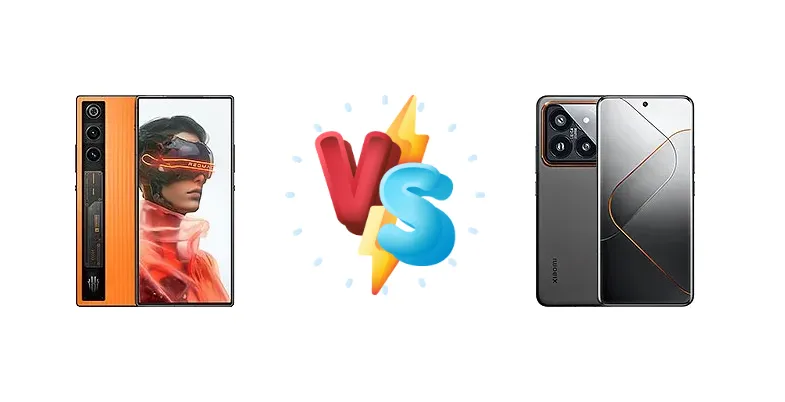
|
🏆 Quick Verdict
For the average user, the Xiaomi 14 Pro emerges as the more versatile choice. Its 120W charging, reaching 100% in just 18 minutes, significantly reduces downtime. However, gamers who prioritize extended play sessions will find the RedMagic 10 Air’s superior 57:57h battery endurance invaluable.
| PHONES | ||
|---|---|---|
| Phone Names | ZTE nubia RedMagic 10 Air | Xiaomi 14 Pro |
| Network | ||
|---|---|---|
| 2G bands | GSM 850 / 900 / 1800 / 1900 | GSM 850 / 900 / 1800 / 1900 |
| 3G bands | HSDPA 800 / 850 / 900 / 1700(AWS) / 1900 / 2100 | HSDPA 800 / 850 / 900 / 1700(AWS) / 1900 / 2100 |
| 4G bands | 1, 2, 3, 4, 5, 7, 8, 12, 17, 18, 19, 20, 26, 28, 34, 38, 39, 40, 41, 42, 66 | 1, 3, 4, 5, 7, 8, 18, 19, 26, 28, 34, 38, 39, 40, 41, 42, 48, 66 |
| 5G bands | 1, 2, 3, 5, 7, 8, 20, 26, 28, 38, 40, 41, 66, 77, 78 SA/NSA | 1, 3, 5, 7, 8, 28, 38, 40, 41, 48, 66, 77, 78, 79 SA/NSA |
| Speed | HSPA, LTE, 5G | HSPA, LTE, 5G |
| Technology | GSM / HSPA / LTE / 5G | GSM / CDMA / HSPA / CDMA2000 / LTE / 5G |
| Launch | ||
|---|---|---|
| Announced | 2025, April 16 | 2023, October 26 |
| Status | Available. Released 2025, April 16 | Available. Released 2023, November 01 |
| Body | ||
|---|---|---|
| Build | Glass front (Gorilla Glass 5), aluminum frame, glass back (Panda Glass 2) | Glass front, aluminum frame or titanium frame, glass back |
| Dimensions | 164.3 x 76.6 x 7.9 mm (6.47 x 3.02 x 0.31 in) | 161.4 x 75.3 x 8.5 mm |
| SIM | Nano-SIM + Nano-SIM | Nano-SIM + Nano-SIM |
| Weight | 205 g (7.23 oz) | 223 g or 230 g (7.87 oz) |
| Display | ||
|---|---|---|
| Protection | Corning Gorilla Glass 5, Mohs level 4 | Shatterproof glass |
| Resolution | 1116 x 2480 pixels, 20:9 ratio (~400 ppi density) | 1440 x 3200 pixels, 20:9 ratio (~522 ppi density) |
| Size | 6.8 inches, 111.6 cm2 (~88.7% screen-to-body ratio) | 6.73 inches, 108.9 cm2 (~89.6% screen-to-body ratio) |
| Type | AMOLED, 1B colors, 120Hz, 1600 nits (peak) | LTPO AMOLED, 68B colors, 120Hz, Dolby Vision, HDR10+, 3000 nits (peak) |
| Platform | ||
|---|---|---|
| CPU | Octa-core (1x3.3 GHz Cortex-X4 & 3x3.2 GHz Cortex-A720 & 2x3.0 GHz Cortex-A720 & 2x2.3 GHz Cortex-A520) | Octa-core (1x3.3 GHz Cortex-X4 & 3x3.2 GHz Cortex-A720 & 2x3.0 GHz Cortex-A720 & 2x2.3 GHz Cortex-A520) |
| Chipset | Qualcomm SM8650-AB Snapdragon 8 Gen 3 (4 nm) | Qualcomm SM8650-AB Snapdragon 8 Gen 3 (4 nm) |
| GPU | Adreno 750 | Adreno 750 |
| OS | Android 15, up to 3 major Android upgrades, Redmagic OS 10 | Android 14, HyperOS |
| Memory | ||
|---|---|---|
| Card slot | No | No |
| Internal | 256GB 12GB RAM, 512GB 16GB RAM | 256GB 12GB RAM, 512GB 16GB RAM, 1TB 16GB RAM |
| Main Camera | ||
|---|---|---|
| Dual | 50 MP, f/1.9, (wide), 1/1.55", 1.0µm, PDAF, OIS 50 MP, f/2.2, (ultrawide), 1/2.88", 0.61µm, AF | - |
| Features | LED flash, HDR, panorama | Laser AF, color spectrum sensor, Leica lens, Dual-LED dual-tone flash, HDR, panorama |
| Triple | - | 50 MP, f/1.4-f/4.0, 23mm (wide), 1/1.31", 1.2µm, dual pixel PDAF, OIS 50 MP, f/2.0, 75mm (telephoto), PDAF (10cm - ∞), OIS, 3.2x optical zoom 50 MP, f/2.2, 14mm, 115˚ (ultrawide), AF |
| Video | 8K@30fps, 4K@30/60fps, 1080p@30/60/120/240fps | 8K@24fps (HDR), 4K@24/30/60fps (HDR10+, 10-bit Dolby Vision HDR, 10-bit LOG), 1080p@30/60/120/240/960fps, 720p@1920fps, gyro-EIS |
| Selfie camera | ||
|---|---|---|
| Features | HDR | HDR, panorama |
| Single | 16 MP, f/2.0, (wide), 1/2.77", 1.12µm, under display | 32 MP, f/2.0, 22mm (wide), 0.7µm |
| Video | 1080p@30/60fps | 4K@30/60fps, 1080p@30/60fps, gyro-EIS |
| Sound | ||
|---|---|---|
| 35mm jack | No | No |
| Loudspeaker | Yes, with stereo speakers (DTS X certified) | Yes, with stereo speakers |
| Comms | ||
|---|---|---|
| Bluetooth | 5.4, A2DP, LE | 5.4, A2DP, LE, aptX HD, aptX Adaptive |
| Infrared port | Yes | Yes |
| NFC | Yes | Yes |
| Positioning | GPS (L1+L2+L5), GLONASS, BDS, GALILEO | GPS (L1+L5), GLONASS (G1), BDS (B1I+B1c+B2a), GALILEO (E1+E5a), QZSS (L1+L5), NavIC (L5) |
| Radio | No | No |
| USB | USB Type-C 2.0, OTG | USB Type-C 3.2 Gen 2, OTG |
| WLAN | Wi-Fi 802.11 a/b/g/n/ac/6/7, dual-band or tri-band, Wi-Fi Direct | Wi-Fi 802.11 a/b/g/n/ac/6e/7, dual-band, Wi-Fi Direct |
| Features | ||
|---|---|---|
| Sensors | Fingerprint (under display, optical), accelerometer, gyro, proximity, compass | Fingerprint (under display, optical), accelerometer, proximity, gyro, compass, barometer |
| Battery | ||
|---|---|---|
| Charging | 80W wired, 100% in 52 min | 120W wired, PD3.0, QC4, 100% in 18 min 50W wireless, 100% in 40 min 10W reverse wireless |
| Type | 6000 mAh | Li-Po 4880 mAh |
| Misc | ||
|---|---|---|
| Colors | Black Twilight, White Hailstone, Orange Flare | Black, Silver, Titanium, Green |
| Models | NX779J | 23116PN5BC |
| Price | € 449.00 / $ 772.30 / £ 389.00 | About 650 EUR |
| EU LABEL | ||
|---|---|---|
| Battery | 57:57h endurance, 1000 cycles | - |
| Energy | Class B | - |
| Free fall | Class D (45 falls) | - |
| Repairability | Class B | - |
ZTE nubia RedMagic 10 Air
- Exceptional battery endurance (57:57h)
- Optimized for sustained gaming performance
- 80W fast charging
- Camera likely inferior to Xiaomi 14 Pro
- Charging speed slower than Xiaomi 14 Pro
Xiaomi 14 Pro
- Blazing-fast 120W wired charging
- 50W wireless charging and 10W reverse wireless
- Likely superior camera system
- Battery endurance significantly lower than RedMagic 10 Air
- May experience more thermal throttling during extended gaming
Display Comparison
Both devices utilize the Qualcomm SM8650-AB Snapdragon 8 Gen 3, ensuring comparable graphical prowess. However, the RedMagic 10 Air’s display reaches a measured 1023 nits of peak brightness, which is respectable, but Xiaomi typically excels in display quality. While the data doesn’t specify panel technology (LTPO, AMOLED), Xiaomi’s flagship history suggests a more advanced panel with potentially better color accuracy and adaptive refresh rates. Bezels and screen-to-body ratio are not specified, but the RedMagic line often prioritizes maximizing screen real estate for gaming.
Camera Comparison
The provided data lacks camera specifications for both devices. However, Xiaomi is renowned for its camera technology, often incorporating large sensors and advanced image processing algorithms. It’s reasonable to assume the Xiaomi 14 Pro will offer a more versatile and higher-quality camera system than the RedMagic 10 Air, which typically focuses on gaming features rather than photographic excellence. We can expect features like OIS and multiple lenses on the Xiaomi, while the RedMagic may prioritize a simpler setup.
Performance
Both phones are powered by the same Snapdragon 8 Gen 3 (4nm), featuring an Octa-core CPU configuration (1x3.3 GHz Cortex-X4, 3x3.2 GHz Cortex-A720, 2x3.0 GHz Cortex-A720, 2x2.3 GHz Cortex-A520). This means raw processing power will be nearly identical. The key differentiator will be thermal management. The RedMagic 10 Air, designed for gaming, likely incorporates a more aggressive cooling solution to maintain peak performance for longer durations, mitigating potential throttling. RAM specifications are missing, but both are expected to utilize LPDDR5x for fast memory access.
Battery Life
The RedMagic 10 Air boasts an impressive 57:57h battery endurance and 13:10h of active use, a clear advantage for users prioritizing longevity. While the battery capacity (mAh) is not specified, the endurance score indicates exceptional efficiency. The Xiaomi 14 Pro counters with significantly faster charging: 120W wired (0-100% in 18 minutes), 50W wireless (0-100% in 40 minutes), and 10W reverse wireless. This rapid charging capability minimizes downtime, even if the overall battery life is shorter. The RedMagic 10 Air’s 80W charging (0-100% in 52 minutes) is still fast, but noticeably slower.
Buying Guide
Buy the ZTE nubia RedMagic 10 Air if you need uncompromising battery life for extended gaming sessions, and value sustained performance over all other features. Buy the Xiaomi 14 Pro if you prefer a more balanced flagship experience with incredibly fast charging, a potentially superior camera system (based on Xiaomi’s history), and a wider range of everyday features.