
RedMagic 10 Air vs iQOO 12 Pro: A Deep Dive into Gaming and Charging Prowess
| Phones Images | |||||
|---|---|---|---|---|---|
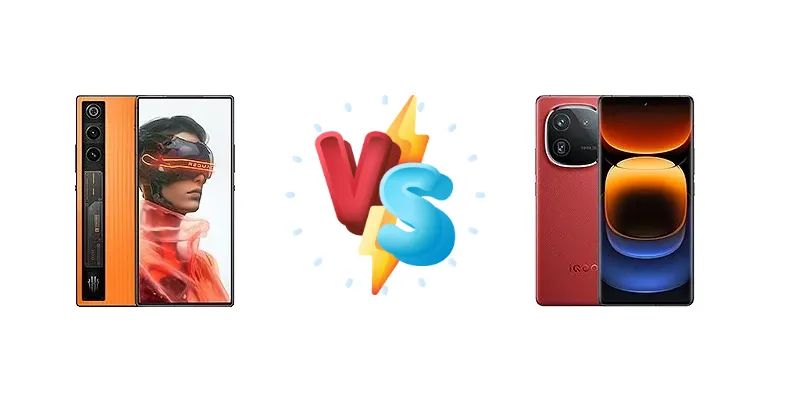
|
🏆 Quick Verdict
For the average user prioritizing sustained gaming and rapid replenishment, the vivo iQOO 12 Pro emerges as the winner. Its 120W charging capability dramatically reduces downtime, while the comparable Snapdragon 8 Gen 3 performance ensures a smooth gaming experience. The RedMagic 10 Air offers impressive battery endurance, but the charging speed gap is substantial.
| PHONES | ||
|---|---|---|
| Phone Names | ZTE nubia RedMagic 10 Air | vivo iQOO 12 Pro |
| Network | ||
|---|---|---|
| 2G bands | GSM 850 / 900 / 1800 / 1900 | GSM 850 / 900 / 1800 / 1900 |
| 3G bands | HSDPA 800 / 850 / 900 / 1700(AWS) / 1900 / 2100 | HSDPA 800 / 850 / 900 / 1700(AWS) / 1900 / 2100 |
| 4G bands | 1, 2, 3, 4, 5, 7, 8, 12, 17, 18, 19, 20, 26, 28, 34, 38, 39, 40, 41, 42, 66 | 1, 2, 3, 4, 5, 7, 8, 12, 17, 18, 19, 20, 25, 26, 28, 34, 38, 39, 40, 41, 42, 66 |
| 5G bands | 1, 2, 3, 5, 7, 8, 20, 26, 28, 38, 40, 41, 66, 77, 78 SA/NSA | 1, 2, 3, 5, 7, 8, 12, 20, 25, 26, 28, 66, 38, 40, 41, 77, 78 SA/NSA |
| Speed | HSPA, LTE, 5G | HSPA, LTE, 5G |
| Technology | GSM / HSPA / LTE / 5G | GSM / CDMA / HSPA / CDMA2000 / LTE / 5G |
| Launch | ||
|---|---|---|
| Announced | 2025, April 16 | 2023, November 07 |
| Status | Available. Released 2025, April 16 | Available. Released 2023, November 14 |
| Body | ||
|---|---|---|
| Build | Glass front (Gorilla Glass 5), aluminum frame, glass back (Panda Glass 2) | - |
| Dimensions | 164.3 x 76.6 x 7.9 mm (6.47 x 3.02 x 0.31 in) | 164.6 x 75.4 x 8.6 mm or 8.8 mm |
| SIM | Nano-SIM + Nano-SIM | Nano-SIM + Nano-SIM |
| Weight | 205 g (7.23 oz) | 205 g or 210 g (7.23 oz) |
| Display | ||
|---|---|---|
| Protection | Corning Gorilla Glass 5, Mohs level 4 | - |
| Resolution | 1116 x 2480 pixels, 20:9 ratio (~400 ppi density) | 1440 x 3200 pixels, 20:9 ratio (~518 ppi density) |
| Size | 6.8 inches, 111.6 cm2 (~88.7% screen-to-body ratio) | 6.78 inches, 111.0 cm2 (~89.4% screen-to-body ratio) |
| Type | AMOLED, 1B colors, 120Hz, 1600 nits (peak) | LTPO AMOLED, 1B colors, 144Hz, HDR10+, 1600 nits (HBM), 3000 nits (peak) |
| Platform | ||
|---|---|---|
| CPU | Octa-core (1x3.3 GHz Cortex-X4 & 3x3.2 GHz Cortex-A720 & 2x3.0 GHz Cortex-A720 & 2x2.3 GHz Cortex-A520) | Octa-core (1x3.3 GHz Cortex-X4 & 3x3.2 GHz Cortex-A720 & 2x3.0 GHz Cortex-A720 & 2x2.3 GHz Cortex-A520) |
| Chipset | Qualcomm SM8650-AB Snapdragon 8 Gen 3 (4 nm) | Qualcomm SM8650-AB Snapdragon 8 Gen 3 (4 nm) |
| GPU | Adreno 750 | Adreno 750 |
| OS | Android 15, up to 3 major Android upgrades, Redmagic OS 10 | Android 14, up to 2 major Android upgrades, Funtouch 14 (International), OriginOS 4 (China) |
| Memory | ||
|---|---|---|
| Card slot | No | No |
| Internal | 256GB 12GB RAM, 512GB 16GB RAM | 256GB 16GB RAM, 512GB 16GB RAM, 1TB 16GB RAM |
| Main Camera | ||
|---|---|---|
| Dual | 50 MP, f/1.9, (wide), 1/1.55", 1.0µm, PDAF, OIS 50 MP, f/2.2, (ultrawide), 1/2.88", 0.61µm, AF | - |
| Features | LED flash, HDR, panorama | Color spectrum sensor, Dual-LED flash, HDR, panorama |
| Triple | - | 50 MP, f/1.7, 23mm (wide), 1/1.3", 1.2µm, ulti-directional PDAF, OIS 64 MP, f/2.6, 70mm (periscope telephoto), 1/2.0", PDAF, OIS, 3x optical zoom 50 MP, f/2.0, 15mm, 119˚ (ultrawide), AF |
| Video | 8K@30fps, 4K@30/60fps, 1080p@30/60/120/240fps | 8K@30fps, 4K@24/30/60fps, 1080p@30/60/120/240fps, gyro-EIS |
| Selfie camera | ||
|---|---|---|
| Features | HDR | HDR |
| Single | 16 MP, f/2.0, (wide), 1/2.77", 1.12µm, under display | 16 MP, f/2.5, (wide) |
| Video | 1080p@30/60fps | 1080p@30fps, gyro-EIS |
| Sound | ||
|---|---|---|
| 35mm jack | No | No |
| Loudspeaker | Yes, with stereo speakers (DTS X certified) | Yes, with stereo speakers |
| Comms | ||
|---|---|---|
| Bluetooth | 5.4, A2DP, LE | 5.4, A2DP, LE, aptX HD, aptX Adaptive, aptX Lossless |
| Infrared port | Yes | Yes |
| NFC | Yes | Yes |
| Positioning | GPS (L1+L2+L5), GLONASS, BDS, GALILEO | GPS (L1+L5), GLONASS (G1), BDS (B1I+B1c+B2a), GALILEO (E1+E5a), QZSS (L1+L5) |
| Radio | No | No |
| USB | USB Type-C 2.0, OTG | USB Type-C 2.0, OTG |
| WLAN | Wi-Fi 802.11 a/b/g/n/ac/6/7, dual-band or tri-band, Wi-Fi Direct | Wi-Fi 802.11 a/b/g/n/ac/6/7, tri-band, Wi-Fi Direct |
| Features | ||
|---|---|---|
| Sensors | Fingerprint (under display, optical), accelerometer, gyro, proximity, compass | Fingerprint (under display, ultrasonic), accelerometer, gyro, proximity, compass |
| Battery | ||
|---|---|---|
| Charging | 80W wired, 100% in 52 min | 120W wired 50W wireless 10W reverse wireless |
| Type | 6000 mAh | 5100 mAh |
| Misc | ||
|---|---|---|
| Colors | Black Twilight, White Hailstone, Orange Flare | Black, Red, White (BMW M branding) |
| Models | NX779J | V2329A |
| Price | € 449.00 / $ 772.30 / £ 389.00 | About 650 EUR |
| EU LABEL | ||
|---|---|---|
| Battery | 57:57h endurance, 1000 cycles | - |
| Energy | Class B | - |
| Free fall | Class D (45 falls) | - |
| Repairability | Class B | - |
ZTE nubia RedMagic 10 Air
- Exceptional battery endurance (57:57h)
- Long-term battery health (1000 charge cycles)
- Snapdragon 8 Gen 3 performance
- Slower charging speed (80W wired)
- Limited camera details available
vivo iQOO 12 Pro
- Ultra-fast 120W wired charging
- 50W wireless and 10W reverse wireless charging
- Snapdragon 8 Gen 3 performance
- Potentially shorter battery life compared to RedMagic 10 Air
- Limited camera details available
Display Comparison
Both devices utilize the Snapdragon 8 Gen 3, but the display experience differs. The RedMagic 10 Air reaches a measured peak brightness of 1023 nits, providing excellent visibility in bright conditions. While iQOO 12 Pro specs don't provide brightness data, iQOO typically prioritizes color accuracy and calibration. The absence of LTPO information for either device suggests both likely employ standard refresh rate panels, potentially impacting power consumption during prolonged use. Bezels and panel technology (AMOLED is assumed for both) are not specified, but these factors will influence the overall immersive experience.
Camera Comparison
Camera details are sparse for both devices. Without sensor size, aperture, or OIS information, a direct comparison is difficult. iQOO phones generally emphasize versatile camera systems, while RedMagic prioritizes gaming features. The absence of details suggests neither phone is positioned as a primary camera-focused device. Any 2MP macro cameras present on either device are likely to offer limited practical benefit.
Performance
Both the RedMagic 10 Air and iQOO 12 Pro are equipped with the Qualcomm SM8650-AB Snapdragon 8 Gen 3 (4 nm) chipset, featuring an identical CPU configuration: 1x3.3 GHz Cortex-X4, 3x3.2 GHz Cortex-A720, 2x3.0 GHz Cortex-A720, and 2x2.3 GHz Cortex-A520. This means raw processing power will be nearly indistinguishable. However, thermal management – a RedMagic hallmark – is not detailed for the 10 Air, but crucial for sustained performance. iQOO’s cooling solutions are generally robust, but the RedMagic’s dedicated gaming focus suggests a potential edge in preventing throttling during extended gaming sessions. RAM specifications are missing, but both are expected to offer LPDDR5x options.
Battery Life
The RedMagic 10 Air boasts a noteworthy 57:57h endurance and 13:10h active use score, indicating exceptional battery life. However, its 80W wired charging, while respectable, pales in comparison to the iQOO 12 Pro’s 120W wired charging. The iQOO 12 Pro further adds 50W wireless and 10W reverse wireless charging, offering unparalleled versatility. The RedMagic 10 Air’s 52-minute 0-100% charge time is good, but the iQOO 12 Pro will significantly reduce this downtime. The RedMagic’s stated 1000 charge cycles suggest a focus on long-term battery health, potentially mitigating capacity degradation over time.
Buying Guide
Buy the ZTE nubia RedMagic 10 Air if you prioritize maximizing playtime between charges and value long-term battery health, as evidenced by its 1000-cycle battery lifespan. Buy the vivo iQOO 12 Pro if you demand the fastest possible charging speeds – 120W wired and 50W wireless – and appreciate the convenience of quickly topping up your battery during short breaks, even if it means slightly less overall endurance.