
RedMagic 10 Air vs Asus ROG Phone 8 Pro: Which Gaming Phone Reigns Supreme?
| Phones Images | |||||
|---|---|---|---|---|---|
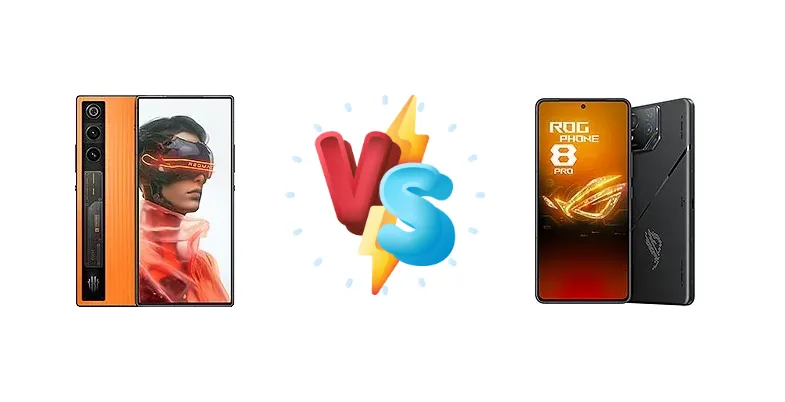
|
🏆 Quick Verdict
For the average gamer prioritizing sustained performance and a brighter, more vibrant display, the Asus ROG Phone 8 Pro is the superior choice. Its faster charging and slightly longer active use battery life, coupled with a significantly brighter screen, outweigh the RedMagic 10 Air’s more affordable price.
| PHONES | ||
|---|---|---|
| Phone Names | ZTE nubia RedMagic 10 Air | Asus ROG Phone 8 Pro |
| Network | ||
|---|---|---|
| 2G bands | GSM 850 / 900 / 1800 / 1900 | GSM 850 / 900 / 1800 / 1900 |
| 3G bands | HSDPA 800 / 850 / 900 / 1700(AWS) / 1900 / 2100 | HSDPA 850 / 900 / 1700(AWS) / 1800 / 1900 / 2100 - International |
| 4G bands | 1, 2, 3, 4, 5, 7, 8, 12, 17, 18, 19, 20, 26, 28, 34, 38, 39, 40, 41, 42, 66 | 1, 2, 3, 4, 5, 7, 8, 12, 17, 18, 19, 20, 25, 26, 28, 32, 34, 38, 39, 40, 41, 42, 43, 48, 66 - International |
| 5G bands | 1, 2, 3, 5, 7, 8, 20, 26, 28, 38, 40, 41, 66, 77, 78 SA/NSA | 1, 2, 3, 5, 7, 8, 12, 18, 20, 25, 26, 28, 38, 40, 41, 48, 66, 77, 78, 79 SA/NSA/Sub6 - International |
| Speed | HSPA, LTE, 5G | HSPA, LTE (Up to 7CA), 5G |
| Technology | GSM / HSPA / LTE / 5G | GSM / CDMA / HSPA / LTE / 5G |
| Launch | ||
|---|---|---|
| Announced | 2025, April 16 | 2024, January 08 |
| Status | Available. Released 2025, April 16 | Available. Released 2024, January 18 |
| Body | ||
|---|---|---|
| Build | Glass front (Gorilla Glass 5), aluminum frame, glass back (Panda Glass 2) | Glass front (Gorilla Glass Victus 2), glass back (Gorilla Glass), aluminum frame |
| Dimensions | 164.3 x 76.6 x 7.9 mm (6.47 x 3.02 x 0.31 in) | 163.8 x 76.8 x 8.9 mm (6.45 x 3.02 x 0.35 in) |
| SIM | Nano-SIM + Nano-SIM | Nano-SIM + Nano-SIM |
| Weight | 205 g (7.23 oz) | 225 g (7.94 oz) |
| Display | ||
|---|---|---|
| Protection | Corning Gorilla Glass 5, Mohs level 4 | Corning Gorilla Glass Victus 2 |
| Resolution | 1116 x 2480 pixels, 20:9 ratio (~400 ppi density) | 1080 x 2400 pixels, 20:9 ratio (~388 ppi density) |
| Size | 6.8 inches, 111.6 cm2 (~88.7% screen-to-body ratio) | 6.78 inches, 111.0 cm2 (~88.2% screen-to-body ratio) |
| Type | AMOLED, 1B colors, 120Hz, 1600 nits (peak) | LTPO AMOLED, 1B colors, 165Hz, HDR10, 1600 nits (HBM), 2500 nits (peak) |
| Platform | ||
|---|---|---|
| CPU | Octa-core (1x3.3 GHz Cortex-X4 & 3x3.2 GHz Cortex-A720 & 2x3.0 GHz Cortex-A720 & 2x2.3 GHz Cortex-A520) | Octa-core (1x3.3 GHz Cortex-X4 & 3x3.2 GHz Cortex-A720 & 2x3.0 GHz Cortex-A720 & 2x2.3 GHz Cortex-A520) |
| Chipset | Qualcomm SM8650-AB Snapdragon 8 Gen 3 (4 nm) | Qualcomm SM8650-AB Snapdragon 8 Gen 3 (4 nm) |
| GPU | Adreno 750 | Adreno 750 |
| OS | Android 15, up to 3 major Android upgrades, Redmagic OS 10 | Android 14, up to 2 major Android upgrades |
| Memory | ||
|---|---|---|
| Card slot | No | No |
| Internal | 256GB 12GB RAM, 512GB 16GB RAM | 512GB 16GB RAM, 1TB 24GB RAM |
| Main Camera | ||
|---|---|---|
| Dual | 50 MP, f/1.9, (wide), 1/1.55", 1.0µm, PDAF, OIS 50 MP, f/2.2, (ultrawide), 1/2.88", 0.61µm, AF | - |
| Features | LED flash, HDR, panorama | LED flash, HDR, panorama |
| Triple | - | 50 MP, f/1.9, 24mm (wide), 1/1.56", 1.0µm, PDAF, gimbal OIS 32 MP, f/2.4, (telephoto), 1/3.2", 0.7µm, PDAF, OIS, 3x optical zoom 13 MP, f/2.2, 13mm, 120˚ (ultrawide) |
| Video | 8K@30fps, 4K@30/60fps, 1080p@30/60/120/240fps | 8K@24fps, 4K@30/60fps, 1080p@30/60/120/240fps, 720p@480fps; gyro-EIS, HDR10+ |
| Selfie camera | ||
|---|---|---|
| Features | HDR | Panorama, HDR |
| Single | 16 MP, f/2.0, (wide), 1/2.77", 1.12µm, under display | 32 MP, f/2.5, 22mm (wide), 1/3.2", 0.7µm |
| Video | 1080p@30/60fps | 1080p@30fps |
| Sound | ||
|---|---|---|
| 35mm jack | No | Yes |
| Loudspeaker | Yes, with stereo speakers (DTS X certified) | Yes, with stereo speakers |
| Comms | ||
|---|---|---|
| Bluetooth | 5.4, A2DP, LE | 5.4, A2DP, LE, aptX HD, aptX Adaptive, aptX Lossless |
| Infrared port | Yes | - |
| NFC | Yes | Yes |
| Positioning | GPS (L1+L2+L5), GLONASS, BDS, GALILEO | GPS (L1+L5), BDS (B1I+B1c+B2a), GALILEO (E1+E5a), QZSS (L1+L5), NavIC (L5), GLONASS |
| Radio | No | No |
| USB | USB Type-C 2.0, OTG | USB Type-C (side), DisplayPort 1.4; USB Type-C (bottom), OTG |
| WLAN | Wi-Fi 802.11 a/b/g/n/ac/6/7, dual-band or tri-band, Wi-Fi Direct | Wi-Fi 802.11 a/b/g/n/ac/6e/7, tri-band, Wi-Fi Direct |
| Features | ||
|---|---|---|
| Sensors | Fingerprint (under display, optical), accelerometer, gyro, proximity, compass | Fingerprint (under display, optical), accelerometer, gyro, proximity, compass |
| Battery | ||
|---|---|---|
| Charging | 80W wired, 100% in 52 min | 65W wired, PD3.0, PPS, QC5, 100% in 39 min - International 30W wired, PD3.0, PPS - India 15W wireless (Qi) 10W reverse wired |
| Type | 6000 mAh | 5500 mAh |
| Misc | ||
|---|---|---|
| Colors | Black Twilight, White Hailstone, Orange Flare | Phantom Black |
| Models | NX779J | AI2401, AI2401_A, AI2401_D |
| Price | € 449.00 / $ 772.30 / £ 389.00 | $ 1,157.98 / £ 1,693.75 / € 632.66 |
| EU LABEL | ||
|---|---|---|
| Battery | 57:57h endurance, 1000 cycles | - |
| Energy | Class B | - |
| Free fall | Class D (45 falls) | - |
| Repairability | Class B | - |
ZTE nubia RedMagic 10 Air
- More affordable price point
- Longer battery lifespan (1000 cycles)
- 80W fast charging
- Snapdragon 8 Gen 3 performance
- Lower peak display brightness
- Slower charging time (52 minutes)
- Limited camera information
- Potentially less effective thermal management
Asus ROG Phone 8 Pro
- Significantly brighter display (1765 nits)
- Faster charging (39 minutes)
- Wireless charging and reverse wired charging
- Likely superior thermal management
- Higher price
- Slightly shorter active use battery life
- Charging speed varies by region (India gets 30W)
- Camera details are lacking
Display Comparison
The Asus ROG Phone 8 Pro boasts a significantly brighter display, reaching a measured 1765 nits compared to the RedMagic 10 Air’s 1023 nits. This translates to superior visibility in direct sunlight and a more impactful HDR experience. While both utilize the Snapdragon 8 Gen 3, the ROG Phone’s brighter panel enhances visual fidelity during gaming. The RedMagic 10 Air’s display specifications are not detailed enough to assess panel technology (LTPO or not), but the ROG Phone 8 Pro’s likely inclusion of LTPO allows for dynamic refresh rate scaling, improving battery efficiency. Bezels appear comparable based on available imagery, but color accuracy data is missing for both devices, making a definitive judgment impossible.
Camera Comparison
The provided data for the ROG Phone 8 Pro simply states 'Photo / Video' capabilities, lacking specific sensor details. The RedMagic 10 Air lacks any camera information. Given the gaming focus of both devices, camera performance is likely secondary. However, Asus typically includes capable camera systems in its ROG Phones, suggesting a potential advantage over the RedMagic 10 Air, which historically has prioritized gaming features over camera quality. Without detailed sensor information, a precise comparison is impossible, but the ROG Phone 8 Pro’s brand reputation suggests a more versatile camera experience.
Performance
Both the RedMagic 10 Air and the ROG Phone 8 Pro are powered by the Qualcomm SM8650-AB Snapdragon 8 Gen 3 (4 nm) chipset, featuring the same Octa-core CPU configuration. This means raw processing power will be nearly identical. However, thermal management is where differences may emerge. The ROG Phone series historically prioritizes advanced cooling solutions, which, while not detailed here, likely provide better sustained performance under heavy load. The RedMagic 10 Air, while capable, may experience more throttling during extended gaming sessions. RAM specifications are not provided, but the ROG Phone 8 Pro’s ecosystem often includes options for higher RAM configurations, potentially benefiting multitasking.
Battery Life
The Asus ROG Phone 8 Pro edges out the RedMagic 10 Air in active use battery life, achieving 14:43h compared to the RedMagic’s 13:10h. While the RedMagic 10 Air boasts a claimed 57:57h endurance and 1000 charge cycles, this is a different metric than real-world active use. The ROG Phone 8 Pro also offers significantly faster charging at 65W (international) or 30W (India) versus the RedMagic 10 Air’s 80W. Despite the higher wattage, the ROG Phone 8 Pro achieves a full charge in 39 minutes, while the RedMagic 10 Air takes 52 minutes. Furthermore, the ROG Phone 8 Pro adds the convenience of 15W wireless charging and 10W reverse wired charging, features absent on the RedMagic 10 Air.
Buying Guide
Buy the ZTE nubia RedMagic 10 Air if you need a powerful gaming experience on a tighter budget and prioritize long-term battery health with its 1000-cycle lifespan. Buy the Asus ROG Phone 8 Pro if you prefer a more refined, feature-rich experience with a stunning display, faster charging speeds, and the added convenience of wireless charging, even if it comes at a higher cost.