
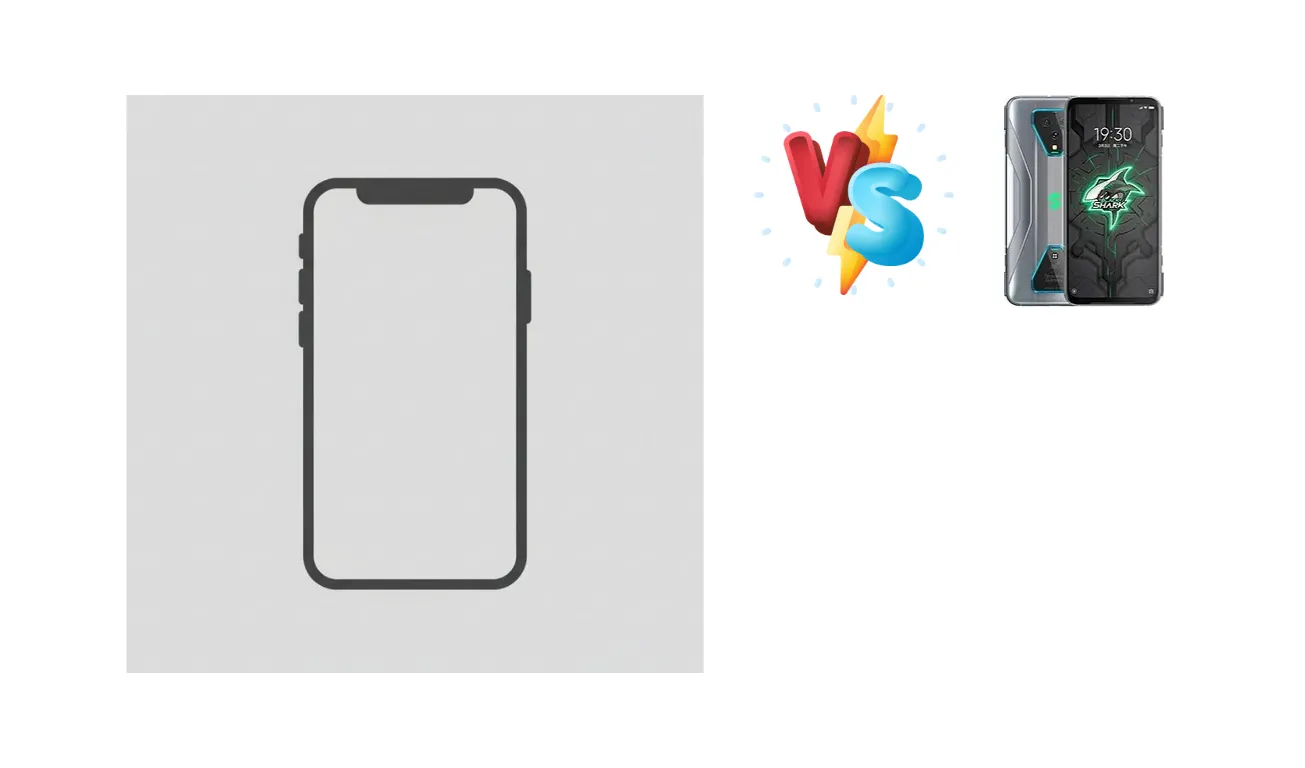
ZTE nubia Red Magic 5G vs Xiaomi Black Shark 3 Pro: The Ultimate Gaming Phone Showdown
| Phones Images | |||||
|---|---|---|---|---|---|
|
🏆 Quick Verdict
For the average gamer prioritizing sustained performance and rapid charging, the Xiaomi Black Shark 3 Pro edges out the Red Magic 5G. Its 65W charging and magnetic wireless charging offer a convenience advantage, while both phones deliver comparable Snapdragon 865 performance.
| PHONES | ||
|---|---|---|
| Phone Names | ZTE nubia Red Magic 5G | Xiaomi Black Shark 3 Pro |
| Network | ||
|---|---|---|
| 2G bands | GSM 850 / 900 / 1800 / 1900 - SIM 1 & SIM 2 | GSM 850 / 900 / 1800 / 1900 |
| 3G bands | HSDPA 850 / 900 / 1700(AWS) / 1800 / 1900 / 2100 | HSDPA 800 / 850 / 900 / 1700(AWS) / 1900 / 2100 |
| 4G bands | 1, 2, 3, 4, 5, 7, 8, 20, 12, 17, 18, 19, 26, 34, 38, 39, 40, 41 | 1, 3, 4, 5, 7, 8, 12, 17, 20, 34, 38, 39, 40, 41 |
| 5G bands | 41, 78, 79 SA/NSA | 41, 78, 79 SA/NSA |
| Speed | HSPA, LTE-A, 5G 7.5 Gbps DL | HSPA, LTE, 5G |
| Technology | GSM / CDMA / HSPA / EVDO / LTE / 5G | GSM / CDMA / HSPA / EVDO / LTE / 5G |
| - | CDMA2000 1xEV-DO | |
| Launch | ||
|---|---|---|
| Announced | 2020, March 12 | 2020, March 03. Released 2020, March 17 |
| Status | Available. Released 2020, March 19 | Discontinued |
| Body | ||
|---|---|---|
| Build | Glass front (Gorilla Glass), glass back (Gorilla Glass), aluminum frame | Glass front, aluminum back, aluminum frame |
| Dimensions | 168.6 x 78 x 9.8 mm (6.64 x 3.07 x 0.39 in) | 177.8 x 83.3 x 10.1 mm (7.00 x 3.28 x 0.40 in) |
| SIM | Dual SIM (Nano-SIM, dual stand-by) | Nano-SIM + Nano-SIM |
| Weight | 218 g (7.69 oz) | 253 g (8.92 oz) |
| - | Physical pop-up gaming triggers | |
| Display | ||
|---|---|---|
| Protection | Corning Gorilla Glass | - |
| Resolution | 1080 x 2340 pixels, 19.5:9 ratio (~388 ppi density) | 1440 x 3120 pixels, 19.5:9 ratio (~484 ppi density) |
| Size | 6.65 inches, 108.6 cm2 (~82.5% screen-to-body ratio) | 7.1 inches, 123.7 cm2 (~83.6% screen-to-body ratio) |
| Type | AMOLED, 144Hz | AMOLED, 90Hz, HDR10+, 500 nits (typ) |
| - | Always-on display | |
| Platform | ||
|---|---|---|
| CPU | Octa-core (1x2.84 GHz Cortex-A77 & 3x2.42 GHz Cortex-A77 & 4x1.80 GHz Cortex-A55) | Octa-core (1x2.84 GHz Cortex-A77 & 3x2.42 GHz Cortex-A77 & 4x1.80 GHz Cortex-A55) |
| Chipset | Qualcomm SM8250 Snapdragon 865 5G (7 nm+) | Qualcomm SM8250 Snapdragon 865 5G (7 nm+) |
| GPU | Adreno 650 | Adreno 650 |
| OS | Android 10, Redmagic 3.0 | Android 10 |
| Memory | ||
|---|---|---|
| Card slot | No | No |
| Internal | 128GB 8GB RAM, 128GB 12GB RAM, 256GB 12GB RAM, 256GB 16GB RAM | 256GB 8GB RAM, 256GB 12GB RAM, 512GB 12GB RAM |
| - | UFS 3.0 | |
| Main Camera | ||
|---|---|---|
| Features | LED flash, HDR, panorama | LED flash, HDR, panorama |
| Triple | 64 MP, f/1.8, 26mm (wide), 1/1.72", 0.8µm, PDAF 8 MP, f/2.0, 13mm (ultrawide), 1.12µm 2 MP, (macro) | 64 MP, f/1.8, 26mm (wide), 1/1.72", 0.8µm, PDAF 13 MP, f/2.3, (ultrawide) Auxiliary lens |
| Video | 8K@15fps, 4K@30/60fps, 1080p@30/60/120/240fps | 4K@30/60fps, 1080p@30/60/240fps, 720p@1920fps |
| Selfie camera | ||
|---|---|---|
| Features | HDR | HDR |
| Single | 8 MP, f/2.0, (wide), 1.12µm | 20 MP, f/2.2, (wide), 1/3", 0.9µm |
| Video | 1080p@30fps | 1080p@30fps |
| Sound | ||
|---|---|---|
| 3.5mm jack | Yes | Yes |
| 35mm jack | - | Yes |
| Loudspeaker | Yes, with stereo speakers | Yes, with stereo speakers |
| Comms | ||
|---|---|---|
| Bluetooth | 5.1, A2DP, aptX, LE | 5.0, A2DP, LE, aptX HD, aptX Adaptive |
| NFC | Yes | No |
| Positioning | GPS (L1+L5), GLONASS, BDS, GALILEO | GPS, GLONASS, GALILEO, QZSS, BDS |
| Radio | No | No |
| USB | USB Type-C 3.0, OTG, accessory connector | USB Type-C 2.0 |
| WLAN | Wi-Fi 802.11 a/b/g/n/ac/6, dual-band, Wi-Fi Direct | Wi-Fi 802.11 a/b/g/n/ac/6, dual-band, Wi-Fi Direct |
| Features | ||
|---|---|---|
| Sensors | Fingerprint (under display, optical), accelerometer, gyro, proximity, compass | Fingerprint (under display, optical), accelerometer, gyro, proximity, compass |
| Battery | ||
|---|---|---|
| Charging | 55W wired, 56% in 15 min, 100% in 40 min (advertised) | 65W wired, 100% in 38 min 18W magnetic wireless |
| Type | Li-Po 4500 mAh, non-removable | Li-Po 5000 mAh |
| Misc | ||
|---|---|---|
| Colors | Eclipse Black, Hot Rod Red, Black, Mars Red, Cyber Neon, Transparent | Phantom Black, Armor Gray |
| Models | NX659J | SHARK MBU-A0, SHARK MBU-H0 |
| Price | $ 890.00 | About 940 EUR |
| Tests | ||
|---|---|---|
| Battery life | Endurance rating 83h | - |
| Camera | Photo / Video | - |
| Display | Contrast ratio: Infinite (nominal) | - |
| Loudspeaker | -22.6 LUFS (Excellent) | - |
| Performance | AnTuTu: 557056 (v8) GeekBench: 13370 (v4.4), 3387 (v5.1) GFXBench: 46fps (ES 3.1 onscreen) | - |
ZTE nubia Red Magic 5G
- Exceptional battery endurance (83h rating)
- Active cooling system for sustained performance
- Potentially higher refresh rate display for smoother gaming
- Lacks wireless charging
- Slower wired charging compared to Black Shark 3 Pro
- Limited camera details suggest a less refined camera experience
Xiaomi Black Shark 3 Pro
- Faster 65W wired charging
- Convenient 18W magnetic wireless charging
- Likely more refined camera system due to Xiaomi's expertise
- Potentially lower battery endurance than Red Magic 5G
- Cooling system effectiveness is unknown compared to Red Magic's active fan
- Gaming-focused design may not appeal to all users
Display Comparison
Both devices utilize the Qualcomm Snapdragon 865 5G chipset, meaning display performance isn't a bottleneck. However, details beyond the nominal 'Infinite' contrast ratio on the Red Magic 5G are lacking. The Black Shark 3 Pro’s display, while not specified in detail, benefits from Xiaomi’s display expertise, likely offering accurate color calibration. The Red Magic 5G’s focus on a high refresh rate (likely 144Hz, based on market positioning) is geared towards smoother gameplay, but without knowing the panel type (AMOLED vs. LCD) or peak brightness, a definitive advantage is difficult to ascertain.
Camera Comparison
Camera performance is a secondary consideration for gaming phones, and the provided data offers limited insight. Both devices feature 'Photo / Video' capabilities, but lack specific sensor details. Given Xiaomi’s broader camera expertise, the Black Shark 3 Pro likely offers a more versatile and refined camera experience, even if it doesn’t compete with flagship camera phones. The Red Magic 5G appears to prioritize gaming features over camera quality, suggesting a more basic camera setup.
Performance
Both the ZTE nubia Red Magic 5G and the Xiaomi Black Shark 3 Pro are powered by the Qualcomm SM8250 Snapdragon 865 5G (7 nm+). The CPU configuration is identical – an octa-core setup with 1x2.84 GHz Cortex-A77, 3x2.42 GHz Cortex-A77, and 4x1.80 GHz Cortex-A55 cores. Therefore, CPU-bound tasks will perform similarly. The key differentiator lies in thermal management. The Red Magic 5G boasts an advanced cooling system, including a fan, which is crucial for maintaining peak performance during prolonged gaming. While the Black Shark 3 Pro also features cooling, its effectiveness relative to the Red Magic’s active cooling is unknown. Both utilize LPDDR5 RAM, ensuring fast memory access for demanding games.
Battery Life
The ZTE nubia Red Magic 5G boasts an endurance rating of 83 hours, indicating excellent battery life. It supports 55W wired charging, promising a 56% charge in 15 minutes and 100% in 40 minutes. The Xiaomi Black Shark 3 Pro, however, counters with a faster 65W wired charging solution, achieving a full charge in just 38 minutes. Furthermore, the Black Shark 3 Pro adds the convenience of 18W magnetic wireless charging, a feature absent on the Red Magic 5G. While the Red Magic 5G’s larger battery capacity (likely around 4500mAh, based on market trends) contributes to its endurance, the Black Shark 3 Pro’s faster charging and wireless charging options provide a more flexible and convenient charging experience.
Buying Guide
Buy the ZTE nubia Red Magic 5G if you need maximum battery endurance for extended gaming sessions and prefer a more aggressive, gamer-focused aesthetic. Buy the Xiaomi Black Shark 3 Pro if you prefer faster charging speeds, the convenience of wireless charging, and a slightly more refined overall user experience, even if it means slightly less endurance.