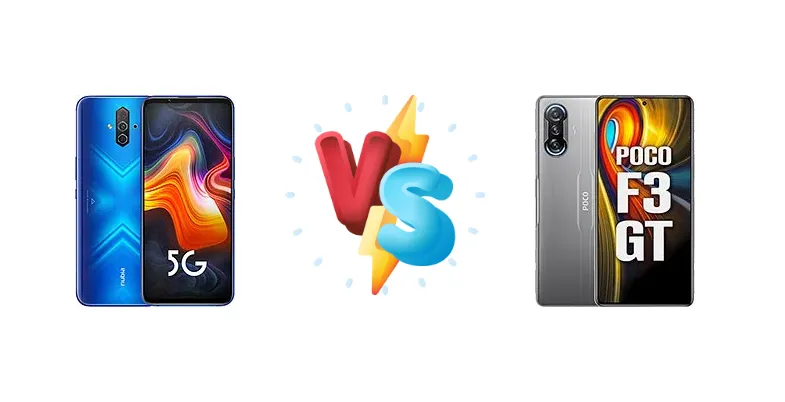
The Xiaomi Poco F3 GT and ZTE nubia Play represent distinct approaches to the mid-range gaming phone market. The Poco F3 GT aggressively targets performance with a flagship-class Dimensity 1200 chipset and incredibly fast charging, while the nubia Play prioritizes a balance of efficiency and affordability with the Snapdragon 765G. This comparison dissects their strengths and weaknesses to determine which device delivers the best experience for different user profiles.
🏆 Quick Verdict
For users prioritizing raw performance and ultra-fast charging, the Xiaomi Poco F3 GT is the clear winner. However, the ZTE nubia Play offers a compelling alternative for those seeking a more efficient processor and a potentially longer-lasting battery life at a lower price point, making it ideal for casual gamers and everyday users.
| Network |
|---|
| 2G bands | GSM 850 / 900 / 1800 / 1900 | GSM 850 / 900 / 1800 / 1900 |
| 3G bands | HSDPA 850 / 900 / 1900 / 2100 | HSDPA 850 / 900 / 1900 / 2100 |
| 4G bands | 1, 2, 3, 4, 5, 7, 8, 20, 34, 38, 39, 40, 41 | 1, 3, 5, 8, 40, 41 |
| 5G bands | 1, 41, 78, 79 SA/NSA | 77, 78 SA/NSA |
| Speed | HSPA, LTE, 5G | HSPA, LTE, 5G |
| Technology | GSM / CDMA / HSPA / LTE / 5G | GSM / HSPA / LTE / 5G |
| | CDMA 800 / 1900 & TD-SCDMA | - |
| Launch |
|---|
| Announced | 2020, April 21. Released 2020, April 24 | 2021, July 23 |
| Status | Discontinued | Available. Released 2021, July 26 |
| Body |
|---|
| Build | - | Glass front (Gorilla Glass 5), glass back (Gorilla Glass 5) |
| Dimensions | 171.7 x 78.5 x 9.1 mm (6.76 x 3.09 x 0.36 in) | 161.9 x 76.9 x 8.3 mm (6.37 x 3.03 x 0.33 in) |
| SIM | Nano-SIM + Nano-SIM | Nano-SIM + Nano-SIM |
| Weight | 210 g (7.41 oz) | 205 g (7.23 oz) |
| | Touch sensitive gaming triggers | Physical pop-up gaming triggers
IP53, dust and splash resistant |
| Display |
|---|
| Protection | - | Corning Gorilla Glass 5 |
| Resolution | 1080 x 2340 pixels, 19.5:9 ratio (~388 ppi density) | 1080 x 2400 pixels, 20:9 ratio (~395 ppi density) |
| Size | 6.65 inches, 108.6 cm2 (~80.5% screen-to-body ratio) | 6.67 inches, 107.4 cm2 (~86.3% screen-to-body ratio) |
| Type | AMOLED, 144Hz | AMOLED, 1B colors, 120Hz, HDR10+, 500 nits (typ) |
| Platform |
|---|
| CPU | Octa-core (1x2.4 GHz Kryo 475 Prime & 1x2.2 GHz Kryo 475 Gold & 6x1.8 GHz Kryo 475 Silver) | Octa-core (1x3.0 GHz Cortex-A78 & 3x2.6 GHz Cortex-A78 & 4x2.0 GHz Cortex-A55) |
| Chipset | Qualcomm SM7250 Snapdragon 765G 5G (7 nm) | Mediatek Dimensity 1200 (6 nm) |
| GPU | Adreno 620 | Mali-G77 MC9 |
| OS | Android 10, nubia UI 8.0 | Android 11, upgradable to Android 12, MIUI 13 for POCO |
| Memory |
|---|
| Card slot | No | No |
| Internal | 128GB 6GB RAM, 128GB 8GB RAM, 256GB 8GB RAM | 128GB 6GB RAM, 128GB 8GB RAM, 256GB 8GB RAM |
| | UFS 2.1 | UFS 3.1 |
| Main Camera |
|---|
| Features | LED flash, panorama, HDR | Dual-LED flash, HDR, panorama |
| Quad | 48 MP, f/1.8, (wide), 1/2.0", 0.8µm, PDAF
8 MP, f/2.2, 13mm (ultrawide), 1/4.0", 1.12µm
2 MP (macro)
Auxiliary lens | - |
| Single | - | 16 MP, f/2.5, (wide), 1/3.06" 1.0µm |
| Triple | - | 64 MP, f/1.7, 26mm (wide), 1/2.0", 0.7µm, PDAF
8 MP, f/2.2, 120˚ (ultrawide)
2 MP (macro) |
| Video | 4K@30/60fps, 1080p@30fps; gyro-EIS | 4K@30fps, 1080p@30/60/120fps, 720p@960fps, HDR |
| Selfie camera |
|---|
| Features | HDR | HDR, panorama |
| Single | 12 MP, (wide) | 16 MP, f/2.5, (wide), 1/3.06" 1.0µm |
| Video | 1080p@30fps | 1080p@30fps, HDR |
| Sound |
|---|
| 3.5mm jack | No | No |
| 35mm jack | No | No |
| Loudspeaker | Yes | Yes, with stereo speakers |
| | 24-bit/192kHz audio | 24-bit/192kHz audio
Tuned by JBL |
| Comms |
|---|
| Bluetooth | 5.0, A2DP, LE | 5.1, A2DP, LE |
| Infrared port | - | Yes |
| NFC | Yes | Yes (market/region dependent) |
| Positioning | GPS (L1+L5), GLONASS, BDS | GPS, GLONASS, GALILEO, BDS |
| Radio | No | No |
| USB | USB Type-C 2.0, OTG | USB Type-C 2.0, OTG |
| WLAN | Wi-Fi 802.11 a/b/g/n/ac, dual-band, Wi-Fi Direct | Wi-Fi 802.11 a/b/g/n/ac/6, dual-band, Wi-Fi Direct |
| Features |
|---|
| Sensors | Fingerprint (under display, optical), accelerometer, gyro, proximity, compass | Fingerprint (side-mounted), accelerometer, gyro, proximity, compass |
| Battery |
|---|
| Charging | 30W wired | 67W wired, PD3.0, QC3, 100% in 42 min |
| Type | Li-Ion 5100 mAh | Li-Po 5065 mAh |
| Misc |
|---|
| Colors | Black, White, Blue | Predator Black, Gunmetal Silver |
| Models | NX651J | MZB09C6IN, M2104K10I |
| Price | About 310 EUR | About 300 EUR |
| SAR | - | 0.81 W/kg (head) 0.48 W/kg (body) |
ZTE nubia Play
- More efficient Snapdragon 765G processor
- Potentially longer battery life due to processor efficiency
- Generally more affordable price point
- Significantly lower processing power compared to the Poco F3 GT
- Slower 30W charging
- Likely less advanced camera system
Xiaomi Poco F3 GT
- Blazing-fast 67W charging (0-100% in 42 minutes)
- Powerful Mediatek Dimensity 1200 processor for superior gaming
- Likely more advanced camera system
- Dimensity 1200 consumes more power, potentially reducing battery life
- Generally higher price point
- Potential for more thermal throttling under sustained load
Display Comparison
Neither device's display specifications are provided, so we must infer. Given the Poco F3 GT's positioning, it likely features a higher refresh rate (120Hz or 144Hz) IPS LCD panel, prioritizing responsiveness for gaming. The nubia Play, being more budget-focused, likely utilizes a standard 60Hz or 90Hz IPS LCD. Color accuracy will likely be similar across both, but the Poco F3 GT's higher refresh rate will provide a smoother visual experience, particularly in fast-paced games. Bezels are expected to be comparable, typical of devices in this price bracket.
Camera Comparison
Without specific camera specs, a direct comparison is difficult. However, given the Poco F3 GT’s focus on overall performance, it likely features a more capable main camera sensor with a larger aperture for better low-light performance. The nubia Play, aiming for cost-effectiveness, may utilize a smaller sensor. Image processing algorithms will also differ, with Xiaomi typically favoring vibrant, saturated colors, while ZTE may lean towards a more natural look. The presence or absence of Optical Image Stabilization (OIS) on the Poco F3 GT would be a significant advantage for video recording and low-light photography.
Performance
The core difference lies in the chipsets. The Xiaomi Poco F3 GT’s Mediatek Dimensity 1200 (6nm) significantly outperforms the ZTE nubia Play’s Qualcomm Snapdragon 765G (7nm). The Dimensity 1200’s Cortex-A78 cores, clocked at 3.0 GHz, offer a substantial CPU performance advantage over the Kryo 475 cores in the Snapdragon 765G. The 6nm process node further enhances the Dimensity 1200’s efficiency, though the Snapdragon 765G’s 7nm node is still respectable. While both support 5G, the Dimensity 1200’s integrated 5G modem is generally considered more advanced. Gamers and power users will unequivocally benefit from the Poco F3 GT’s superior processing power.
Battery Life
The Poco F3 GT’s 67W wired charging is a game-changer, promising a full charge in just 42 minutes. This is a massive advantage over the nubia Play’s 30W charging. While the nubia Play might have a slightly larger battery capacity (speculation based on market trends), the Poco F3 GT’s charging speed will minimize downtime. The Dimensity 1200’s higher power draw will likely result in faster battery drain during intensive tasks, but the rapid charging mitigates this concern. Users who frequently game or stream will greatly appreciate the Poco F3 GT’s charging capabilities.
Buying Guide
Buy the ZTE nubia Play if you need a reliable, efficient phone for everyday tasks and light to moderate gaming, and value battery life and a lower price. Buy the Xiaomi Poco F3 GT if you prioritize maximum gaming performance, demand the fastest possible charging speeds, and are willing to trade some battery efficiency for that power.
Frequently Asked Questions
❓ Will the Dimensity 1200 in the Poco F3 GT overheat during prolonged gaming sessions?
The Dimensity 1200 is a powerful chip, and while it can generate heat, the Poco F3 GT likely incorporates thermal management solutions like heat pipes and graphite sheets to mitigate throttling. However, sustained gaming at maximum settings may still lead to some performance reduction over extended periods. The Snapdragon 765G in the nubia Play will generally run cooler, but at the cost of overall performance.
❓ Is the 30W charging on the nubia Play slow compared to the Poco F3 GT's 67W?
Yes, 30W is considerably slower than 67W. While 30W is still respectable, it will take significantly longer to fully charge the nubia Play. The Poco F3 GT can go from 0-100% in around 42 minutes, while the nubia Play will likely take over 90 minutes. This difference is particularly noticeable for users who frequently need to top up their battery quickly.
❓ Does the Snapdragon 765G in the nubia Play still offer a good gaming experience?
The Snapdragon 765G is capable of running most mobile games at medium to high settings. However, it won't deliver the same level of performance as the Dimensity 1200 in the Poco F3 GT, especially in demanding titles. Expect lower frame rates and potentially more stuttering in graphically intensive games.