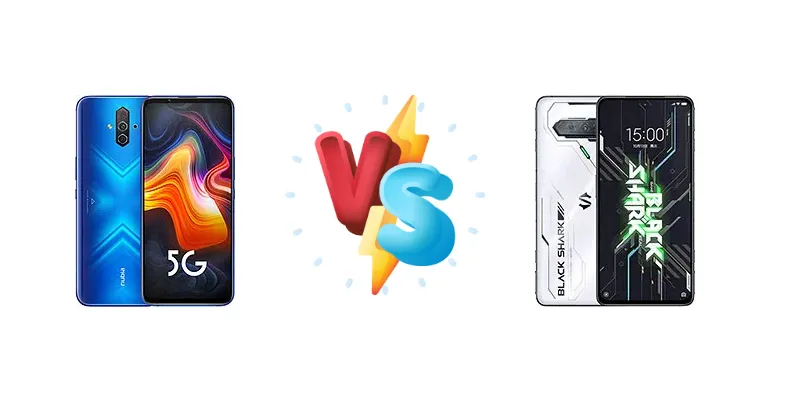
The mobile gaming market offers a spectrum of choices, from budget-friendly options to uncompromising flagships. The ZTE nubia Play and Xiaomi Black Shark 4S Pro represent distinct points on this spectrum. The nubia Play aims for accessible gaming, while the Black Shark 4S Pro targets enthusiasts demanding top-tier performance and features. This comparison dissects their core differences to help you choose the right device.
🏆 Quick Verdict
For the average gamer prioritizing raw power and ultra-fast charging, the Xiaomi Black Shark 4S Pro is the clear winner. Its Snapdragon 888+ chipset delivers significantly higher performance. However, the ZTE nubia Play offers a compelling value proposition for casual gamers and those seeking a more efficient, affordable experience.
| Network |
|---|
| 2G bands | GSM 850 / 900 / 1800 / 1900 | GSM 850 / 900 / 1800 / 1900 |
| 3G bands | HSDPA 850 / 900 / 1900 / 2100 | HSDPA 800 / 850 / 900 / 1700(AWS) / 1900 / 2100 |
| 4G bands | 1, 2, 3, 4, 5, 7, 8, 20, 34, 38, 39, 40, 41 | 1, 2, 3, 4, 5, 7, 8, 18, 19, 20, 26, 28, 34, 38, 39, 40, 41 |
| 5G bands | 1, 41, 78, 79 SA/NSA | 1, 3, 8, 28, 41, 77, 78, 79 SA/NSA |
| Speed | HSPA, LTE, 5G | HSPA, LTE, 5G |
| Technology | GSM / CDMA / HSPA / LTE / 5G | GSM / CDMA / HSPA / EVDO / LTE / 5G |
| | CDMA 800 / 1900 & TD-SCDMA | CDMA2000 1xEV-DO |
| Launch |
|---|
| Announced | 2020, April 21. Released 2020, April 24 | 2021, October 13 |
| Status | Discontinued | Available. Released 2021, October 16 |
| Body |
|---|
| Dimensions | 171.7 x 78.5 x 9.1 mm (6.76 x 3.09 x 0.36 in) | 163.7 x 76.2 x 9.9 mm (6.44 x 3.00 x 0.39 in) |
| SIM | Nano-SIM + Nano-SIM | Nano-SIM + Nano-SIM |
| Weight | 210 g (7.41 oz) | 220 g (7.76 oz) |
| | Touch sensitive gaming triggers | Physical pop-up gaming triggers |
| Display |
|---|
| Resolution | 1080 x 2340 pixels, 19.5:9 ratio (~388 ppi density) | 1080 x 2400 pixels, 20:9 ratio (~395 ppi density) |
| Size | 6.65 inches, 108.6 cm2 (~80.5% screen-to-body ratio) | 6.67 inches, 107.4 cm2 (~86.1% screen-to-body ratio) |
| Type | AMOLED, 144Hz | Super AMOLED, 144Hz, HDR10+, 1300 nits (peak) |
| | - | Always-on display |
| Platform |
|---|
| CPU | Octa-core (1x2.4 GHz Kryo 475 Prime & 1x2.2 GHz Kryo 475 Gold & 6x1.8 GHz Kryo 475 Silver) | Octa-core (1x3.0 GHz Cortex-X1 & 3x2.42 GHz Cortex-A78 & 4x1.80 GHz Cortex-A55) |
| Chipset | Qualcomm SM7250 Snapdragon 765G 5G (7 nm) | Qualcomm SM8350 Snapdragon 888+ 5G (5 nm) |
| GPU | Adreno 620 | Adreno 660 |
| OS | Android 10, nubia UI 8.0 | Android 11, Joy UI 12.8 |
| Memory |
|---|
| Card slot | No | No |
| Internal | 128GB 6GB RAM, 128GB 8GB RAM, 256GB 8GB RAM | 256GB 8GB RAM, 256GB 12GB RAM, 512GB 16GB RAM |
| | UFS 2.1 | UFS 3.1 |
| Main Camera |
|---|
| Features | LED flash, panorama, HDR | LED flash, HDR, panorama |
| Quad | 48 MP, f/1.8, (wide), 1/2.0", 0.8µm, PDAF
8 MP, f/2.2, 13mm (ultrawide), 1/4.0", 1.12µm
2 MP (macro)
Auxiliary lens | - |
| Single | - | 20 MP, f/2.5, (wide), 0.8µm |
| Triple | - | 64 MP, f/1.8, (wide), 1/1.97", 0.7µm, PDAF
8 MP, f/2.2, 120˚ (ultrawide), 1/4.0", 1.12µm
5 MP (macro), AF |
| Video | 4K@30/60fps, 1080p@30fps; gyro-EIS | 4K@30/60fps, 1080p@30/60/240fps, 1080p@960fps; HDR10+ |
| Selfie camera |
|---|
| Features | HDR | HDR |
| Single | 12 MP, (wide) | 20 MP, f/2.5, (wide), 0.8µm |
| Video | 1080p@30fps | 1080p@30fps |
| Sound |
|---|
| 3.5mm jack | No | Yes |
| 35mm jack | No | Yes |
| Loudspeaker | Yes | Yes, with stereo speakers |
| | 24-bit/192kHz audio | 24-bit/192kHz audio |
| Comms |
|---|
| Bluetooth | 5.0, A2DP, LE | 5.2, A2DP, LE, aptX HD, aptX Adaptive |
| NFC | Yes | Yes |
| Positioning | GPS (L1+L5), GLONASS, BDS | GPS, GLONASS, GALILEO, QZSS, BDS |
| Radio | No | No |
| USB | USB Type-C 2.0, OTG | USB Type-C 2.0 |
| WLAN | Wi-Fi 802.11 a/b/g/n/ac, dual-band, Wi-Fi Direct | Wi-Fi 802.11 a/b/g/n/ac/6, dual-band, Wi-Fi Direct |
| Features |
|---|
| Sensors | Fingerprint (under display, optical), accelerometer, gyro, proximity, compass | Fingerprint (side-mounted), accelerometer, gyro, proximity, compass, barometer |
| Battery |
|---|
| Charging | 30W wired | 120W wired, 50% in 5 min, 100% in 15 min |
| Type | Li-Ion 5100 mAh | Li-Po 4500 mAh |
| Misc |
|---|
| Colors | Black, White, Blue | Black, White |
| Models | NX651J | - |
| Price | About 310 EUR | About 650 EUR |
ZTE nubia Play
- More affordable price point
- Good balance of performance and efficiency
- Likely longer battery life due to less power-hungry chipset
- Significantly less powerful than the Black Shark 4S Pro
- Slower charging speeds
- May struggle with graphically demanding games at maximum settings
Xiaomi Black Shark 4S Pro
- Exceptional performance with Snapdragon 888+
- Ultra-fast 120W charging
- Superior gaming experience with higher frame rates and graphics settings
- Higher price tag
- Potentially shorter battery life under heavy gaming load
- May run hotter than the nubia Play during prolonged gaming sessions
Display Comparison
While both devices likely feature high refresh rate displays (based on market positioning), the core difference lies in the processing power driving them. The nubia Play, with its Snapdragon 765G, will deliver a smooth experience, but the Black Shark 4S Pro’s Snapdragon 888+ will handle graphically intensive games with greater ease. We lack specific display specs, but the Black Shark’s higher processing power will translate to a more responsive and visually detailed gaming experience, especially in fast-paced titles. The 888+’s Adreno 660 GPU is a substantial upgrade over the 765G’s Adreno 620.
Camera Comparison
Given the gaming focus of both devices, camera performance is likely secondary. However, the Black Shark 4S Pro, being a higher-end device, likely incorporates a more sophisticated camera system. While specific sensor details are missing, the 888+’s image signal processor (ISP) offers superior image processing capabilities compared to the 765G’s ISP. Expect better dynamic range, noise reduction, and overall image quality from the Black Shark 4S Pro, particularly in low-light conditions. We can assume the Black Shark will have a larger main sensor, contributing to better detail and low-light performance.
Performance
The performance gap is the most significant differentiator. The Xiaomi Black Shark 4S Pro’s Snapdragon 888+ 5G (5nm) is built on a smaller fabrication process than the ZTE nubia Play’s Snapdragon 765G (7nm). This 5nm process allows for greater transistor density, resulting in higher performance and improved power efficiency. The 888+’s CPU configuration – 1x3.0 GHz Cortex-X1, 3x2.42 GHz Cortex-A78, and 4x1.80 GHz Cortex-A55 – significantly outperforms the nubia Play’s 1x2.4 GHz Kryo 475 Prime, 1x2.2 GHz Kryo 475 Gold, and 6x1.8 GHz Kryo 475 Silver. This translates to faster loading times, smoother frame rates, and the ability to handle more demanding games without throttling.
Battery Life
The nubia Play’s 30W wired charging is respectable, but the Black Shark 4S Pro’s 120W wired charging is in a different league. The Black Shark boasts a 50% charge in 5 minutes and a full charge in 15 minutes, a game-changer for gamers who need to quickly top up their battery between matches. While the nubia Play’s battery capacity is unknown, the Black Shark’s faster charging effectively mitigates any potential capacity disadvantage. The 5nm process of the 888+ also contributes to better power efficiency, potentially offsetting the higher power draw of the more powerful chipset.
Buying Guide
Buy the ZTE nubia Play if you need a capable gaming phone on a budget, prioritizing battery life and a more manageable price point. It's ideal for mobile gamers who enjoy titles like *Genshin Impact* on medium settings or less demanding games. Buy the Xiaomi Black Shark 4S Pro if you prefer uncompromising performance, the fastest possible charging speeds, and are willing to pay a premium for a truly high-end gaming experience, capable of maxing out graphics settings in demanding titles like *PUBG Mobile* and *Call of Duty: Mobile*.
Frequently Asked Questions
❓ Will the Black Shark 4S Pro overheat during extended gaming sessions?
The Snapdragon 888+ is known to generate heat under sustained load. However, the Black Shark 4S Pro incorporates advanced cooling solutions, such as liquid cooling or vapor chamber technology, to mitigate thermal throttling. While some heat is inevitable, the device is designed to maintain stable performance during long gaming sessions.
❓ Is the Snapdragon 765G in the nubia Play sufficient for playing *Genshin Impact*?
The Snapdragon 765G can run *Genshin Impact*, but you'll likely need to lower the graphics settings to medium or low to achieve a consistently smooth frame rate. Expect some occasional frame drops during intense combat scenarios. It's playable, but not ideal for those seeking the highest visual fidelity.
❓ Does the Black Shark 4S Pro support external game controllers?
Yes, the Black Shark 4S Pro supports both Bluetooth and wired external game controllers, enhancing the gaming experience with more precise controls. It's compatible with a wide range of controllers, including those from Xbox and PlayStation.
❓ How does the 120W charging affect the battery's long-term health?
Xiaomi employs battery protection technologies to mitigate the potential impact of ultra-fast charging on long-term battery health. These technologies regulate the charging process and prevent overcharging, minimizing degradation over time. While all batteries degrade eventually, the Black Shark 4S Pro's charging system is designed to maximize battery lifespan.