
OnePlus 9RT 5G vs ZTE nubia Play: Which Mid-Range Phone Delivers More?
| Phones Images | |||||
|---|---|---|---|---|---|
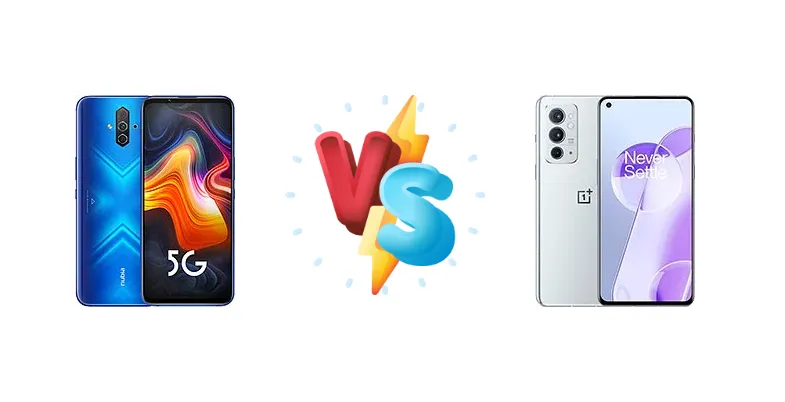
|
🏆 Quick Verdict
For users prioritizing raw performance and rapid charging, the OnePlus 9RT 5G is the clear winner. Its Snapdragon 888 chipset offers a substantial leap over the nubia Play’s Snapdragon 765G. However, the nubia Play remains a compelling option for casual gamers and those seeking a more affordable device.
| PHONES | ||
|---|---|---|
| Phone Names | ZTE nubia Play | OnePlus 9RT 5G |
| Network | ||
|---|---|---|
| 2G bands | GSM 850 / 900 / 1800 / 1900 | GSM 850 / 900 / 1800 / 1900 |
| 3G bands | HSDPA 850 / 900 / 1900 / 2100 | HSDPA 800 / 850 / 900 / 1700(AWS) / 1800 / 1900 / 2100 |
| 4G bands | 1, 2, 3, 4, 5, 7, 8, 20, 34, 38, 39, 40, 41 | 1, 2, 3, 4, 5, 7, 8, 12, 17, 18, 19, 20, 26, 28, 34, 38, 39, 40, 41 - Global |
| 5G bands | 1, 41, 78, 79 SA/NSA | 1, 3, 5, 8, 28, 40, 41, 78 SA/NSA - Global |
| Speed | HSPA, LTE, 5G | HSPA 42.2/5.76 Mbps, LTE Cat18 1200/200 Mbps, 5G |
| Technology | GSM / CDMA / HSPA / LTE / 5G | GSM / CDMA / HSPA / EVDO / LTE / 5G |
| CDMA 800 / 1900 & TD-SCDMA | CDMA2000 1xEV-DO | |
| Launch | ||
|---|---|---|
| Announced | 2020, April 21. Released 2020, April 24 | 2021, October 13 |
| Status | Discontinued | Available. Released 2021, October 19 |
| Body | ||
|---|---|---|
| Build | - | Glass front (Gorilla Glass 5), glass back (Gorilla Glass 5), aluminum frame |
| Dimensions | 171.7 x 78.5 x 9.1 mm (6.76 x 3.09 x 0.36 in) | 162.2 x 74.6 x 8.3 mm (6.39 x 2.94 x 0.33 in) |
| SIM | Nano-SIM + Nano-SIM | Nano-SIM + Nano-SIM |
| Weight | 210 g (7.41 oz) | 198.5 g (7.02 oz) |
| Touch sensitive gaming triggers | - | |
| Display | ||
|---|---|---|
| Protection | - | Corning Gorilla Glass 5 |
| Resolution | 1080 x 2340 pixels, 19.5:9 ratio (~388 ppi density) | 1080 x 2400 pixels, 20:9 ratio (~397 ppi density) |
| Size | 6.65 inches, 108.6 cm2 (~80.5% screen-to-body ratio) | 6.62 inches, 106.3 cm2 (~87.9% screen-to-body ratio) |
| Type | AMOLED, 144Hz | AMOLED, 120Hz, HDR10+ |
| - | Always-on display | |
| Platform | ||
|---|---|---|
| CPU | Octa-core (1x2.4 GHz Kryo 475 Prime & 1x2.2 GHz Kryo 475 Gold & 6x1.8 GHz Kryo 475 Silver) | Octa-core (1x2.84 GHz Cortex-X1 & 3x2.42 GHz Cortex-A78 & 4x1.80 GHz Cortex-A55) |
| Chipset | Qualcomm SM7250 Snapdragon 765G 5G (7 nm) | Qualcomm SM8350 Snapdragon 888 5G (5 nm) |
| GPU | Adreno 620 | Adreno 660 |
| OS | Android 10, nubia UI 8.0 | Android 11, upgradable to Android 13, OxygenOS 13 |
| Memory | ||
|---|---|---|
| Card slot | No | No |
| Internal | 128GB 6GB RAM, 128GB 8GB RAM, 256GB 8GB RAM | 128GB 8GB RAM, 256GB 8GB RAM, 256GB 12GB RAM |
| UFS 2.1 | UFS 3.1 | |
| Main Camera | ||
|---|---|---|
| Features | LED flash, panorama, HDR | Dual-LED flash, HDR, panorama |
| Quad | 48 MP, f/1.8, (wide), 1/2.0", 0.8µm, PDAF 8 MP, f/2.2, 13mm (ultrawide), 1/4.0", 1.12µm 2 MP (macro) Auxiliary lens | 50 MP, f/1.8, 24mm (wide), 1/1.56”, 1.0µm, PDAF, OIS 16 MP, f/2.2, 14mm, 123˚ (ultrawide), 1/3.6", 1.0µm 2 MP (macro) |
| Single | - | 16 MP, f/2.4, (wide), 1/3.06", 1.0µm |
| Video | 4K@30/60fps, 1080p@30fps; gyro-EIS | 4K@30/60fps, 1080p@30/60/240fps, Auto HDR, gyro-EIS |
| Selfie camera | ||
|---|---|---|
| Features | HDR | HDR |
| Single | 12 MP, (wide) | 16 MP, f/2.4, (wide), 1/3.06", 1.0µm |
| Video | 1080p@30fps | 1080p@30fps, gyro-EIS |
| Sound | ||
|---|---|---|
| 3.5mm jack | No | No |
| 35mm jack | No | No |
| Loudspeaker | Yes | Yes, with stereo speakers |
| 24-bit/192kHz audio | - | |
| Comms | ||
|---|---|---|
| Bluetooth | 5.0, A2DP, LE | 5.2, A2DP, LE |
| NFC | Yes | Yes |
| Positioning | GPS (L1+L5), GLONASS, BDS | GPS (L1+L5), GLONASS (G1), BDS (B1), GALILEO (E1+E5a) |
| Radio | No | No |
| USB | USB Type-C 2.0, OTG | USB Type-C 2.0, OTG |
| WLAN | Wi-Fi 802.11 a/b/g/n/ac, dual-band, Wi-Fi Direct | Wi-Fi 802.11 a/b/g/n/ac/6, dual-band, Wi-Fi Direct |
| Features | ||
|---|---|---|
| Sensors | Fingerprint (under display, optical), accelerometer, gyro, proximity, compass | Fingerprint (under display, optical), accelerometer, gyro, proximity, compass |
| Battery | ||
|---|---|---|
| Charging | 30W wired | 65W wired, 100% in 29 min |
| Type | Li-Ion 5100 mAh | Li-Po 4500 mAh |
| Misc | ||
|---|---|---|
| Colors | Black, White, Blue | Hacker Black, Nano Silver, Blue |
| Models | NX651J | MT2110, MT2111 |
| Price | About 310 EUR | About 590 EUR |
ZTE nubia Play
- More affordable price point
- Potentially longer battery life during light use
- Solid gaming performance for the price
- Significantly slower charging
- Less powerful processor
- Inferior camera performance
OnePlus 9RT 5G
- Flagship-level Snapdragon 888 performance
- Ultra-fast 65W charging
- Superior camera capabilities
- Higher price tag
- Potentially more thermal throttling under sustained load
- May not offer significantly better battery life than the nubia Play
Display Comparison
Neither device boasts a cutting-edge display. While specific panel details (like OLED vs. LCD) are missing for the nubia Play, both likely utilize IPS LCD technology given their price points. The focus here isn't on visual brilliance, but functionality. The nubia Play's target audience benefits from a larger screen real estate for gaming, while the 9RT's display is adequate for everyday use. We can assume the 9RT has a higher peak brightness due to its more premium positioning, but without specific nit ratings, it's difficult to quantify.
Camera Comparison
Camera performance is another area where the OnePlus 9RT 5G holds an advantage, though specifics are limited. While both phones likely feature multi-camera setups, the 9RT benefits from the more powerful ISP (Image Signal Processor) within the Snapdragon 888. This allows for better image processing, improved low-light performance, and potentially more advanced features like 4K video recording. The nubia Play’s camera is likely adequate for casual snapshots, but won’t compete with the 9RT in terms of detail and dynamic range. We can assume the 9RT has OIS (Optical Image Stabilization) on its main sensor, a feature likely absent on the nubia Play.
Performance
The core difference lies in the chipsets. The OnePlus 9RT 5G’s Snapdragon 888 (5nm) is a significant upgrade over the ZTE nubia Play’s Snapdragon 765G (7nm). The 888 features a Cortex-X1 prime core clocked at 2.84 GHz, offering substantially higher single-core performance compared to the 765G’s Kryo 475 Prime core at 2.4 GHz. This translates to snappier app launches, smoother multitasking, and a more responsive gaming experience. The 5nm process node of the 888 also contributes to better thermal efficiency, potentially reducing throttling during extended gaming sessions. The 9RT also benefits from faster RAM, likely LPDDR5, compared to the nubia Play’s likely LPDDR4X.
Battery Life
The OnePlus 9RT 5G’s 65W wired charging is a game-changer, achieving a full charge in just 29 minutes. The ZTE nubia Play’s 30W charging is considerably slower. While battery capacity isn’t specified, the faster charging of the 9RT mitigates any potential disadvantage from a slightly smaller battery. Users who frequently top up their phones will greatly appreciate the 9RT’s speed. The 7nm process of the 765G in the nubia Play will likely result in better battery life during light use, but the 888's efficiency gains will close the gap during heavier workloads.
Buying Guide
Buy the ZTE nubia Play if you need a capable gaming phone on a tight budget, prioritizing long-term play sessions over peak graphical fidelity. Buy the OnePlus 9RT 5G if you prefer a smoother, faster experience for demanding games, multitasking, and benefit from significantly faster 65W charging, even if it means a higher upfront cost.