
ZTE nubia Play vs. Asus ROG Phone 5s: A Deep Dive for Mobile Gamers
| Phones Images | |||||
|---|---|---|---|---|---|
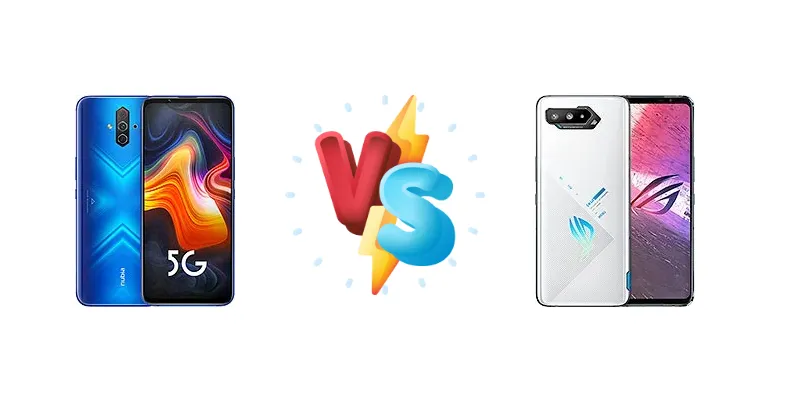
|
🏆 Quick Verdict
For the average gamer prioritizing value, the ZTE nubia Play offers a surprisingly capable experience. However, the Asus ROG Phone 5s is the clear winner for serious gamers demanding the highest frame rates, fastest charging, and sustained performance, justifying its higher price tag with a significantly more powerful chipset.
| PHONES | ||
|---|---|---|
| Phone Names | ZTE nubia Play | Asus ROG Phone 5s |
| Network | ||
|---|---|---|
| 2G bands | GSM 850 / 900 / 1800 / 1900 | GSM 850 / 900 / 1800 / 1900 |
| 3G bands | HSDPA 850 / 900 / 1900 / 2100 | HSDPA 800 / 850 / 900 / 1700(AWS) / 1800 / 1900 / 2100 - Version 1 |
| 4G bands | 1, 2, 3, 4, 5, 7, 8, 20, 34, 38, 39, 40, 41 | 1, 2, 3, 4, 5, 7, 8, 12, 13, 17, 18, 19, 20, 25, 26, 28, 29, 30, 32, 34, 38, 39, 40, 41, 42, 48, 66, 71 - Version 1 |
| 5G bands | 1, 41, 78, 79 SA/NSA | 1, 2, 3, 5, 7, 8, 12, 20, 25, 28, 38, 40, 41, 66, 71, 77, 78, 79 SA/NSA - Version 1 |
| Speed | HSPA, LTE, 5G | HSPA 42.2/5.76 Mbps, LTE (7CA) Cat20 1400/150 Mbps, 5G 4 Gbps DL |
| Technology | GSM / CDMA / HSPA / LTE / 5G | GSM / HSPA / LTE / 5G |
| CDMA 800 / 1900 & TD-SCDMA | 2, 3, 5, 7, 12, 20, 25, 28, 38, 40, 66, 71, 77, 78, 79 SA/NSA - Version 4 | |
| Launch | ||
|---|---|---|
| Announced | 2020, April 21. Released 2020, April 24 | 2021, August 16 |
| Status | Discontinued | Available. Released 2021, August 26 |
| Body | ||
|---|---|---|
| Build | - | Glass front (Gorilla Glass Victus), glass back (Gorilla Glass 3), aluminum frame |
| Dimensions | 171.7 x 78.5 x 9.1 mm (6.76 x 3.09 x 0.36 in) | 172.8 x 77.3 x 9.9 mm (6.80 x 3.04 x 0.39 in) |
| SIM | Nano-SIM + Nano-SIM | Nano-SIM + Nano-SIM |
| Weight | 210 g (7.41 oz) | 238 g (8.40 oz) |
| Touch sensitive gaming triggers | RGB light panel (on the back) Pressure sensitive zones (Gaming triggers) | |
| Display | ||
|---|---|---|
| Protection | - | Corning Gorilla Glass Victus |
| Resolution | 1080 x 2340 pixels, 19.5:9 ratio (~388 ppi density) | 1080 x 2448 pixels (~395 ppi density) |
| Size | 6.65 inches, 108.6 cm2 (~80.5% screen-to-body ratio) | 6.78 inches, 109.5 cm2 (~82.0% screen-to-body ratio) |
| Type | AMOLED, 144Hz | AMOLED, 1B colors, 144Hz, HDR10+, 800 nits (typ), 1200 nits (peak) |
| Platform | ||
|---|---|---|
| CPU | Octa-core (1x2.4 GHz Kryo 475 Prime & 1x2.2 GHz Kryo 475 Gold & 6x1.8 GHz Kryo 475 Silver) | Octa-core (1x2.99 GHz Cortex-X1 & 3x2.42 GHz Cortex-A78 & 4x1.80 GHz Cortex-A55) |
| Chipset | Qualcomm SM7250 Snapdragon 765G 5G (7 nm) | Qualcomm SM8350 Snapdragon 888+ 5G (5 nm) |
| GPU | Adreno 620 | Adreno 660 |
| OS | Android 10, nubia UI 8.0 | Android 11, upgradable to Android 13, ROG UI |
| Memory | ||
|---|---|---|
| Card slot | No | No |
| Internal | 128GB 6GB RAM, 128GB 8GB RAM, 256GB 8GB RAM | 128GB 8GB RAM, 128GB 12GB RAM, 256GB 12GB RAM, 256GB 16GB RAM, 512GB 16GB RAM, 512GB 18GB RAM |
| UFS 2.1 | UFS 3.1 | |
| Main Camera | ||
|---|---|---|
| Features | LED flash, panorama, HDR | LED flash, HDR, panorama |
| Quad | 48 MP, f/1.8, (wide), 1/2.0", 0.8µm, PDAF 8 MP, f/2.2, 13mm (ultrawide), 1/4.0", 1.12µm 2 MP (macro) Auxiliary lens | - |
| Triple | - | 64 MP, f/1.8, 26mm (wide), 1/1.73", 0.8µm, PDAF 13 MP, f/2.4, 11mm, 125˚ (ultrawide) 5 MP (macro) |
| Video | 4K@30/60fps, 1080p@30fps; gyro-EIS | 8K@30fps, 4K@30/60/120fps, 1080p@30/60/120/240fps, 720p@480fps; gyro-EIS |
| Selfie camera | ||
|---|---|---|
| Features | HDR | Panorama, HDR |
| Single | 12 MP, (wide) | 24 MP, f/2.5, 27mm (wide), 0.9µm |
| Video | 1080p@30fps | 1080p@30fps |
| Sound | ||
|---|---|---|
| 3.5mm jack | No | Yes |
| 35mm jack | No | Yes |
| Loudspeaker | Yes | Yes, with stereo speakers (2 amplifiers) |
| 24-bit/192kHz audio | 24-bit/192kHz audio | |
| Comms | ||
|---|---|---|
| Bluetooth | 5.0, A2DP, LE | 5.2, A2DP, LE, aptX HD, aptX Adaptive |
| NFC | Yes | Yes |
| Positioning | GPS (L1+L5), GLONASS, BDS | GPS (L1+L5), GLONASS (L1), BDS (B1I+B1c+B2a), GALILEO (E1+E5a), QZSS (L1+L5), NavIC (L5) |
| Radio | No | No |
| USB | USB Type-C 2.0, OTG | USB Type-C 3.1 (side), USB Type-C 2.0 (bottom), OTG, accessory connector |
| WLAN | Wi-Fi 802.11 a/b/g/n/ac, dual-band, Wi-Fi Direct | Wi-Fi 802.11 a/b/g/n/ac/6e, dual-band, Wi-Fi Direct |
| Features | ||
|---|---|---|
| Sensors | Fingerprint (under display, optical), accelerometer, gyro, proximity, compass | Fingerprint (under display, optical), accelerometer, gyro, proximity, compass |
| Battery | ||
|---|---|---|
| Charging | 30W wired | 65W wired, PD3.0, QC5, 70% in 30 min, 100% in 52 min 10W reverse wired |
| Type | Li-Ion 5100 mAh | Li-Po 6000 mAh |
| Misc | ||
|---|---|---|
| Colors | Black, White, Blue | Phantom Black, Storm White |
| Models | NX651J | ZS676KS |
| Price | About 310 EUR | About 1030 EUR |
ZTE nubia Play
- Significantly more affordable price point
- Competent Snapdragon 765G for casual gaming
- 5G connectivity for fast download speeds
- Substantially weaker performance compared to the ROG Phone 5s
- Slower 30W charging
- Likely less advanced camera system
Asus ROG Phone 5s
- Flagship Snapdragon 888+ for top-tier performance
- Ultra-fast 65W charging with PD3.0 and QC5 support
- Advanced gaming features (likely including triggers and cooling)
- Higher price tag
- Potential for thermal throttling under extreme load (though mitigated by the 5nm process)
- Larger size and weight compared to the nubia Play
Display Comparison
While both devices likely feature high refresh rate displays (data not provided, but standard for the segment), the core difference lies in the processing power driving them. The nubia Play's Snapdragon 765G will struggle to consistently push high frame rates in demanding titles compared to the ROG Phone 5s. The 5s benefits from the Snapdragon 888+, allowing it to fully utilize a high refresh rate panel. The ROG Phone 5s also likely boasts a higher peak brightness, enhancing visibility in outdoor conditions, a detail not available for the nubia Play.
Camera Comparison
Camera performance isn't the primary focus of either device, but the ROG Phone 5s likely benefits from a more sophisticated image signal processor (ISP) integrated within the Snapdragon 888+. While sensor sizes and apertures aren't specified, the ROG Phone 5s' flagship chipset allows for better image processing, particularly in low-light conditions. The nubia Play's camera system will likely be adequate for casual photography, but won't compete with the image quality achievable on the ROG Phone 5s.
Performance
The Asus ROG Phone 5s’ Snapdragon 888+ 5G (5nm) is a substantial upgrade over the ZTE nubia Play’s Snapdragon 765G (7nm). The 888+ features a Cortex-X1 prime core clocked at 2.99 GHz, offering significantly higher single-core performance. The 5nm process node also provides superior power efficiency and thermal headroom, reducing the likelihood of throttling during extended gaming sessions. The nubia Play’s Kryo 475 cores, while competent, simply cannot match the raw processing power of the 888+. This translates to faster loading times, smoother gameplay, and the ability to run games at higher graphical settings.
Battery Life
The Asus ROG Phone 5s’ 65W wired charging is a game-changer, achieving a 70% charge in just 30 minutes and a full charge in 52 minutes. This minimizes downtime between gaming sessions. The nubia Play’s 30W charging is considerably slower. While battery capacity isn't specified, the ROG Phone 5s’ faster charging effectively mitigates any potential disadvantage from a slightly smaller battery, offering a more convenient user experience for power users.
Buying Guide
Buy the ZTE nubia Play if you need a capable 5G gaming phone without breaking the bank, and are willing to accept some performance compromises. It's ideal for casual to moderate gamers who prioritize affordability. Buy the Asus ROG Phone 5s if you prefer uncompromising performance, rapid 65W charging, and features specifically designed for competitive gaming, such as advanced cooling and customizable triggers. This is the choice for hardcore mobile gamers.