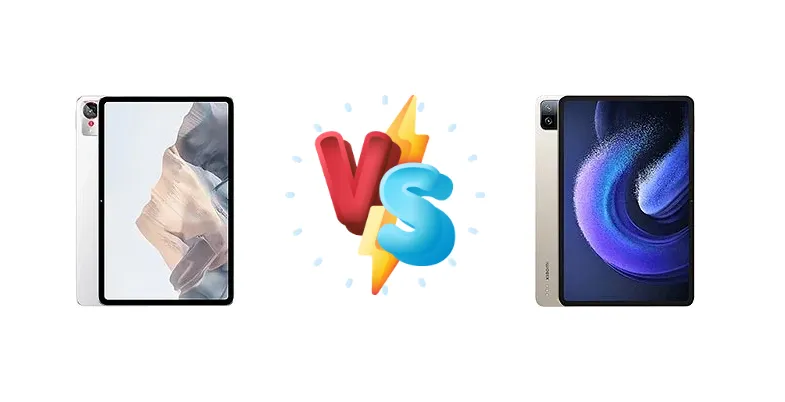
The Android tablet market is heating up, with both ZTE and Xiaomi offering compelling high-performance options. The ZTE nubia Pad Pro, powered by the latest Snapdragon 8 Gen 3, directly challenges the Xiaomi Pad 6 Pro, which utilizes the Snapdragon 8+ Gen 1. This comparison dissects the key differences between these two tablets, focusing on performance, charging, and overall user experience to determine which one reigns supreme.
🏆 Quick Verdict
For users prioritizing raw processing power and future-proofing, the ZTE nubia Pad Pro is the clear winner thanks to its Snapdragon 8 Gen 3 chipset. However, the Xiaomi Pad 6 Pro offers a very competitive experience at potentially a lower price point, with a refined software experience and comparable charging speeds.
| Network |
|---|
| 2G bands | N/A | N/A |
| 3G bands | N/A | N/A |
| 4G bands | N/A | - |
| EDGE | No | N/A |
| GPRS | No | N/A |
| Technology | No cellular connectivity | No cellular connectivity |
| Launch |
|---|
| Announced | 2025, April 28 | 2023, April 18 |
| Status | Available. Released 2025, April 28 | Available. Released 2023, April 30 |
| Body |
|---|
| Build | Glass front, aluminum frame, aluminum back | Glass front (Gorilla Glass 3), aluminum frame, aluminum back |
| Dimensions | 253.3 x 164.6 x 7.3 mm (9.97 x 6.48 x 0.29 in) | 254 x 165.2 x 6.5 mm (10.0 x 6.50 x 0.26 in) |
| SIM | No | No |
| Weight | 523 g (1.15 lb) | 490 g (1.08 lb) |
| | - | Stylus support (magnetic) |
| Display |
|---|
| Protection | - | Corning Gorilla Glass 3 |
| Resolution | 1800 x 2880 pixels, 16:10 ratio (~312 ppi density) | 1800 x 2880 pixels, 16:10 ratio (~309 ppi density) |
| Size | 10.9 inches, 344.5 cm2 (~82.6% screen-to-body ratio) | 11.0 inches, 350.9 cm2 (~83.6% screen-to-body ratio) |
| Type | IPS LCD, 1B colors, 144Hz | IPS LCD, 1B colors, 144Hz, HDR10, Dolby Vision, 550 nits |
| Platform |
|---|
| CPU | Octa-core (1x3.3 GHz Cortex-X4 & 3x3.2 GHz Cortex-A720 & 2x3.0 GHz Cortex-A720 & 2x2.3 GHz Cortex-A520) | Octa-core (1x3.19 GHz Cortex-X2 & 3x2.75 GHz Cortex-A710 & 4x1.80 GHz Cortex-A510) |
| Chipset | Qualcomm SM8650-AB Snapdragon 8 Gen 3 (4 nm) | Qualcomm SM8475 Snapdragon 8+ Gen 1 (4 nm) |
| GPU | Adreno 750 | Adreno 730 |
| OS | Android 15 | Android 13, MIUI 14 |
| Memory |
|---|
| Card slot | No | No |
| Internal | 256GB 8GB RAM, 256GB 12GB RAM, 512GB 16GB RAM, 1TB 16GB RAM | 128GB 8GB RAM, 256GB 8GB RAM, 256GB 12GB RAM, 512GB 12GB RAM |
| | - | UFS 3.1 |
| Main Camera |
|---|
| Dual | - | 50 MP, f/1.8, (wide), 1/2.76", 0.64µm, PDAF
Auxiliary lens |
| Features | LED flash, HDR, panorama | Dual-LED flash, HDR, panorama |
| Single | 13 MP, (wide) | - |
| Video | Yes | 4K@30/60fps, 1080p@30/60fps |
| Selfie camera |
|---|
| Single | 20 MP, f/2.0, 26mm (wide) | 20 MP, f/2.2, (wide), 1/3.4", 0.8µm |
| Video | 1080p@30fps | 1080p@30/60fps |
| Sound |
|---|
| 3.5mm jack | - | No |
| 35mm jack | No | No |
| Loudspeaker | Yes, with stereo speakers (4 speakers) | Yes, with stereo speakers (4 speakers) |
| | - | 24-bit/192kHz audio |
| Comms |
|---|
| Bluetooth | Yes | 5.3, A2DP, LE |
| NFC | No | No |
| Positioning | No | No |
| Radio | No | No |
| USB | USB Type-C 3.2, video output, magnetic connector pins | USB Type-C 3.2, accessory connector |
| WLAN | Yes | Wi-Fi 802.11 a/b/g/n/a/6e, dual-band, Wi-Fi Direct |
| Features |
|---|
| Sensors | Unspecified | Accelerometer, gyro, proximity (accessories only) |
| Battery |
|---|
| Charging | 66W wired | 67W wired, PD3.0, QC4, 100% in 1 hour |
| Type | 10100 mAh | Li-Po 8600 mAh |
| Misc |
|---|
| Colors | Gray, White | Black, Blue, Gold |
| Models | - | 23046RP50C |
| Price | About 420 EUR | About 330 EUR |
ZTE nubia Pad Pro
- Significantly more powerful Snapdragon 8 Gen 3 processor
- Potentially better thermal management due to 4nm process
- Future-proofed for demanding applications and games
- Likely higher price point
- Battery life dependent on capacity and software optimization
Xiaomi Pad 6 Pro
- Competitive performance with Snapdragon 8+ Gen 1
- Fast 67W charging with PD3.0 and QC4 support
- Potentially more affordable price
- Older generation processor
- May exhibit more throttling under sustained load
Display Comparison
While both tablets likely feature high-quality LCD panels (specific panel details are missing), the core difference lies in the processing power driving them. The display quality will be heavily influenced by calibration, which is currently unknown. However, the Snapdragon 8 Gen 3 in the nubia Pad Pro will ensure smoother rendering of complex visuals and animations, potentially making a difference in fast-paced games or video playback. Bezels are a key area for tablet experience, and a comparison of physical dimensions is needed to determine which offers a more immersive viewing experience.
Camera Comparison
Without detailed camera specifications, a direct comparison is limited. However, given the tablet form factor, camera performance is typically secondary to other features. Both devices likely feature multi-camera setups, but the nubia Pad Pro’s superior processing power could lead to better image processing and potentially improved low-light performance. The focus should be on the main sensor resolution and aperture, as these are the most critical factors for image quality. The inclusion of OIS (Optical Image Stabilization) would be a significant advantage for either device.
Performance
The ZTE nubia Pad Pro’s Snapdragon 8 Gen 3 represents a significant architectural leap over the Xiaomi Pad 6 Pro’s Snapdragon 8+ Gen 1. The Gen 3 features a new Cortex-X4 prime core clocked at 3.3 GHz, compared to the Gen 1’s Cortex-X2 at 3.19 GHz. This, combined with the newer Cortex-A720 performance cores, translates to a substantial performance advantage in CPU-intensive tasks. The Snapdragon 8 Gen 3’s improved NPU will also benefit AI-powered features. While the 8+ Gen 1 remains a capable chip, the Gen 3 offers a clear generational advantage, particularly in sustained performance due to its 4nm process node offering better thermal efficiency.
Battery Life
Both tablets offer fast charging with 66W and 67W respectively, with the Xiaomi Pad 6 Pro advertising a full charge in one hour. The slight difference in wattage is unlikely to be noticeable in real-world usage. Battery life will ultimately depend on the battery capacity (currently unknown for both devices) and software optimization. The Snapdragon 8 Gen 3’s improved efficiency could potentially offset a smaller battery capacity in the nubia Pad Pro, but a direct comparison requires testing both devices under identical conditions.
Buying Guide
Buy the ZTE nubia Pad Pro if you demand the absolute best performance for demanding tasks like video editing, high-end gaming, or running multiple applications simultaneously. Buy the Xiaomi Pad 6 Pro if you prioritize a balanced experience with a strong focus on software optimization, efficient power management, and potentially a more accessible price point, making it ideal for everyday productivity and entertainment.
Frequently Asked Questions
❓ Will the Snapdragon 8 Gen 3 in the nubia Pad Pro handle demanding games like Genshin Impact at maximum settings?
Yes, the Snapdragon 8 Gen 3 is designed to handle even the most graphically intensive mobile games at maximum settings with consistently high frame rates. Its advanced GPU and thermal management capabilities will ensure a smooth and enjoyable gaming experience.
❓ Does the Xiaomi Pad 6 Pro support external displays or accessories for productivity?
While specific accessory support requires further investigation, Xiaomi tablets generally offer support for external keyboards and displays via USB-C. The Pad 6 Pro’s USB-C port likely supports display output, making it suitable for use with external monitors for enhanced productivity.
❓ How does the thermal performance of the Snapdragon 8+ Gen 1 in the Xiaomi Pad 6 Pro hold up during extended gaming sessions?
The Snapdragon 8+ Gen 1 is known for its relatively efficient thermal performance. However, prolonged gaming at maximum settings may still lead to some throttling to prevent overheating. The Xiaomi Pad 6 Pro likely incorporates thermal management solutions to mitigate this, but the nubia Pad Pro with the Gen 3 will likely perform better in sustained loads.