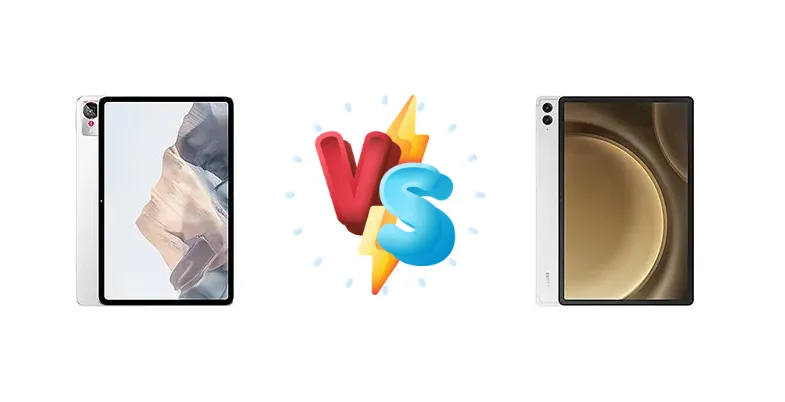
The Android tablet market is heating up, with the ZTE nubia Pad Pro aiming to disrupt the space with flagship-level processing power, while the Samsung Galaxy Tab S9 FE+ offers a compelling blend of features and Samsung’s established ecosystem. This comparison dissects the core differences between these two tablets, focusing on performance, battery life, and overall user experience.
🏆 Quick Verdict
For users prioritizing raw performance and demanding tasks like gaming or video editing, the ZTE nubia Pad Pro is the clear winner thanks to its Snapdragon 8 Gen 3. However, the Samsung Galaxy Tab S9 FE+ provides a more balanced experience with broader software support and a potentially more refined user interface for the average consumer.
| Network |
|---|
| 2G bands | N/A | GSM 850 / 900 / 1800 / 1900 |
| 3G bands | N/A | HSDPA 850 / 900 / 1700(AWS) / 1900 / 2100 |
| 4G bands | N/A | 1, 2, 3, 4, 5, 7, 8, 12, 13, 17, 20, 26, 28, 32, 38, 40, 41, 66 |
| 5G bands | - | 1, 3, 5, 7, 8, 20, 28, 38, 40, 41, 66, 77, 78 SA/NSA/Sub6 |
| EDGE | No | - |
| GPRS | No | - |
| Speed | - | HSPA, LTE, 5G - cellular model only |
| Technology | No cellular connectivity | GSM / HSPA / LTE / 5G |
| Launch |
|---|
| Announced | 2025, April 28 | 2023, October 04 |
| Status | Available. Released 2025, April 28 | Available. Released 2023, October 16 |
| Body |
|---|
| Build | Glass front, aluminum frame, aluminum back | Glass front, aluminum back, aluminum frame |
| Dimensions | 253.3 x 164.6 x 7.3 mm (9.97 x 6.48 x 0.29 in) | 285.4 x 185.4 x 6.5 mm (11.24 x 7.30 x 0.26 in) |
| SIM | No | Nano-SIM + eSIM (cellular model only) |
| Weight | 523 g (1.15 lb) | 627 g or 628 g (1.38 lb) |
| Display |
|---|
| Resolution | 1800 x 2880 pixels, 16:10 ratio (~312 ppi density) | 1600 x 2560 pixels, 16:10 ratio (~243 ppi density) |
| Size | 10.9 inches, 344.5 cm2 (~82.6% screen-to-body ratio) | 12.4 inches, 445.8 cm2 (~84.3% screen-to-body ratio) |
| Type | IPS LCD, 1B colors, 144Hz | IPS LCD, 90Hz |
| Platform |
|---|
| CPU | Octa-core (1x3.3 GHz Cortex-X4 & 3x3.2 GHz Cortex-A720 & 2x3.0 GHz Cortex-A720 & 2x2.3 GHz Cortex-A520) | Octa-core (4x2.4 GHz Cortex-A78 & 4x2.0 GHz Cortex-A55) |
| Chipset | Qualcomm SM8650-AB Snapdragon 8 Gen 3 (4 nm) | Exynos 1380 (5 nm) |
| GPU | Adreno 750 | Mali-G68 MP5 |
| OS | Android 15 | Android 13, up to 4 major Android upgrades, One UI 6 |
| Memory |
|---|
| Card slot | No | microSDXC (dedicated slot) |
| Internal | 256GB 8GB RAM, 256GB 12GB RAM, 512GB 16GB RAM, 1TB 16GB RAM | 128GB 6GB RAM, 128GB 8GB RAM, 256GB 8GB RAM, 256GB 12GB RAM |
| Main Camera |
|---|
| Dual | - | 8 MP, (wide)
8 MP, (ultrawide) |
| Features | LED flash, HDR, panorama | - |
| Single | 13 MP, (wide) | - |
| Video | Yes | 4K@30fps, 1080p@30fps |
| Selfie camera |
|---|
| Single | 20 MP, f/2.0, 26mm (wide) | 12 MP, (ultrawide) |
| Video | 1080p@30fps | Yes |
| Sound |
|---|
| 35mm jack | No | No |
| Loudspeaker | Yes, with stereo speakers (4 speakers) | Yes, with stereo speakers |
| Comms |
|---|
| Bluetooth | Yes | 5.3, A2DP, LE |
| NFC | No | No |
| Positioning | No | GPS, GALILEO, GLONASS, BDS, QZSS - cellular model only |
| Radio | No | No |
| USB | USB Type-C 3.2, video output, magnetic connector pins | USB Type-C 2.0, magnetic connector |
| WLAN | Yes | Wi-Fi 802.11 a/b/g/n/ac/6, dual-band, Wi-Fi Direct |
| Features |
|---|
| Sensors | Unspecified | Fingerprint (side-mounted), accelerometer, gyro, compass, proximity (accessories only) |
| Battery |
|---|
| Charging | 66W wired | 45W wired, QC2.0 |
| Type | 10100 mAh | Li-Po 10090 mAh |
| Misc |
|---|
| Colors | Gray, White | Mint, Silver, Gray, Lavender |
| Models | - | SM-X610, SM-X616B |
| Price | About 420 EUR | About 770 EUR |
| SAR | - | 0.77 W/kg (body) |
| SAR EU | - | 0.50 W/kg (body) |
ZTE nubia Pad Pro
- Significantly faster processor (Snapdragon 8 Gen 3)
- Faster 66W wired charging
- Potentially better thermal management
- Less established software ecosystem
- Potential for higher price
Samsung Galaxy Tab S9 FE+
- Integration with Samsung ecosystem
- Potentially more refined software experience
- Good balance of features and price
- Slower processor (Exynos 1380)
- Slower 45W wired charging
- May exhibit throttling under sustained load
Display Comparison
While both tablets likely feature LCD panels (data not provided), the core difference lies in the processing power driving them. The nubia Pad Pro’s Snapdragon 8 Gen 3 will handle graphically intensive tasks with ease, potentially allowing for higher refresh rates and smoother animations. The Exynos 1380 in the Tab S9 FE+ is a capable chip, but will likely exhibit more performance limitations when pushed to its limits. Without specific display specs, it's difficult to compare brightness or color accuracy, but the Snapdragon's superior GPU could enable more advanced display features.
Camera Comparison
Camera performance is difficult to assess without detailed sensor information. However, given the tablet form factor, camera quality is rarely a primary concern. It's reasonable to assume both tablets will offer adequate cameras for casual use. The absence of detailed camera specs suggests neither device is positioned as a photography powerhouse. We can expect the nubia Pad Pro’s image signal processor (ISP) within the Snapdragon 8 Gen 3 to offer more advanced image processing capabilities, potentially resulting in slightly better image quality in challenging lighting conditions.
Performance
The performance gap is significant. The ZTE nubia Pad Pro’s Snapdragon 8 Gen 3, built on a 4nm process, offers a substantial advantage over the Samsung Galaxy Tab S9 FE+'s Exynos 1380 (5nm). The Snapdragon 8 Gen 3’s Cortex-X4 prime core clocked at 3.3 GHz, combined with its more modern architecture, translates to faster application loading, smoother multitasking, and superior gaming performance. The 5nm process of the Exynos 1380 is more efficient, but the architectural differences favor the Snapdragon. The nubia Pad Pro is likely to maintain higher sustained performance due to better thermal management afforded by the 4nm node.
Battery Life
The nubia Pad Pro’s 66W wired charging is a clear advantage over the Tab S9 FE+'s 45W charging, allowing for significantly faster top-ups. While battery capacity isn’t specified, the faster charging speed mitigates any potential disadvantage if the nubia Pad Pro has a slightly smaller battery. The Exynos 1380’s 5nm process contributes to better power efficiency, potentially leading to comparable or even slightly longer battery life in less demanding scenarios. However, under heavy load, the Snapdragon 8 Gen 3’s superior performance will likely consume more power, but the faster charging will offset this.
Buying Guide
Buy the ZTE nubia Pad Pro if you need uncompromising performance for demanding applications, prioritize fast charging, and aren't heavily invested in the Samsung ecosystem. Buy the Samsung Galaxy Tab S9 FE+ if you prefer a tablet deeply integrated with Samsung’s services, value a more polished software experience, and prioritize a balance between features and price.
Frequently Asked Questions
❓ Does the Exynos 1380 in the Galaxy Tab S9 FE+ overheat during extended gaming sessions?
The Exynos 1380 is a capable chip, but it's likely to experience thermal throttling during prolonged, graphically demanding gaming. While the 5nm process helps with efficiency, it lacks the thermal headroom of the Snapdragon 8 Gen 3's 4nm process, potentially leading to reduced performance over time.
❓ How much faster is the 66W charging on the nubia Pad Pro compared to the 45W charging on the Tab S9 FE+?
The 66W charging on the nubia Pad Pro will significantly reduce charging times. While exact figures depend on battery capacity, expect a 0-100% charge to be at least 30-40% faster on the nubia Pad Pro, minimizing downtime and maximizing usability.
❓ Is the performance difference between the Snapdragon 8 Gen 3 and Exynos 1380 noticeable in everyday tasks like browsing and video streaming?
For basic tasks like web browsing and video streaming, the performance difference will be minimal. However, when multitasking with several apps, editing photos or videos, or playing demanding games, the Snapdragon 8 Gen 3 will provide a noticeably smoother and more responsive experience.