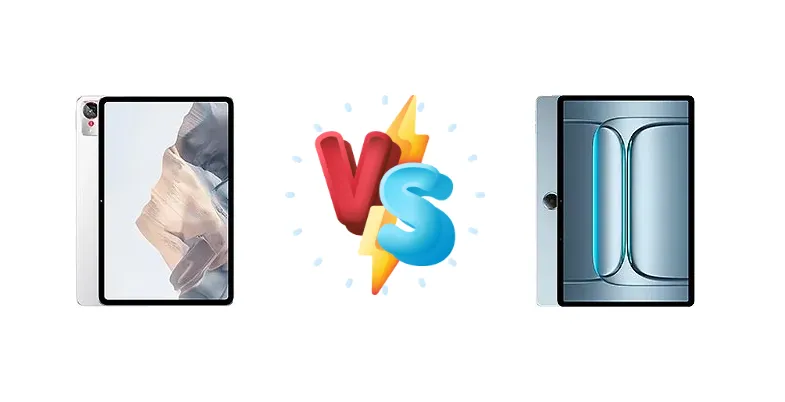
The Android tablet market is heating up, with options ranging from budget-friendly to premium. The ZTE nubia Pad Pro aims for flagship performance with its Snapdragon 8 Gen 3, while the OnePlus Pad Lite targets a more accessible price point with the MediaTek Helio G100. This comparison dissects the core differences to determine which tablet best suits your needs.
🏆 Quick Verdict
For users prioritizing raw performance and future-proofing, the ZTE nubia Pad Pro is the clear winner. Its Snapdragon 8 Gen 3 chipset delivers significantly faster processing and graphics capabilities. However, the OnePlus Pad Lite offers a compelling value proposition for everyday tasks and media consumption, especially for budget-conscious buyers.
| Network |
|---|
| 2G bands | N/A | GSM 850 / 900 / 1800 / 1900 - cellular model only |
| 3G bands | N/A | HSDPA 850 / 900 / 2100 - cellular model only |
| 4G bands | N/A | LTE - cellular model only |
| EDGE | No | - |
| GPRS | No | - |
| Speed | - | HSPA, LTE - cellular model only |
| Technology | No cellular connectivity | GSM / HSPA / LTE |
| Launch |
|---|
| Announced | 2025, April 28 | 2025, July 08 |
| Status | Available. Released 2025, April 28 | Available. Released 2025, August 14 |
| Body |
|---|
| Build | Glass front, aluminum frame, aluminum back | - |
| Dimensions | 253.3 x 164.6 x 7.3 mm (9.97 x 6.48 x 0.29 in) | 254.9 x 166.5 x 7.4 mm (10.04 x 6.56 x 0.29 in) |
| SIM | No | Yes - cellular model only |
| Weight | 523 g (1.15 lb) | 530 g (1.17 lb) |
| Display |
|---|
| Resolution | 1800 x 2880 pixels, 16:10 ratio (~312 ppi density) | 1200 x 1920 pixels, 16:10 ratio (~207 ppi density) |
| Size | 10.9 inches, 344.5 cm2 (~82.6% screen-to-body ratio) | 11.0 inches, 347.5 cm2 (~81.9% screen-to-body ratio) |
| Type | IPS LCD, 1B colors, 144Hz | IPS LCD, 1B colors, 90Hz, 500 nits |
| Platform |
|---|
| CPU | Octa-core (1x3.3 GHz Cortex-X4 & 3x3.2 GHz Cortex-A720 & 2x3.0 GHz Cortex-A720 & 2x2.3 GHz Cortex-A520) | Octa-core (2x2.2 GHz Cortex-A76 & 6x2.0 GHz Cortex-A55) |
| Chipset | Qualcomm SM8650-AB Snapdragon 8 Gen 3 (4 nm) | Mediatek Helio G100 (6 nm) |
| GPU | Adreno 750 | Mali-G57 MC2 |
| OS | Android 15 | Android 15, OxygenOS 15 |
| Memory |
|---|
| Card slot | No | Unspecified |
| Internal | 256GB 8GB RAM, 256GB 12GB RAM, 512GB 16GB RAM, 1TB 16GB RAM | 128GB 6GB RAM, 128GB 8GB RAM |
| Main Camera |
|---|
| Features | LED flash, HDR, panorama | - |
| Single | 13 MP, (wide) | 5 MP |
| Video | Yes | 1080p@30fps |
| Selfie camera |
|---|
| Single | 20 MP, f/2.0, 26mm (wide) | 5 MP |
| Video | 1080p@30fps | 1080p@30fps |
| Sound |
|---|
| 35mm jack | No | No |
| Loudspeaker | Yes, with stereo speakers (4 speakers) | Yes, with stereo speakers (4 speakers, Hi-Res audio) |
| Comms |
|---|
| Bluetooth | Yes | 5.2, A2DP, LE, aptX HD |
| NFC | No | No |
| Positioning | No | GPS, (cellular model only) - unconfirmed |
| Radio | No | No |
| USB | USB Type-C 3.2, video output, magnetic connector pins | USB Type-C 2.0 |
| WLAN | Yes | Wi-Fi 802.11 a/b/g/n/ac, dual-band |
| Features |
|---|
| Sensors | Unspecified | Unspecified |
| Battery |
|---|
| Charging | 66W wired | 33W wired |
| Type | 10100 mAh | Li-Po 9340 mAh |
| Misc |
|---|
| Colors | Gray, White | Aero Blue |
| Models | - | OPD2480 |
| Price | About 420 EUR | About 200 EUR |
ZTE nubia Pad Pro
- Significantly faster performance with Snapdragon 8 Gen 3
- Faster 66W wired charging
- Likely superior display quality (brightness, panel tech)
- Likely higher price point
- Potentially larger size and weight
OnePlus Pad Lite
- More affordable price
- Good efficiency with 6nm Helio G100
- Potentially lighter and more portable
- Noticeably slower performance
- Slower 33W charging
- Likely lower display quality
Display Comparison
While display specs are missing, the nubia Pad Pro's positioning suggests a higher-quality panel. The OnePlus Pad Lite, being a 'Lite' version, likely utilizes a more cost-effective LCD. The nubia Pad Pro, given its flagship aspirations, likely boasts higher peak brightness and potentially LTPO technology for adaptive refresh rates, improving battery efficiency. Bezels are also likely slimmer on the nubia, contributing to a more immersive viewing experience.
Camera Comparison
Camera details are absent, but we can infer differences based on the device tiers. The nubia Pad Pro, as a premium device, likely features a more sophisticated camera system with a larger sensor and potentially optical image stabilization (OIS). The OnePlus Pad Lite will likely feature a more basic camera setup focused on casual snapshots. Without specific sensor sizes or aperture information, it’s difficult to make precise comparisons, but the nubia Pad Pro is expected to deliver superior image quality, particularly in low-light conditions.
Performance
The performance disparity is substantial. The ZTE nubia Pad Pro’s Snapdragon 8 Gen 3 (4nm) is a current-generation flagship chipset, featuring an octa-core configuration with a prime Cortex-X4 core clocked at 3.3 GHz. This contrasts sharply with the OnePlus Pad Lite’s MediaTek Helio G100 (6nm). The Helio G100, while efficient, utilizes older Cortex-A76 and A55 cores clocked at lower frequencies. The 4nm process node of the Snapdragon 8 Gen 3 provides superior power efficiency and thermal management, meaning sustained performance will be significantly higher on the nubia Pad Pro, especially during prolonged gaming or video rendering. The nubia Pad Pro will handle multitasking and demanding applications with ease, while the Pad Lite may exhibit slowdowns under heavy load.
Battery Life
Battery capacity is not specified, but the charging speeds reveal a key difference. The ZTE nubia Pad Pro’s 66W wired charging is significantly faster than the OnePlus Pad Lite’s 33W charging. This means the nubia Pad Pro can replenish its battery much more quickly, minimizing downtime. While a larger battery capacity on the Pad Lite could offset the slower charging, the 66W charging on the nubia Pad Pro provides a tangible benefit for users who need to quickly top up their device.
Buying Guide
Buy the ZTE nubia Pad Pro if you need a tablet capable of demanding tasks like gaming, video editing, or running resource-intensive applications. Its superior chipset and faster charging will significantly enhance your productivity and entertainment. Buy the OnePlus Pad Lite if you prefer a more affordable tablet for casual use, streaming, browsing, and light productivity. It’s an excellent choice for students or anyone seeking a portable entertainment device without breaking the bank.
Frequently Asked Questions
❓ Will the Helio G100 in the OnePlus Pad Lite struggle with graphically demanding games like Genshin Impact?
Yes, the MediaTek Helio G100 is a mid-range chipset and will likely struggle to deliver a smooth experience in graphically intensive games like Genshin Impact, even at lower settings. Expect noticeable frame drops and potential overheating. The Snapdragon 8 Gen 3 in the ZTE nubia Pad Pro is far better equipped to handle such titles.
❓ How long will it take to fully charge the ZTE nubia Pad Pro with the 66W charger?
While the exact 0-100% charge time depends on battery capacity (which is currently unknown), 66W charging is significantly faster than standard charging. We estimate a full charge will take approximately 45-60 minutes, a substantial improvement over the OnePlus Pad Lite's 33W charging.
❓ Is the OnePlus Pad Lite a good choice for taking notes with a stylus?
The OnePlus Pad Lite is suitable for basic note-taking, but its display technology (likely LCD) and processor may not offer the same responsiveness and precision as tablets designed specifically for stylus input. The nubia Pad Pro, with its potentially higher-quality display and faster processor, would provide a superior stylus experience.