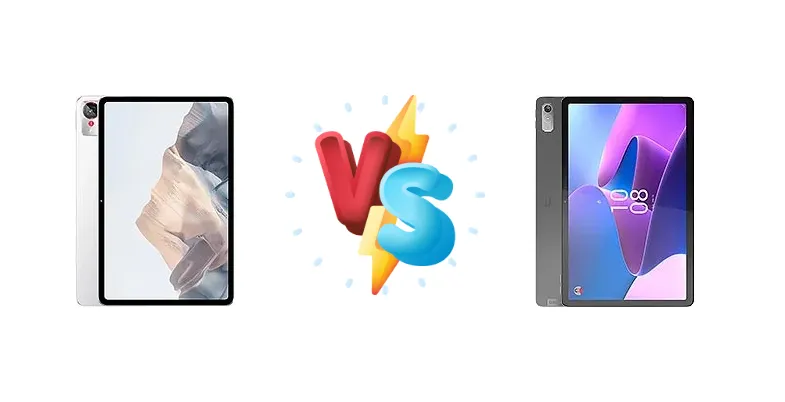
The Android tablet market is heating up, with options ranging from budget-friendly media consumption devices to high-performance productivity powerhouses. The ZTE nubia Pad Pro, armed with the flagship Qualcomm Snapdragon 8 Gen 3, directly challenges the Lenovo Tab P11 Pro Gen 2, which opts for the more efficient Mediatek Kompanio 1300T. This comparison dissects the core differences to determine which tablet best suits your needs.
🏆 Quick Verdict
For users prioritizing raw performance and future-proofing, the ZTE nubia Pad Pro is the clear winner. Its Snapdragon 8 Gen 3 chipset delivers a significantly more responsive experience, especially for demanding tasks like gaming and video editing. However, the Lenovo Tab P11 Pro Gen 2 offers a compelling value proposition for those seeking a balanced tablet experience with good efficiency.
| Network |
|---|
| 2G bands | N/A | GSM 850 / 900 / 1800 / 1900 |
| 3G bands | N/A | HSDPA 850 / 900 / 1900 / 2100 |
| 4G bands | N/A | LTE |
| EDGE | No | - |
| GPRS | No | - |
| Speed | - | HSPA, LTE - cellular model only |
| Technology | No cellular connectivity | GSM / HSPA / LTE |
| Launch |
|---|
| Announced | 2025, April 28 | 2022, September 01 |
| Status | Available. Released 2025, April 28 | Available. Released 2022, September 01 |
| Body |
|---|
| Build | Glass front, aluminum frame, aluminum back | Glass front, plastic back, plastic frame |
| Dimensions | 253.3 x 164.6 x 7.3 mm (9.97 x 6.48 x 0.29 in) | 263.7 x 166.7 x 6.8 mm (10.38 x 6.56 x 0.27 in) |
| SIM | No | Nano-SIM (cellular model only) |
| Weight | 523 g (1.15 lb) | 480 g (1.06 lb) |
| | - | Stylus support (magnetic) |
| Display |
|---|
| Resolution | 1800 x 2880 pixels, 16:10 ratio (~312 ppi density) | 1536 x 2560 pixels, 5:3 ratio (~267 ppi density) |
| Size | 10.9 inches, 344.5 cm2 (~82.6% screen-to-body ratio) | 11.2 inches, 357.0 cm2 (~81.2% screen-to-body ratio) |
| Type | IPS LCD, 1B colors, 144Hz | OLED, HDR10+, Dolby Vision, 120Hz, 420 nits (typ), 600 nits (peak) |
| Platform |
|---|
| CPU | Octa-core (1x3.3 GHz Cortex-X4 & 3x3.2 GHz Cortex-A720 & 2x3.0 GHz Cortex-A720 & 2x2.3 GHz Cortex-A520) | Octa-core (4x2.6 GHz Cortex-A78 & 4x2.0 GHz Cortex-A55) |
| Chipset | Qualcomm SM8650-AB Snapdragon 8 Gen 3 (4 nm) | Mediatek MT8797 Kompanio 1300T (6 nm) |
| GPU | Adreno 750 | Mali-G77 MC9 |
| OS | Android 15 | Android 12, upgradable to Android 13 |
| Memory |
|---|
| Card slot | No | microSDXC (dedicated slot) |
| Internal | 256GB 8GB RAM, 256GB 12GB RAM, 512GB 16GB RAM, 1TB 16GB RAM | 128GB 4GB RAM, 128GB 6GB RAM, 256GB 8GB RAM |
| | - | UFS 3.1 |
| Main Camera |
|---|
| Features | LED flash, HDR, panorama | LED flash |
| Single | 13 MP, (wide) | 13 MP, f/2.4, (wide), AF |
| Video | Yes | 1080p@30fps |
| Selfie camera |
|---|
| Single | 20 MP, f/2.0, 26mm (wide) | 8 MP |
| Video | 1080p@30fps | 1080p@30fps |
| Sound |
|---|
| 3.5mm jack | - | No |
| 35mm jack | No | No |
| Loudspeaker | Yes, with stereo speakers (4 speakers) | Yes, with stereo speakers (4 speakers) |
| | - | Tuned by JBL |
| Comms |
|---|
| Bluetooth | Yes | 5.1, A2DP, LE |
| NFC | No | No |
| Positioning | No | GPS, GLONASS - cellular model only |
| Radio | No | No |
| USB | USB Type-C 3.2, video output, magnetic connector pins | USB Type-C 3.0, OTG, magnetic connector, video output |
| WLAN | Yes | Wi-Fi 802.11 a/b/g/n/ac/6, dual-band, Wi-Fi Direct |
| Features |
|---|
| Sensors | Unspecified | Accelerometer, gyro, proximity, compass |
| Battery |
|---|
| Charging | 66W wired | 20W wired, QC3 |
| Type | 10100 mAh | Li-Po 8200 mAh |
| Misc |
|---|
| Colors | Gray, White | Storm Grey, Oat |
| Models | - | ZAB50194GB, ZAB50043SE |
| Price | About 420 EUR | About 500 EUR |
| Tests |
|---|
| Performance | - |
AnTuTu: 616573 (v9)
GeekBench: 2827 (v5.1) |
ZTE nubia Pad Pro
- Unmatched performance with Snapdragon 8 Gen 3
- Ultra-fast 66W charging
- Potentially superior camera system
- Future-proofed for demanding applications
- Likely higher price point
- Potentially higher thermal output under sustained load
Lenovo Tab P11 Pro Gen 2
- More affordable price
- Good power efficiency with Kompanio 1300T
- Balanced performance for everyday tasks
- QC3 fast charging support
- Significantly lower performance compared to Snapdragon 8 Gen 3
- Slower 20W charging
Display Comparison
While both tablets likely feature high-resolution displays (data not provided), the core difference lies in the processing power driving them. Display quality will be a key differentiator, but without specific nit brightness or panel technology details, it's difficult to assess. However, the nubia Pad Pro's superior chipset will allow for smoother rendering of complex visuals and potentially higher refresh rates if supported by the display panel.
Camera Comparison
Without detailed camera specifications, a direct comparison is limited. However, the nubia brand often prioritizes camera capabilities, suggesting the Pad Pro may feature a more advanced camera system. The Lenovo Tab P11 Pro Gen 2 likely offers a competent camera for casual use, but the nubia Pad Pro is expected to deliver superior image quality and features, potentially including advanced image processing algorithms leveraging the Snapdragon 8 Gen 3’s ISP.
Performance
The performance gap is substantial. The ZTE nubia Pad Pro’s Qualcomm SM8650-AB Snapdragon 8 Gen 3 (4nm) is a flagship chipset built on a cutting-edge 4nm process, featuring an octa-core configuration with a prime Cortex-X4 core clocked at 3.3 GHz. This contrasts sharply with the Lenovo Tab P11 Pro Gen 2’s Mediatek MT8797 Kompanio 1300T (6nm) and its octa-core setup with Cortex-A78 cores peaking at 2.6 GHz. The 4nm node of the Snapdragon 8 Gen 3 offers significantly improved power efficiency and thermal performance, translating to sustained peak performance during intensive tasks. The Snapdragon’s architecture, with newer Cortex-A720 cores, also provides a generational leap in instruction processing compared to the Tab P11 Pro Gen 2’s A78 cores. This means faster app loading, smoother multitasking, and a more responsive overall experience on the nubia Pad Pro.
Battery Life
The ZTE nubia Pad Pro’s 66W wired charging is a significant advantage over the Lenovo Tab P11 Pro Gen 2’s 20W charging with QC3. This translates to substantially faster charging times, minimizing downtime. While battery capacity isn’t specified for either device, the Snapdragon 8 Gen 3’s efficiency could offset a potentially smaller battery in the nubia Pad Pro, providing comparable or even better real-world battery life despite the higher performance demands. The QC3 support on the Lenovo tablet is a standard, but the 66W charging on the nubia Pad Pro is a game-changer for convenience.
Buying Guide
Buy the ZTE nubia Pad Pro if you need uncompromising performance for gaming, content creation, or multitasking, and are willing to pay a premium. Its Snapdragon 8 Gen 3 ensures longevity and handles demanding applications with ease. Buy the Lenovo Tab P11 Pro Gen 2 if you prioritize a balance of performance, efficiency, and affordability, and primarily use your tablet for media consumption, light productivity, and everyday tasks.
Frequently Asked Questions
❓ Will the Snapdragon 8 Gen 3 in the nubia Pad Pro overheat during extended gaming sessions?
The Snapdragon 8 Gen 3 is designed with thermal efficiency in mind, utilizing a 4nm process. While some heat generation is inevitable during prolonged gaming, the chipset's architecture and potential for advanced cooling solutions within the nubia Pad Pro should mitigate significant throttling, providing sustained performance.
❓ Is the Mediatek Kompanio 1300T in the Lenovo Tab P11 Pro Gen 2 sufficient for playing demanding games like Genshin Impact?
The Kompanio 1300T can run Genshin Impact, but you'll likely need to lower graphics settings to achieve a smooth frame rate. It's not designed for consistently high-end gaming experiences, and you may encounter occasional stuttering or frame drops during intense scenes.
❓ How long will it take to fully charge the ZTE nubia Pad Pro with the 66W charger?
With 66W charging, the ZTE nubia Pad Pro should be able to charge from 0% to 100% in approximately 45-60 minutes, depending on battery capacity. This is significantly faster than the Lenovo Tab P11 Pro Gen 2's 20W charging.
❓ Does the Lenovo Tab P11 Pro Gen 2 support stylus input or keyboard attachments?
While not explicitly stated in the provided data, Lenovo tablets often support stylus and keyboard accessories. Checking Lenovo's official website or retailer listings will confirm compatibility with these peripherals for the Tab P11 Pro Gen 2.