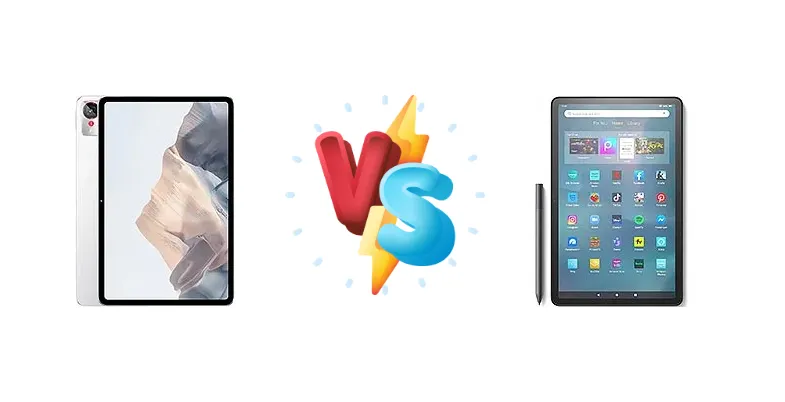
The tablet market offers a wide spectrum of choices, from high-performance Android slates to ecosystem-locked options like Amazon’s Fire tablets. We pit the ZTE nubia Pad Pro, a flagship-level device powered by the Snapdragon 8 Gen 3, against the Amazon Fire Max 11, a more affordable tablet designed for media consumption and Amazon services, to determine which offers the best value for different user needs.
🏆 Quick Verdict
For users prioritizing performance, gaming, and a full Android experience, the ZTE nubia Pad Pro is the clear winner. Its Snapdragon 8 Gen 3 chipset delivers significantly faster processing speeds. However, the Amazon Fire Max 11 provides a compelling entry point for those deeply invested in the Amazon ecosystem and seeking a budget-friendly tablet for casual use.
| Network |
|---|
| 2G bands | N/A | N/A |
| 3G bands | N/A | - |
| 4G bands | N/A | - |
| EDGE | No | No |
| GPRS | No | No |
| Technology | No cellular connectivity | No cellular connectivity |
| Launch |
|---|
| Announced | 2025, April 28 | 2023, May 23 |
| Status | Available. Released 2025, April 28 | Available. Released 2023, May 23 |
| Body |
|---|
| Build | Glass front, aluminum frame, aluminum back | - |
| Dimensions | 253.3 x 164.6 x 7.3 mm (9.97 x 6.48 x 0.29 in) | 259.1 x 163.7 x 7.5 mm (10.20 x 6.44 x 0.30 in) |
| SIM | No | No |
| Weight | 523 g (1.15 lb) | 490 g (1.08 lb) |
| Display |
|---|
| Resolution | 1800 x 2880 pixels, 16:10 ratio (~312 ppi density) | 2000 x 1200 pixels, 5:3 ratio (~212 ppi density) |
| Size | 10.9 inches, 344.5 cm2 (~82.6% screen-to-body ratio) | 11.0 inches, 344.4 cm2 (~81.2% screen-to-body ratio) |
| Type | IPS LCD, 1B colors, 144Hz | IPS LCD |
| Platform |
|---|
| CPU | Octa-core (1x3.3 GHz Cortex-X4 & 3x3.2 GHz Cortex-A720 & 2x3.0 GHz Cortex-A720 & 2x2.3 GHz Cortex-A520) | Octa-core (2x2.2 GHz Cortex-A78 & 6x2.0 GHz Cortex-A55) |
| Chipset | Qualcomm SM8650-AB Snapdragon 8 Gen 3 (4 nm) | Mediatek MT8188J |
| GPU | Adreno 750 | Mali-G57 MC2 |
| OS | Android 15 | Android 11, Fire OS 8 |
| Memory |
|---|
| Card slot | No | microSDXC (dedicated slot) |
| Internal | 256GB 8GB RAM, 256GB 12GB RAM, 512GB 16GB RAM, 1TB 16GB RAM | 64GB 4GB RAM, 128GB 4GB RAM |
| Main Camera |
|---|
| Features | LED flash, HDR, panorama | - |
| Single | 13 MP, (wide) | 8 MP, AF |
| Video | Yes | 1080p |
| Selfie camera |
|---|
| Single | 20 MP, f/2.0, 26mm (wide) | 8 MP |
| Video | 1080p@30fps | 1080p |
| Sound |
|---|
| 35mm jack | No | No |
| Loudspeaker | Yes, with stereo speakers (4 speakers) | Yes, with stereo speakers |
| Comms |
|---|
| Bluetooth | Yes | 5.3, A2DP, LE |
| NFC | No | No |
| Positioning | No | No |
| Radio | No | No |
| USB | USB Type-C 3.2, video output, magnetic connector pins | USB Type-C 2.0, OTG, magnetic accessory connector |
| WLAN | Yes | Wi-Fi 802.11 a/b/g/n/ac/6, dual-band |
| Features |
|---|
| Sensors | Unspecified | Fingerprint (side-mounted), accelerometer, proximity (accessories only) |
| Battery |
|---|
| Charging | 66W wired | 15W wired |
| Type | 10100 mAh | Li-Ion |
| Misc |
|---|
| Colors | Gray, White | Gray |
| Models | - | KFSNWI |
| Price | About 420 EUR | About 270 EUR |
ZTE nubia Pad Pro
- Exceptional performance with Snapdragon 8 Gen 3
- 66W fast charging for minimal downtime
- Likely higher-resolution and brighter display
- Full Android experience with access to a wider range of apps
- Potentially higher price point
- Battery capacity not specified
Amazon Fire Max 11
- Affordable price point
- Integration with Amazon ecosystem (Prime Video, Kindle)
- Decent display for media consumption
- Kid-friendly features and parental controls
- Significantly slower performance with MediaTek MT8188J
- Slow 15W charging
- Limited app availability compared to Google Play Store
- Fire OS is a heavily customized Android experience
Display Comparison
While specific display specs for the nubia Pad Pro are missing, the focus on a Snapdragon 8 Gen 3 suggests a high-resolution panel to leverage the chipset’s capabilities. The Fire Max 11 features a 10.1-inch 1920x1200 display. The nubia Pad Pro, given its positioning, likely boasts a higher peak brightness and potentially a higher refresh rate for smoother visuals. The Fire Max 11’s display is adequate for media consumption, but the nubia Pad Pro is expected to offer a more vibrant and detailed viewing experience. Bezels are likely slimmer on the nubia Pad Pro, contributing to a more modern aesthetic.
Camera Comparison
Camera details for the nubia Pad Pro are unavailable, but a flagship tablet typically includes a capable camera system. The Amazon Fire Max 11 features a 5MP front and rear camera. Given the Fire Max 11’s focus on affordability, its camera performance is likely limited to basic video calls and casual snapshots. The nubia Pad Pro, assuming a higher-quality sensor and image processing, will likely deliver superior image and video quality, making it a better choice for content creators or those who frequently use their tablet for photography.
Performance
The performance gap is substantial. The ZTE nubia Pad Pro’s Qualcomm SM8650-AB Snapdragon 8 Gen 3 (4nm) is a flagship chipset featuring an octa-core CPU with a prime Cortex-X4 core clocked at 3.3 GHz. This architecture, built on a 4nm process, delivers significantly higher performance and improved power efficiency compared to the Amazon Fire Max 11’s MediaTek MT8188J. The MT8188J’s octa-core CPU, with its 2x2.2 GHz Cortex-A78 and 6x2.0 GHz Cortex-A55 cores, is geared towards everyday tasks but will struggle with demanding applications. The nubia Pad Pro will excel in gaming, video editing, and multitasking, while the Fire Max 11 is best suited for web browsing, streaming, and light productivity. The nubia Pad Pro will also benefit from faster LPDDR5x RAM, further enhancing performance.
Battery Life
Battery capacity is not specified for either device. However, the nubia Pad Pro’s 66W wired charging is a significant advantage. This allows for incredibly fast charging times, minimizing downtime. The Amazon Fire Max 11’s 15W wired charging is considerably slower. While the Fire Max 11 may have a larger battery capacity, the nubia Pad Pro’s faster charging will likely result in a more convenient user experience, especially for power users who need to quickly top up their battery.
Buying Guide
Buy the ZTE nubia Pad Pro if you need a powerful tablet for demanding tasks like video editing, gaming, or running multiple applications simultaneously. Its superior chipset and faster charging will significantly enhance your productivity. Buy the Amazon Fire Max 11 if you prefer a simple, affordable tablet primarily for consuming media, reading, and accessing Amazon services, especially if you're already a Prime member and value the integrated ecosystem.
Frequently Asked Questions
❓ Will the MediaTek MT8188J in the Fire Max 11 struggle with graphically intensive games like Genshin Impact?
Yes, the MediaTek MT8188J is not designed for demanding games. While it can handle simpler titles, you'll likely experience significant frame rate drops and lag in games like Genshin Impact, even on lower settings. The nubia Pad Pro’s Snapdragon 8 Gen 3 is specifically engineered for high-performance gaming.
❓ How much does the Amazon Fire OS limit app availability compared to standard Android?
Amazon Fire OS is based on Android but lacks access to the Google Play Store. You primarily rely on the Amazon Appstore, which has a smaller selection of apps. While many popular apps are available, you may find some are missing or outdated. Sideloading apps is possible, but requires technical knowledge and isn't officially supported.
❓ Is the 66W charging on the nubia Pad Pro compatible with standard USB-PD chargers?
While the nubia Pad Pro supports 66W charging, compatibility with standard USB-PD chargers will vary. It's best to use the included charger for optimal charging speeds. Some USB-PD chargers may deliver slower charging speeds, while others may not be compatible at all.
❓ Does the Amazon Fire Max 11 support split-screen multitasking effectively?
The Fire Max 11 does support split-screen multitasking, but its performance can be limited by the MediaTek MT8188J chipset. Running two demanding apps simultaneously may result in noticeable lag and slowdowns. The nubia Pad Pro, with its superior processing power, will handle split-screen multitasking much more smoothly.