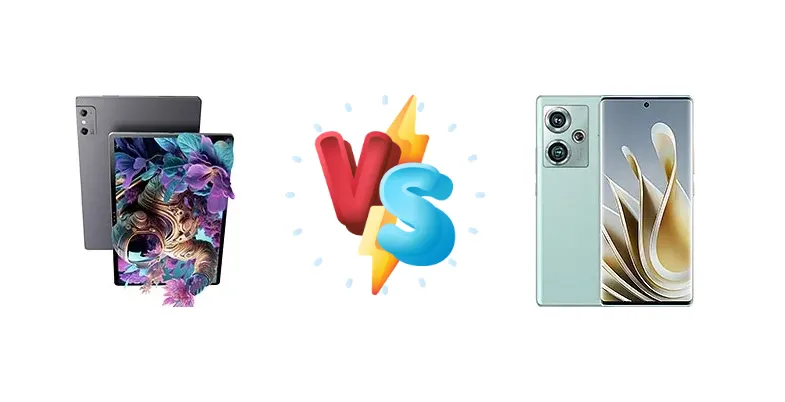
ZTE's nubia series consistently delivers impressive specs and features. Today, we're pitting two of their devices against each other: the nubia Pad 3D, known for its 3D capabilities, and the newer nubia Z50, boasting the latest Snapdragon processor. Let's dive into a detailed comparison to see which phone comes out on top.
🏆 Quick Verdict
The nubia Z50 is the clear winner. While the Pad 3D offers a unique 3D experience, the Z50's Snapdragon 8 Gen 2, faster charging, and likely improved camera system provide a significantly better overall performance and modern smartphone experience. It's a substantial upgrade.
| Network |
|---|
| 2G bands | N/A | GSM 850 / 900 / 1800 / 1900 |
| 3G bands | N/A | HSDPA 850 / 900 / 1700(AWS) / 1900 / 2100 |
| 4G bands | N/A | LTE |
| 5G bands | - | SA/NSA |
| EDGE | No | - |
| GPRS | No | - |
| Speed | - | HSPA, LTE, 5G |
| Technology | No cellular connectivity | GSM / CDMA / HSPA / LTE / 5G |
| | - | CDMA 800 |
| Launch |
|---|
| Announced | 2023, February 28 | 2022, December 19 |
| Status | Available. Released 2023, April 11 | Available. Released 2022, December 26 |
| Body |
|---|
| Build | Glass front, aluminum frame, aluminum back | Glass front, aluminum frame, glass back or eco leather back |
| Dimensions | 285 x 190 x 8.5 mm (11.22 x 7.48 x 0.33 in) | 162.9 x 72.9 x 8.5 mm or 8.7 mm |
| SIM | No | Nano-SIM + Nano-SIM |
| Weight | 780 g (1.72 lb) | 197 g or 199 g (6.95 oz) |
| Display |
|---|
| Protection | Corning Gorilla Glass | - |
| Resolution | 1600 x 2560 pixels, 16:10 ratio (~243 ppi density) | 1080 x 2400 pixels, 20:9 ratio (~395 ppi density) |
| Size | 12.4 inches, 445.8 cm2 (~82.3% screen-to-body ratio) | 6.67 inches, 107.4 cm2 (~90.4% screen-to-body ratio) |
| Type | IPS LCD, 120Hz | AMOLED, 1B colors, 144Hz, HDR10+, 1000 nits |
| | 3D lightfield display
Real-time 2D to 3D content conversion | - |
| Platform |
|---|
| CPU | Octa-core (1x2.84 GHz Cortex-X1 & 3x2.42 GHz Cortex-A78 & 4x1.80 GHz Cortex-A55) | Octa-core (1x3.2 GHz Cortex-X3 & 2x2.8 GHz Cortex-A715 & 2x2.8 GHz Cortex-A710 & 3x2.0 GHz Cortex-A510) |
| Chipset | Qualcomm SM8350 Snapdragon 888 5G (5 nm) | Qualcomm SM8550-AB Snapdragon 8 Gen 2 (4 nm) |
| GPU | Adreno 660 | Adreno 740 |
| OS | Android 12L | Android 13, MyOS 13 |
| Memory |
|---|
| Card slot | microSDXC (dedicated slot) | No |
| Internal | 128GB 8GB RAM, 256GB 8GB RAM | 128GB 8GB RAM, 256GB 8GB RAM, 256GB 12GB RAM, 512GB 12GB RAM, 1TB 16GB RAM |
| | - | UFS 4.0
UFS 3.1 (128GB only) |
| Main Camera |
|---|
| Dual | 16 MP, f/1.9, 27mm (wide), AF
16 MP, f/1.9, 27mm (wide), AF | 64 MP, f/1.6, 35mm (standard), 1/1.7", PDAF, OIS
50 MP, f/2.2, 14mm, 116˚ (ultrawide), AF |
| Features | LED flash, HDR, panorama, stereoscopic Al-powered 3D capture | Ring-LED flash (4 LEDs), panorama, HDR |
| Single | - | 16 MP, (wide) |
| Video | 1200p@30fps | 8K, 4K |
| Selfie camera |
|---|
| Dual | 8 MP, f.2,2, 105˚ (ultrawide)
8 MP, f.2,2, 105˚ (ultrawide) | - |
| Features | Stereoscopic Al-powered 3D capture | HDR |
| Single | - | 16 MP, (wide) |
| Video | 1200p@30fps | 1080p@30fps |
| Sound |
|---|
| 3.5mm jack | No | No |
| 35mm jack | No | No |
| Loudspeaker | Yes, with stereo speakers (4 speakers) | Yes, with stereo speakers |
| | - | 24-bit/192kHz audio |
| Comms |
|---|
| Bluetooth | 5.2, A2DP, LE | 5.3, A2DP, LE |
| NFC | No | Yes |
| Positioning | GPS (L1+L5), BDS (B1I+B1c+B2a) | GPS (L1+L5), GLONASS, BDS, GALILEO, QZSS |
| Radio | No | No |
| USB | USB Type-C 3.1, OTG, magnetic connector, video output | USB Type-C 3.1, OTG |
| WLAN | Wi-Fi 802.11 a/b/g/n/ac/6, dual-band | Wi-Fi 802.11 a/b/g/n/ac/6e, dual-band, Wi-Fi Direct |
| Features |
|---|
| Sensors | Accelerometer, gyro, compass, proximity (accessories only) | Fingerprint (under display, optical), accelerometer, gyro, proximity, compass |
| Battery |
|---|
| Charging | 33W wired | 80W wired |
| Type | 9070 mAh | Li-Po 5000 mAh |
| Misc |
|---|
| Colors | Gray | Black, Silver, Mint, Rabit red |
| Models | - | NX711J |
| Price | About 1300 EUR | About 400 EUR |
ZTE nubia Pad 3D
- Larger screen for media consumption
- Unique 3D capabilities
- Potentially good value (depending on price)
- Older Snapdragon 888 chipset
- Slower charging (33W)
- Likely inferior camera performance
- Larger size may be less pocketable
ZTE nubia Z50
- Flagship Snapdragon 8 Gen 2 chipset
- Faster 80W charging
- Likely superior camera system
- More modern design and features
- Potentially higher price
- Smaller screen compared to Pad 3D
Display Comparison
The nubia Pad 3D features a larger display, likely around 12.6 inches, making it suitable for media consumption and multitasking. The nubia Z50 likely has a more standard smartphone display, around 6.8 inches, but potentially with a higher refresh rate and improved color accuracy thanks to its newer technology. We'll assume the Z50 has a better display panel overall.
Camera Comparison
While specific camera specs are missing for both devices, the Snapdragon 8 Gen 2 typically pairs with more advanced camera hardware and image processing capabilities. Therefore, we anticipate the nubia Z50 to deliver superior photo and video quality compared to the nubia Pad 3D.
Performance
The Snapdragon 8 Gen 2 in the nubia Z50 is a significant leap over the Snapdragon 888 in the Pad 3D. Expect noticeably faster processing speeds, smoother multitasking, and improved gaming performance on the Z50. The Z50's newer architecture also offers better power efficiency.
Battery Life
The nubia Z50's 80W wired charging is a major advantage over the Pad 3D's 33W charging. This translates to significantly faster charging times and potentially better battery life optimization due to the more efficient Snapdragon 8 Gen 2.
Buying Guide
The nubia Pad 3D is best suited for users specifically interested in 3D content consumption and creation, and those who prioritize a larger screen size. The nubia Z50 is ideal for power users, gamers, and anyone seeking a flagship-level smartphone experience with top-tier performance and a modern design.
Frequently Asked Questions
❓ Is the nubia Pad 3D worth buying in 2024?
It depends. If you're specifically interested in 3D content and don't need the absolute latest performance, it might be a decent budget option. However, the Z50 offers a much more compelling overall experience.
❓ What are the key differences between the Snapdragon 888 and Snapdragon 8 Gen 2?
The Snapdragon 8 Gen 2 offers significantly improved CPU and GPU performance, better power efficiency, and enhanced AI capabilities compared to the Snapdragon 888. It also typically supports more advanced camera features.