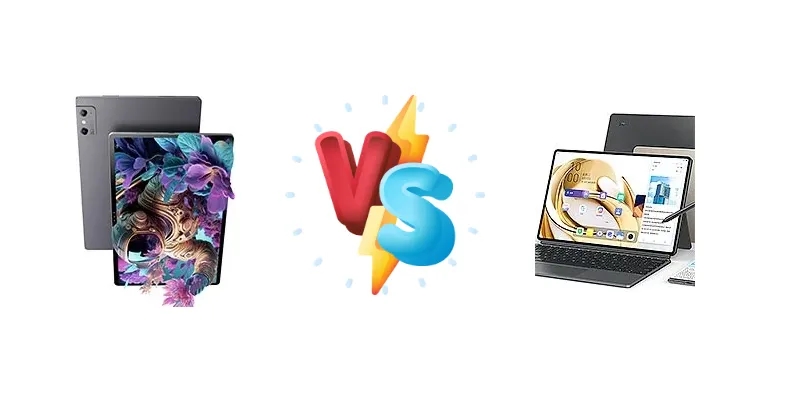
The tablet market is heating up, and ZTE is vying for a piece of the action. We're pitting two of their contenders against each other: the nubia Pad 3D and the Axon Pad. Both offer premium features, but which one delivers the best overall experience?
🏆 Quick Verdict
The ZTE Axon Pad takes the crown thanks to its significantly faster Snapdragon 8+ Gen 1 chipset, blazing-fast 80W charging, and likely improved display technology. While the nubia Pad 3D boasts a capable Snapdragon 888, the Axon Pad's upgrades make it the superior choice for performance and convenience.
| Network |
|---|
| 2G bands | N/A | GSM 850 / 900 / 1800 / 1900 |
| 3G bands | N/A | HSDPA 850 / 900 / 2100 |
| 4G bands | N/A | 1, 3, 5, 7, 8, 4, 12, 17, 20, 34, 38, 39, 40, 41 |
| 5G bands | - | 1, 5, 8, 28, 41, 78 SA/NSA |
| EDGE | No | - |
| GPRS | No | - |
| Speed | - | HSPA, LTE, 5G |
| Technology | No cellular connectivity | GSM / HSPA / LTE / 5G |
| Launch |
|---|
| Announced | 2023, February 28 | 2023, April 12 |
| Status | Available. Released 2023, April 11 | Available. Released 2023, May |
| Body |
|---|
| Build | Glass front, aluminum frame, aluminum back | - |
| Dimensions | 285 x 190 x 8.5 mm (11.22 x 7.48 x 0.33 in) | 279 x 181 x 6.5 mm (10.98 x 7.13 x 0.26 in) |
| SIM | No | Nano-SIM |
| Weight | 780 g (1.72 lb) | 605 g (1.33 lb) |
| Display |
|---|
| Protection | Corning Gorilla Glass | - |
| Resolution | 1600 x 2560 pixels, 16:10 ratio (~243 ppi density) | 1600 x 2560 pixels, 16:10 ratio (~249 ppi density) |
| Size | 12.4 inches, 445.8 cm2 (~82.3% screen-to-body ratio) | 12.1 inches, 424.5 cm2 (~84.1% screen-to-body ratio) |
| Type | IPS LCD, 120Hz | IPS LCD, 1B colors, 120Hz |
| | 3D lightfield display
Real-time 2D to 3D content conversion | - |
| Platform |
|---|
| CPU | Octa-core (1x2.84 GHz Cortex-X1 & 3x2.42 GHz Cortex-A78 & 4x1.80 GHz Cortex-A55) | Octa-core (1x3.0 GHz Cortex-X2 & 3x2.5 GHz Cortex-A710 & 4x1.8 GHz Cortex-A510) |
| Chipset | Qualcomm SM8350 Snapdragon 888 5G (5 nm) | Qualcomm SM8475 Snapdragon 8+ Gen 1 (4 nm) |
| GPU | Adreno 660 | Adreno 730 |
| OS | Android 12L | Android 13, MyOS 13 |
| Memory |
|---|
| Card slot | microSDXC (dedicated slot) | No |
| Internal | 128GB 8GB RAM, 256GB 8GB RAM | 256GB 8GB RAM, 512GB 12GB RAM |
| Main Camera |
|---|
| Dual | 16 MP, f/1.9, 27mm (wide), AF
16 MP, f/1.9, 27mm (wide), AF | - |
| Features | LED flash, HDR, panorama, stereoscopic Al-powered 3D capture | LED flash, HDR, panorama |
| Single | - | 13 MP, AF |
| Video | 1200p@30fps | 1080p@30fps |
| Selfie camera |
|---|
| Dual | 8 MP, f.2,2, 105˚ (ultrawide)
8 MP, f.2,2, 105˚ (ultrawide) | - |
| Features | Stereoscopic Al-powered 3D capture | - |
| Single | - | 16 MP |
| Video | 1200p@30fps | 1080p@30fps |
| Sound |
|---|
| 3.5mm jack | No | No |
| 35mm jack | No | No |
| Loudspeaker | Yes, with stereo speakers (4 speakers) | Yes, with stereo speakers (4 speakers) |
| Comms |
|---|
| Bluetooth | 5.2, A2DP, LE | 5.2, A2DP, LE, aptX HD, aptX Adaptive, aptX Lossless |
| NFC | No | Yes |
| Positioning | GPS (L1+L5), BDS (B1I+B1c+B2a) | GPS, GLONASS, GALILEO, BDS |
| Radio | No | No |
| USB | USB Type-C 3.1, OTG, magnetic connector, video output | USB Type-C 3.1, OTG, magnetic connector |
| WLAN | Wi-Fi 802.11 a/b/g/n/ac/6, dual-band | Wi-Fi 802.11 a/b/g/n/ac/6, dual-band |
| Features |
|---|
| Sensors | Accelerometer, gyro, compass, proximity (accessories only) | Accelerometer, gyro, compass, proximity (accessories only) |
| Battery |
|---|
| Charging | 33W wired | 80W wired |
| Type | 9070 mAh | Li-Po 10000 mAh |
| Misc |
|---|
| Colors | Gray | Black, Gold |
| Price | About 1300 EUR | About 460 EUR |
ZTE nubia Pad 3D
- Powerful Snapdragon 888 chipset
- Unique 3D capabilities
- Potentially more affordable
- Slower charging (33W)
- Less information available on display quality
- Potentially older software
ZTE Axon Pad
- Blazing-fast Snapdragon 8+ Gen 1 chipset
- Ultra-fast 80W charging
- Likely superior display
- More modern design
- Potentially higher price
- 3D capabilities absent
Display Comparison
While specific display details for the nubia Pad 3D are scarce, the Axon Pad is expected to feature a higher resolution and potentially a higher refresh rate display, offering a smoother and more vibrant visual experience. The nubia Pad 3D's 3D capabilities are a unique selling point, but the Axon Pad's overall display quality is likely to be superior.
Camera Comparison
Camera specifications are not readily available for either device. However, given the Axon Pad's higher-end chipset, it's reasonable to assume it may have a slightly better camera system, though this is not a primary differentiator for tablets.
Performance
The Snapdragon 8+ Gen 1 in the Axon Pad is a clear winner here. It offers a noticeable performance boost over the Snapdragon 888 in the nubia Pad 3D, resulting in faster app loading times, smoother multitasking, and better gaming performance. The Axon Pad's newer architecture and improved efficiency also contribute to better thermal management.
Battery Life
The Axon Pad's 80W wired charging is a game-changer. It will charge the device significantly faster than the nubia Pad 3D's 33W charging. Battery capacity is likely similar, but the Axon Pad's charging speed provides a major advantage.
Buying Guide
The nubia Pad 3D is a good option for users seeking a powerful tablet at a potentially lower price point, especially if 3D capabilities are a priority. The ZTE Axon Pad is ideal for power users, gamers, and anyone who values top-tier performance, fast charging, and a premium display experience.
Frequently Asked Questions
❓ Is the nubia Pad 3D really 3D?
Yes, the nubia Pad 3D utilizes glasses-free 3D technology, offering a unique viewing experience. However, the quality and effectiveness of the 3D effect can vary.
❓ Which tablet is better for gaming?
The ZTE Axon Pad is the better choice for gaming due to its more powerful Snapdragon 8+ Gen 1 chipset and likely superior cooling system.