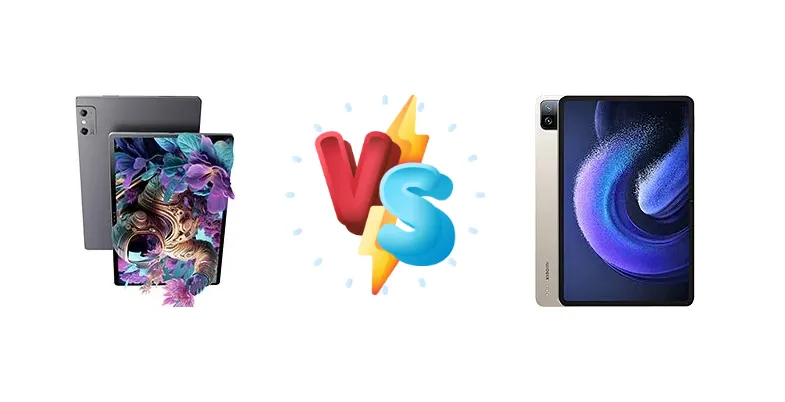
The Android tablet market is heating up, and two contenders are vying for your attention: the ZTE Nubia Pad 3D and the Xiaomi Pad 6 Pro. Both offer premium features and performance, but cater to slightly different needs. Let's dive into a detailed comparison to see which tablet comes out on top.
🏆 Quick Verdict
The Xiaomi Pad 6 Pro takes the crown with its superior charging speed, slightly better performance thanks to the Snapdragon 8+ Gen 1, and a generally more polished software experience. While the Nubia Pad 3D boasts a powerful Snapdragon 888, the Xiaomi offers a more compelling overall package.
| Network |
|---|
| 2G bands | N/A | N/A |
| 3G bands | N/A | N/A |
| 4G bands | N/A | - |
| EDGE | No | N/A |
| GPRS | No | N/A |
| Technology | No cellular connectivity | No cellular connectivity |
| Launch |
|---|
| Announced | 2023, February 28 | 2023, April 18 |
| Status | Available. Released 2023, April 11 | Available. Released 2023, April 30 |
| Body |
|---|
| Build | Glass front, aluminum frame, aluminum back | Glass front (Gorilla Glass 3), aluminum frame, aluminum back |
| Dimensions | 285 x 190 x 8.5 mm (11.22 x 7.48 x 0.33 in) | 254 x 165.2 x 6.5 mm (10.0 x 6.50 x 0.26 in) |
| SIM | No | No |
| Weight | 780 g (1.72 lb) | 490 g (1.08 lb) |
| | - | Stylus support (magnetic) |
| Display |
|---|
| Protection | Corning Gorilla Glass | Corning Gorilla Glass 3 |
| Resolution | 1600 x 2560 pixels, 16:10 ratio (~243 ppi density) | 1800 x 2880 pixels, 16:10 ratio (~309 ppi density) |
| Size | 12.4 inches, 445.8 cm2 (~82.3% screen-to-body ratio) | 11.0 inches, 350.9 cm2 (~83.6% screen-to-body ratio) |
| Type | IPS LCD, 120Hz | IPS LCD, 1B colors, 144Hz, HDR10, Dolby Vision, 550 nits |
| | 3D lightfield display
Real-time 2D to 3D content conversion | - |
| Platform |
|---|
| CPU | Octa-core (1x2.84 GHz Cortex-X1 & 3x2.42 GHz Cortex-A78 & 4x1.80 GHz Cortex-A55) | Octa-core (1x3.19 GHz Cortex-X2 & 3x2.75 GHz Cortex-A710 & 4x1.80 GHz Cortex-A510) |
| Chipset | Qualcomm SM8350 Snapdragon 888 5G (5 nm) | Qualcomm SM8475 Snapdragon 8+ Gen 1 (4 nm) |
| GPU | Adreno 660 | Adreno 730 |
| OS | Android 12L | Android 13, MIUI 14 |
| Memory |
|---|
| Card slot | microSDXC (dedicated slot) | No |
| Internal | 128GB 8GB RAM, 256GB 8GB RAM | 128GB 8GB RAM, 256GB 8GB RAM, 256GB 12GB RAM, 512GB 12GB RAM |
| | - | UFS 3.1 |
| Main Camera |
|---|
| Dual | 16 MP, f/1.9, 27mm (wide), AF
16 MP, f/1.9, 27mm (wide), AF | 50 MP, f/1.8, (wide), 1/2.76", 0.64µm, PDAF
Auxiliary lens |
| Features | LED flash, HDR, panorama, stereoscopic Al-powered 3D capture | Dual-LED flash, HDR, panorama |
| Video | 1200p@30fps | 4K@30/60fps, 1080p@30/60fps |
| Selfie camera |
|---|
| Dual | 8 MP, f.2,2, 105˚ (ultrawide)
8 MP, f.2,2, 105˚ (ultrawide) | - |
| Features | Stereoscopic Al-powered 3D capture | - |
| Single | - | 20 MP, f/2.2, (wide), 1/3.4", 0.8µm |
| Video | 1200p@30fps | 1080p@30/60fps |
| Sound |
|---|
| 3.5mm jack | No | No |
| 35mm jack | No | No |
| Loudspeaker | Yes, with stereo speakers (4 speakers) | Yes, with stereo speakers (4 speakers) |
| | - | 24-bit/192kHz audio |
| Comms |
|---|
| Bluetooth | 5.2, A2DP, LE | 5.3, A2DP, LE |
| NFC | No | No |
| Positioning | GPS (L1+L5), BDS (B1I+B1c+B2a) | No |
| Radio | No | No |
| USB | USB Type-C 3.1, OTG, magnetic connector, video output | USB Type-C 3.2, accessory connector |
| WLAN | Wi-Fi 802.11 a/b/g/n/ac/6, dual-band | Wi-Fi 802.11 a/b/g/n/a/6e, dual-band, Wi-Fi Direct |
| Features |
|---|
| Sensors | Accelerometer, gyro, compass, proximity (accessories only) | Accelerometer, gyro, proximity (accessories only) |
| Battery |
|---|
| Charging | 33W wired | 67W wired, PD3.0, QC4, 100% in 1 hour |
| Type | 9070 mAh | Li-Po 8600 mAh |
| Misc |
|---|
| Colors | Gray | Black, Blue, Gold |
| Models | - | 23046RP50C |
| Price | About 1300 EUR | About 330 EUR |
ZTE nubia Pad 3D
- Powerful Snapdragon 888 chipset
- Potentially unique 3D capabilities (software dependent)
- Large display
- Slower charging speed
- Less polished software experience
- Camera quality likely inferior
- 3D software support uncertain
Xiaomi Pad 6 Pro
- Faster Snapdragon 8+ Gen 1 chipset
- 67W fast charging
- Vibrant 120Hz display
- Generally better software experience
- Can be slightly more expensive
- Design may be less distinctive
Display Comparison
The Xiaomi Pad 6 Pro features an 11-inch 2.880 x 1800 LCD display with a 120Hz refresh rate, offering vibrant colors and smooth scrolling. The Nubia Pad 3D likely has a similar resolution but may lack the 120Hz refresh rate. Xiaomi's display generally receives higher praise for its color accuracy and brightness.
Camera Comparison
The Xiaomi Pad 6 Pro typically features a more versatile camera setup, often including a higher-resolution main sensor and potentially a wider ultrawide lens. The Nubia Pad 3D's camera specs are less readily available, but it's likely to be a more basic setup. Xiaomi generally wins in camera quality and features.
Performance
While both tablets utilize Snapdragon 8-series chips, the Xiaomi Pad 6 Pro's Snapdragon 8+ Gen 1 holds a slight edge in performance and efficiency. The Nubia Pad 3D's Snapdragon 888 is still very capable, but the 8+ Gen 1 offers a noticeable boost in demanding tasks and gaming.
Battery Life
The Xiaomi Pad 6 Pro's 67W fast charging is a significant advantage, allowing for incredibly quick top-ups. The Nubia Pad 3D's 33W charging is respectable but considerably slower. Battery capacity is likely similar, but Xiaomi's charging speed makes a big difference in real-world usage.
Buying Guide
The ZTE Nubia Pad 3D is a good choice for users prioritizing raw processing power and potentially 3D capabilities (though software support is a question mark). The Xiaomi Pad 6 Pro is ideal for those seeking a well-rounded tablet experience with fast charging, a vibrant display, and a smoother user interface.
Frequently Asked Questions
❓ Does the Nubia Pad 3D have good 3D software support?
3D software support for the Nubia Pad 3D is a significant question mark. ZTE's commitment to updates and 3D content is unclear, so it's a risk factor.
❓ Which tablet is better for gaming?
The Xiaomi Pad 6 Pro is generally better for gaming due to its slightly more powerful chipset, faster refresh rate display, and better thermal management.