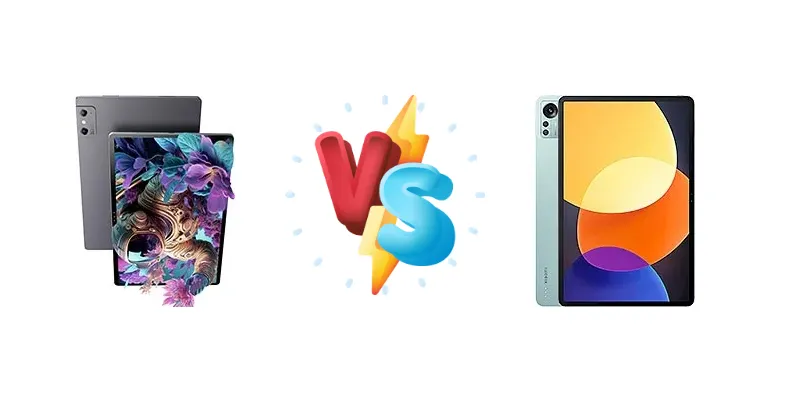
The tablet market is heating up, and these two contenders – the ZTE Nubia Pad 3D and the Xiaomi Pad 5 Pro 12.4 – are vying for your attention. Both offer premium features and impressive specs, but which one truly delivers the best experience? Let's dive into a comprehensive comparison to help you decide.
🏆 Quick Verdict
The Xiaomi Pad 5 Pro 12.4 takes the crown thanks to its superior display, significantly faster charging, and generally more polished software experience. While the Nubia Pad 3D boasts a Snapdragon 888, the Xiaomi's overall package is more compelling for most users.
| Network |
|---|
| 2G bands | N/A | N/A |
| 3G bands | N/A | N/A |
| 4G bands | N/A | N/A |
| EDGE | No | No |
| GPRS | No | No |
| Technology | No cellular connectivity | No cellular connectivity |
| Launch |
|---|
| Announced | 2023, February 28 | 2022, August 11 |
| Status | Available. Released 2023, April 11 | Available. Released 2022, August 24 |
| Body |
|---|
| Build | Glass front, aluminum frame, aluminum back | Glass front (Gorilla Glass 3), aluminum frame, aluminum back |
| Dimensions | 285 x 190 x 8.5 mm (11.22 x 7.48 x 0.33 in) | 285 x 185.2 x 6.7 mm (11.22 x 7.29 x 0.26 in) |
| SIM | No | No |
| Weight | 780 g (1.72 lb) | 620 g (1.37 lb) |
| | - | Stylus support (magnetic) |
| Display |
|---|
| Protection | Corning Gorilla Glass | Corning Gorilla Glass 3 |
| Resolution | 1600 x 2560 pixels, 16:10 ratio (~243 ppi density) | 1600 x 2560 pixels, 16:10 ratio (~243 ppi density) |
| Size | 12.4 inches, 445.8 cm2 (~82.3% screen-to-body ratio) | 12.4 inches, 445.8 cm2 (~84.5% screen-to-body ratio) |
| Type | IPS LCD, 120Hz | IPS LCD, 120Hz, HDR10, Dolby Vision, 500 nits |
| | 3D lightfield display
Real-time 2D to 3D content conversion | - |
| Platform |
|---|
| CPU | Octa-core (1x2.84 GHz Cortex-X1 & 3x2.42 GHz Cortex-A78 & 4x1.80 GHz Cortex-A55) | Octa-core (1x3.2 GHz Kryo 585 & 3x2.42 GHz Kryo 585 & 4x1.80 GHz Kryo 585) |
| Chipset | Qualcomm SM8350 Snapdragon 888 5G (5 nm) | Qualcomm SM8250-AC Snapdragon 870 5G (7 nm) |
| GPU | Adreno 660 | Adreno 650 |
| OS | Android 12L | Android 12, MIUI Pad 13 |
| Memory |
|---|
| Card slot | microSDXC (dedicated slot) | No |
| Internal | 128GB 8GB RAM, 256GB 8GB RAM | 128GB 6GB RAM, 256GB 8GB RAM, 512GB 12GB RAM |
| | - | UFS 3.1 |
| Main Camera |
|---|
| Dual | 16 MP, f/1.9, 27mm (wide), AF
16 MP, f/1.9, 27mm (wide), AF | 50 MP, f/1.8, 1/2.76", 0.64µm, PDAF
Auxiliary lens |
| Features | LED flash, HDR, panorama, stereoscopic Al-powered 3D capture | Color spectrum sensor, LED flash, panorama, HDR |
| Video | 1200p@30fps | 4K@30fps, 1080p@30/60fps |
| Selfie camera |
|---|
| Dual | 8 MP, f.2,2, 105˚ (ultrawide)
8 MP, f.2,2, 105˚ (ultrawide) | - |
| Features | Stereoscopic Al-powered 3D capture | - |
| Single | - | 20 MP, f/2.2, 1/3.4", 0.8µm |
| Video | 1200p@30fps | 1080p@30/60fps |
| Sound |
|---|
| 3.5mm jack | No | No |
| 35mm jack | No | No |
| Loudspeaker | Yes, with stereo speakers (4 speakers) | Yes, with stereo speakers (4 speakers) |
| Comms |
|---|
| Bluetooth | 5.2, A2DP, LE | 5.2, A2DP, LE |
| NFC | No | No |
| Positioning | GPS (L1+L5), BDS (B1I+B1c+B2a) | No |
| Radio | No | No |
| USB | USB Type-C 3.1, OTG, magnetic connector, video output | USB Type-C 3.2 video output |
| WLAN | Wi-Fi 802.11 a/b/g/n/ac/6, dual-band | Wi-Fi 802.11 a/b/g/n/ac/6, dual-band, Wi-Fi Direct |
| Features |
|---|
| Sensors | Accelerometer, gyro, compass, proximity (accessories only) | Accelerometer, gyro, proximity, compass |
| Battery |
|---|
| Charging | 33W wired | 67W wired, PD3.0, QC4, 60% in 36 min, 100% in 68 min |
| Type | 9070 mAh | Li-Po 10000 mAh |
| Misc |
|---|
| Colors | Gray | Black, Silver, Green |
| Price | About 1300 EUR | About 400 EUR |
ZTE nubia Pad 3D
- Potentially powerful Snapdragon 888 chipset
- 3D capabilities (though software support is uncertain)
- Competitive price (potentially)
- Limited information available on specs and features
- Likely smaller and lower-resolution display
- Slower charging
- Uncertain software support for 3D features
Xiaomi Pad 5 Pro 12.4
- Stunning 12.4-inch 2K+ 120Hz display
- Fast 67W charging
- Excellent overall performance with Snapdragon 870
- Well-optimized MIUI for Pad software
- Good camera setup
- Can be pricier than the Nubia Pad 3D
- MIUI can have occasional bloatware
Display Comparison
The Xiaomi Pad 5 Pro 12.4 features a stunning 12.4-inch 2K+ LCD display with a 120Hz refresh rate, offering vibrant colors and smooth visuals. The Nubia Pad 3D likely has a smaller display (around 10.1 inches) with a potentially lower resolution and refresh rate, though specific details are scarce. Xiaomi's display is the clear winner here.
Camera Comparison
Camera details for the Nubia Pad 3D are limited. The Xiaomi Pad 5 Pro 12.4 features a 13MP rear camera and a 8MP front camera. While not flagship-level, the Xiaomi's cameras are adequate for video calls and casual photography. The Xiaomi likely wins due to having more readily available camera specs.
Performance
Both tablets are powered by flagship Snapdragon processors. The Nubia Pad 3D utilizes the Snapdragon 888, while the Xiaomi Pad 5 Pro 12.4 has the Snapdragon 870. While the 888 has a slight edge in raw CPU power, the 870 is exceptionally efficient and delivers excellent real-world performance. Gaming and multitasking should be smooth on both, but the Xiaomi's optimization might give it a slight advantage.
Battery Life
The Xiaomi Pad 5 Pro 12.4 boasts a significantly larger 10,000mAh battery and 67W fast charging, capable of reaching 60% in 36 minutes and 100% in 68 minutes. The Nubia Pad 3D has a smaller battery (likely around 6000-7000mAh) and slower 33W charging. Battery life and charging speed are a major advantage for the Xiaomi.
Buying Guide
The ZTE Nubia Pad 3D is a good choice for users prioritizing raw processing power and potentially 3D content (though software support is a question mark). The Xiaomi Pad 5 Pro 12.4 is ideal for those seeking a premium large-screen experience with excellent display quality, fast charging, and a well-rounded feature set.
Frequently Asked Questions
❓ Is the Nubia Pad 3D good for gaming?
The Snapdragon 888 chipset suggests it *could* be good for gaming, but the smaller display and potential software limitations might hinder the experience. The Xiaomi Pad 5 Pro 12.4 offers a better overall gaming experience due to its larger, higher-resolution display and optimized software.
❓ Does the Nubia Pad 3D support 5G?
Yes, both devices support 5G connectivity, as indicated by the '5G' designation in their chipset names.