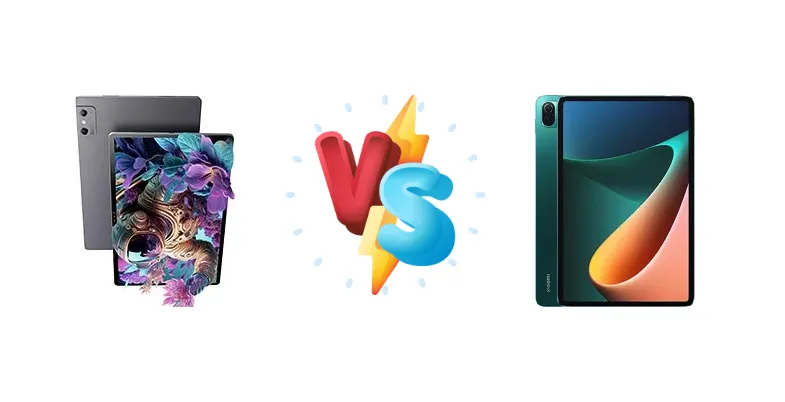
The Android tablet market is heating up, and two contenders are vying for your attention: the ZTE Nubia Pad 3D and the Xiaomi Pad 5. Both offer premium features and performance, but cater to slightly different needs. Let's dive into a detailed comparison to help you decide which one is right for you.
🏆 Quick Verdict
The Xiaomi Pad 5 edges out the Nubia Pad 3D thanks to its brighter display, PD3.0 charging, and generally more refined software experience. While the Nubia Pad 3D boasts a Snapdragon 888, the Xiaomi Pad 5 offers a better overall package for most users.
| Network |
|---|
| 2G bands | N/A | N/A |
| 3G bands | N/A | N/A |
| 4G bands | N/A | - |
| EDGE | No | N/A |
| GPRS | No | N/A |
| Technology | No cellular connectivity | No cellular connectivity |
| Launch |
|---|
| Announced | 2023, February 28 | 2021, August 10 |
| Status | Available. Released 2023, April 11 | Available. Released 2021, August 10 |
| Body |
|---|
| Build | Glass front, aluminum frame, aluminum back | Glass front, aluminum frame, plastic back |
| Dimensions | 285 x 190 x 8.5 mm (11.22 x 7.48 x 0.33 in) | 254.7 x 166.3 x 6.9 mm (10.03 x 6.55 x 0.27 in) |
| SIM | No | No |
| Weight | 780 g (1.72 lb) | 511 g (1.13 lb) |
| | - | Stylus support (magnetic) |
| Display |
|---|
| Protection | Corning Gorilla Glass | - |
| Resolution | 1600 x 2560 pixels, 16:10 ratio (~243 ppi density) | 1600 x 2560 pixels, 16:10 ratio (~274 ppi density) |
| Size | 12.4 inches, 445.8 cm2 (~82.3% screen-to-body ratio) | 11.0 inches, 350.9 cm2 (~82.8% screen-to-body ratio) |
| Type | IPS LCD, 120Hz | IPS LCD, 1B colors, 120Hz, HDR10, Dolby Vision |
| | 3D lightfield display
Real-time 2D to 3D content conversion | - |
| Platform |
|---|
| CPU | Octa-core (1x2.84 GHz Cortex-X1 & 3x2.42 GHz Cortex-A78 & 4x1.80 GHz Cortex-A55) | Octa-core (1x2.96 GHz Kryo 485 Gold & 3x2.42 GHz Kryo 485 Gold & 4x1.78 GHz Kryo 485 Silver) |
| Chipset | Qualcomm SM8350 Snapdragon 888 5G (5 nm) | Qualcomm Snapdragon 860 (7 nm) |
| GPU | Adreno 660 | Adreno 640 |
| OS | Android 12L | Android 11, upgradable to Android 13, MIUI 14 |
| Memory |
|---|
| Card slot | microSDXC (dedicated slot) | No |
| Internal | 128GB 8GB RAM, 256GB 8GB RAM | 128GB 6GB RAM, 256GB 6GB RAM |
| | - | UFS 3.1 |
| Main Camera |
|---|
| Dual | 16 MP, f/1.9, 27mm (wide), AF
16 MP, f/1.9, 27mm (wide), AF | - |
| Features | LED flash, HDR, panorama, stereoscopic Al-powered 3D capture | Dual-LED flash, HDR, panorama |
| Single | - | 13 MP, f/2.0 |
| Video | 1200p@30fps | 4K@30fps, 1080p@30fps |
| Selfie camera |
|---|
| Dual | 8 MP, f.2,2, 105˚ (ultrawide)
8 MP, f.2,2, 105˚ (ultrawide) | - |
| Features | Stereoscopic Al-powered 3D capture | - |
| Single | - | 8 MP, f/2.0 |
| Video | 1200p@30fps | 1080p@30fps |
| Sound |
|---|
| 3.5mm jack | No | No |
| 35mm jack | No | No |
| Loudspeaker | Yes, with stereo speakers (4 speakers) | Yes, with stereo speakers (4 speakers) |
| | - | 24-bit/192kHz audio |
| Comms |
|---|
| Bluetooth | 5.2, A2DP, LE | 5.0, A2DP, LE |
| NFC | No | No |
| Positioning | GPS (L1+L5), BDS (B1I+B1c+B2a) | No |
| Radio | No | No |
| USB | USB Type-C 3.1, OTG, magnetic connector, video output | USB Type-C |
| WLAN | Wi-Fi 802.11 a/b/g/n/ac/6, dual-band | Wi-Fi 802.11 a/b/g/n/ac, dual-band, Wi-Fi Direct |
| Features |
|---|
| Sensors | Accelerometer, gyro, compass, proximity (accessories only) | Accelerometer, gyro, proximity, compass |
| Battery |
|---|
| Charging | 33W wired | 33W wired, PD3.0 |
| Type | 9070 mAh | Li-Po 8720 mAh |
| Misc |
|---|
| Colors | Gray | Cosmic Gray, Pearl White, Green |
| Models | - | 21051182G, 21051182C |
| Price | About 1300 EUR | About 350 EUR |
| Tests |
|---|
| Display | - |
Contrast ratio: 1271:1 (nominal) |
| Loudspeaker | - |
-24.4 LUFS (Very good)
|
| Performance | - |
AnTuTu: 473819 (v8), 555079 (v9)
GeekBench: 2583 (v5.1)
GFXBench: 24fps (ES 3.1 onscreen) |
ZTE nubia Pad 3D
- Powerful Snapdragon 888 chipset
- Potentially good for 3D content (though limited support)
- Large display
- Less bright display
- 33W charging (slower than Xiaomi)
- Software support potentially lacking
- Camera quality unknown
Xiaomi Pad 5
- Brighter and smoother 120Hz display
- PD3.0 fast charging
- Well-optimized software
- Strong overall value
- Slightly less powerful chipset than Nubia Pad 3D
- Potential for thermal throttling under heavy load
Display Comparison
The Xiaomi Pad 5 takes the display crown. While both tablets offer excellent contrast ratios (1271:1), the Xiaomi Pad 5's measured 478 nits of brightness significantly outperform the Nubia Pad 3D, making it easier to view content outdoors or in brightly lit environments. The Xiaomi Pad 5 also benefits from a smoother 120Hz refresh rate, enhancing scrolling and gaming.
Camera Comparison
Camera quality is often an afterthought on tablets. Both devices likely offer decent but not exceptional camera performance. The Xiaomi Pad 5 likely has a slightly better camera system due to Xiaomi's generally stronger camera optimization. Detailed camera comparisons are difficult to find for the Nubia Pad 3D.
Performance
The Nubia Pad 3D holds a slight advantage in raw processing power thanks to its Snapdragon 888 chipset. This translates to slightly faster performance in demanding tasks and games. However, the Xiaomi Pad 5's Snapdragon 860 is still incredibly capable and provides a smooth and responsive user experience for most applications. Thermal management might be a factor, with the Nubia Pad 3D potentially throttling under sustained load.
Battery Life
Battery life is expected to be comparable between the two devices, likely offering around 8-10 hours of typical usage. The Xiaomi Pad 5's support for PD3.0 fast charging provides a faster charging experience compared to the Nubia Pad 3D's 33W wired charging.
Buying Guide
The ZTE Nubia Pad 3D is ideal for users prioritizing raw processing power and potentially 3D content (though 3D support is often limited). The Xiaomi Pad 5 is a better choice for those seeking a well-rounded tablet experience with a vibrant display, reliable performance, and a more polished software.
Frequently Asked Questions
❓ Is the Nubia Pad 3D good for gaming?
The Nubia Pad 3D's Snapdragon 888 provides ample power for most games, but thermal throttling could be a concern during extended gaming sessions. The Xiaomi Pad 5 is also a capable gaming tablet.
❓ Does the Nubia Pad 3D support 5G?
Yes, the Nubia Pad 3D supports 5G connectivity.
❓ Which tablet has better software support?
The Xiaomi Pad 5 generally receives more frequent and timely software updates compared to ZTE devices.