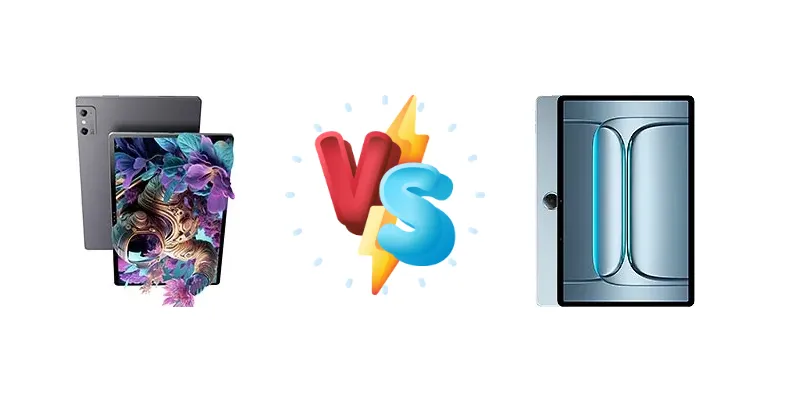
The tablet market is heating up with compelling options at various price points. The ZTE nubia Pad 3D aims to deliver flagship-level performance with its Snapdragon 888, while the OnePlus Pad Lite focuses on providing a balanced experience with a more efficient MediaTek Helio G100. This comparison dissects the key differences to help you determine which tablet best suits your needs.
🏆 Quick Verdict
For users prioritizing raw performance and demanding tasks like gaming, the ZTE nubia Pad 3D is the clear winner thanks to its Snapdragon 888. However, the OnePlus Pad Lite offers a compelling value proposition with its efficient Helio G100, making it ideal for everyday use and media consumption.
| Network |
|---|
| 2G bands | N/A | GSM 850 / 900 / 1800 / 1900 - cellular model only |
| 3G bands | N/A | HSDPA 850 / 900 / 2100 - cellular model only |
| 4G bands | N/A | LTE - cellular model only |
| EDGE | No | - |
| GPRS | No | - |
| Speed | - | HSPA, LTE - cellular model only |
| Technology | No cellular connectivity | GSM / HSPA / LTE |
| Launch |
|---|
| Announced | 2023, February 28 | 2025, July 08 |
| Status | Available. Released 2023, April 11 | Available. Released 2025, August 14 |
| Body |
|---|
| Build | Glass front, aluminum frame, aluminum back | - |
| Dimensions | 285 x 190 x 8.5 mm (11.22 x 7.48 x 0.33 in) | 254.9 x 166.5 x 7.4 mm (10.04 x 6.56 x 0.29 in) |
| SIM | No | Yes - cellular model only |
| Weight | 780 g (1.72 lb) | 530 g (1.17 lb) |
| Display |
|---|
| Protection | Corning Gorilla Glass | - |
| Resolution | 1600 x 2560 pixels, 16:10 ratio (~243 ppi density) | 1200 x 1920 pixels, 16:10 ratio (~207 ppi density) |
| Size | 12.4 inches, 445.8 cm2 (~82.3% screen-to-body ratio) | 11.0 inches, 347.5 cm2 (~81.9% screen-to-body ratio) |
| Type | IPS LCD, 120Hz | IPS LCD, 1B colors, 90Hz, 500 nits |
| | 3D lightfield display
Real-time 2D to 3D content conversion | - |
| Platform |
|---|
| CPU | Octa-core (1x2.84 GHz Cortex-X1 & 3x2.42 GHz Cortex-A78 & 4x1.80 GHz Cortex-A55) | Octa-core (2x2.2 GHz Cortex-A76 & 6x2.0 GHz Cortex-A55) |
| Chipset | Qualcomm SM8350 Snapdragon 888 5G (5 nm) | Mediatek Helio G100 (6 nm) |
| GPU | Adreno 660 | Mali-G57 MC2 |
| OS | Android 12L | Android 15, OxygenOS 15 |
| Memory |
|---|
| Card slot | microSDXC (dedicated slot) | Unspecified |
| Internal | 128GB 8GB RAM, 256GB 8GB RAM | 128GB 6GB RAM, 128GB 8GB RAM |
| Main Camera |
|---|
| Dual | 16 MP, f/1.9, 27mm (wide), AF
16 MP, f/1.9, 27mm (wide), AF | - |
| Features | LED flash, HDR, panorama, stereoscopic Al-powered 3D capture | - |
| Single | - | 5 MP |
| Video | 1200p@30fps | 1080p@30fps |
| Selfie camera |
|---|
| Dual | 8 MP, f.2,2, 105˚ (ultrawide)
8 MP, f.2,2, 105˚ (ultrawide) | - |
| Features | Stereoscopic Al-powered 3D capture | - |
| Single | - | 5 MP |
| Video | 1200p@30fps | 1080p@30fps |
| Sound |
|---|
| 3.5mm jack | No | - |
| 35mm jack | No | No |
| Loudspeaker | Yes, with stereo speakers (4 speakers) | Yes, with stereo speakers (4 speakers, Hi-Res audio) |
| Comms |
|---|
| Bluetooth | 5.2, A2DP, LE | 5.2, A2DP, LE, aptX HD |
| NFC | No | No |
| Positioning | GPS (L1+L5), BDS (B1I+B1c+B2a) | GPS, (cellular model only) - unconfirmed |
| Radio | No | No |
| USB | USB Type-C 3.1, OTG, magnetic connector, video output | USB Type-C 2.0 |
| WLAN | Wi-Fi 802.11 a/b/g/n/ac/6, dual-band | Wi-Fi 802.11 a/b/g/n/ac, dual-band |
| Features |
|---|
| Sensors | Accelerometer, gyro, compass, proximity (accessories only) | Unspecified |
| Battery |
|---|
| Charging | 33W wired | 33W wired |
| Type | 9070 mAh | Li-Po 9340 mAh |
| Misc |
|---|
| Colors | Gray | Aero Blue |
| Models | - | OPD2480 |
| Price | About 1300 EUR | About 200 EUR |
ZTE nubia Pad 3D
- Significantly more powerful Snapdragon 888 processor
- Potential for better image processing due to advanced ISP
- 5G connectivity for future-proofing
- Likely shorter battery life due to power-hungry chipset
- Potential for thermal throttling under sustained load
OnePlus Pad Lite
- More power-efficient MediaTek Helio G100 processor
- Likely longer battery life
- Competitive price point
- Noticeably lower performance compared to Snapdragon 888
- Less capable GPU for gaming
Display Comparison
Both tablets are expected to feature LCD panels, a common choice in this price bracket. However, detailed display specs like resolution, peak brightness, and color gamut are currently unavailable. The nubia Pad 3D’s higher processing power *could* allow for more sophisticated image processing, potentially improving visual quality. Without specific display data, it’s difficult to definitively declare a winner, but the nubia Pad 3D’s chipset suggests a potential edge in display-related tasks.
Camera Comparison
Camera details are sparse for both devices. Given the market segment, we can expect modest camera performance. Without sensor size or aperture information, it’s difficult to make a meaningful comparison. The nubia Pad 3D’s more powerful ISP (Image Signal Processor) within the Snapdragon 888 *could* translate to slightly better image processing, particularly in low-light conditions, but this is speculative. Focusing on the chipset, the Snapdragon 888’s ISP is significantly more advanced, offering features like 8K video recording and improved HDR capabilities, though these may not be fully utilized in the tablet’s software.
Performance
The core difference lies in the chipsets. The ZTE nubia Pad 3D’s Qualcomm Snapdragon 888 5G (5nm) is a flagship-tier processor, boasting a Cortex-X1 prime core clocked at 2.84GHz. This architecture provides significantly higher peak performance compared to the OnePlus Pad Lite’s MediaTek Helio G100 (6nm). While the G100’s 6nm process is more efficient, the Snapdragon 888’s superior core configuration and Adreno 660 GPU will deliver a noticeably smoother experience in graphically intensive applications and games. The Snapdragon 888’s 5G modem also offers future-proofing, though its utility on a tablet is debatable. The G100’s Cortex-A76 cores, while capable, are a generation behind the A78 cores found in the Snapdragon 888, resulting in lower single-core performance.
Battery Life
Both tablets feature 33W wired charging, suggesting similar charging speeds – approximately 60-75 minutes for a full charge. The battery capacity remains undisclosed for both devices. However, the MediaTek Helio G100’s 6nm process is inherently more power-efficient than the Snapdragon 888’s 5nm process. This means the OnePlus Pad Lite is likely to offer longer battery life under typical usage scenarios, despite potentially having a smaller battery capacity. The Snapdragon 888’s higher power draw will be noticeable during demanding tasks, reducing battery life accordingly.
Buying Guide
Buy the ZTE nubia Pad 3D if you need a tablet capable of handling demanding games, video editing, or multitasking without compromise. Its Snapdragon 888 provides a significant performance advantage. Buy the OnePlus Pad Lite if you prioritize battery life, a smooth everyday experience, and value for money. It’s a fantastic choice for streaming, browsing, and light productivity tasks.
Frequently Asked Questions
❓ Will the Snapdragon 888 in the nubia Pad 3D overheat during extended gaming sessions?
The Snapdragon 888 is known to generate heat under sustained load. While the nubia Pad 3D’s thermal design isn’t known, tablets generally have less effective cooling than phones. Expect some performance throttling during prolonged gaming, but the chipset’s raw power will still provide a superior experience compared to the Helio G100.
❓ Is the OnePlus Pad Lite sufficient for streaming video and browsing the web?
Absolutely. The MediaTek Helio G100 is more than capable of handling everyday tasks like streaming video, browsing the web, and running social media apps. Its power efficiency will also ensure a long-lasting battery life for these activities.
❓ Does the nubia Pad 3D support external storage expansion?
This information is currently unavailable. However, many tablets in this price range include a microSD card slot for expandable storage, so it's a possibility. Check official specifications for confirmation.
❓ What kind of software experience can I expect on each tablet?
The nubia Pad 3D likely runs a customized version of Android based on ZTE’s UI. The OnePlus Pad Lite will run OxygenOS, known for its clean interface and useful features. Software updates and long-term support are key considerations, and OnePlus generally has a better track record in this area.