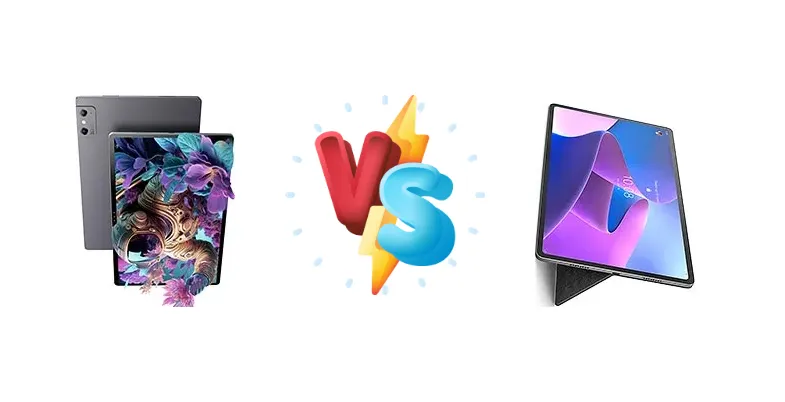
The Android tablet market is heating up, with options ranging from budget-friendly media consumption devices to high-performance contenders. The ZTE nubia Pad 3D and Lenovo Tab P12 Pro represent two distinct approaches: the nubia Pad 3D prioritizes raw processing power with its Snapdragon 888, while the Tab P12 Pro aims for a more balanced experience with the Snapdragon 870 and a focus on features like fast charging and a refined display. This comparison will dissect the key differences to determine which tablet best suits your needs.
🏆 Quick Verdict
For users prioritizing demanding tasks like gaming and video editing, the ZTE nubia Pad 3D is the clear winner thanks to its Snapdragon 888 5G chipset. However, the Lenovo Tab P12 Pro offers a more refined charging experience and potentially better sustained performance due to the 870's thermal characteristics, making it ideal for everyday productivity and media consumption.
| Network |
|---|
| 2G bands | N/A | GSM 850 / 900 / 1800 / 1900 |
| 3G bands | N/A | HSDPA 850 / 900 / 1900 / 2100 |
| 4G bands | N/A | 1, 2, 3, 4, 5, 7, 8, 19, 20, 26, 28, 34, 38, 39, 40, 41 |
| 5G bands | - | 1, 3, 7, 8, 20, 28, 38, 41, 77, 78 SA/NSA/Sub6 |
| EDGE | No | - |
| GPRS | No | - |
| Speed | - | HSPA, LTE, 5G - cellular model only |
| Technology | No cellular connectivity | GSM / HSPA / LTE / 5G |
| Launch |
|---|
| Announced | 2023, February 28 | 2021, September 08 |
| Status | Available. Released 2023, April 11 | Available. Released 2021, November 19 |
| Body |
|---|
| Build | Glass front, aluminum frame, aluminum back | - |
| Dimensions | 285 x 190 x 8.5 mm (11.22 x 7.48 x 0.33 in) | 285.6 x 184.5 x 5.6 mm (11.24 x 7.26 x 0.22 in) |
| SIM | No | Nano-SIM (cellular model only) |
| Weight | 780 g (1.72 lb) | 565 g (1.25 lb) |
| | - | Stylus support |
| Display |
|---|
| Protection | Corning Gorilla Glass | - |
| Resolution | 1600 x 2560 pixels, 16:10 ratio (~243 ppi density) | 1600 x 2560 pixels, 16:10 ratio (~240 ppi density) |
| Size | 12.4 inches, 445.8 cm2 (~82.3% screen-to-body ratio) | 12.6 inches, 460.3 cm2 (~87.4% screen-to-body ratio) |
| Type | IPS LCD, 120Hz | AMOLED, 120Hz, HDR10+, Dolby Vision, 600 nits (HBM) |
| | 3D lightfield display
Real-time 2D to 3D content conversion | - |
| Platform |
|---|
| CPU | Octa-core (1x2.84 GHz Cortex-X1 & 3x2.42 GHz Cortex-A78 & 4x1.80 GHz Cortex-A55) | Octa-core (1x3.2 GHz Kryo 585 & 3x2.42 GHz Kryo 585 & 4x1.80 GHz Kryo 585) |
| Chipset | Qualcomm SM8350 Snapdragon 888 5G (5 nm) | Qualcomm SM8250-AC Snapdragon 870 5G (7 nm) |
| GPU | Adreno 660 | Adreno 650 |
| OS | Android 12L | Android 11 |
| Memory |
|---|
| Card slot | microSDXC (dedicated slot) | microSDXC (dedicated slot) |
| Internal | 128GB 8GB RAM, 256GB 8GB RAM | 128GB 6GB RAM, 256GB 8GB RAM |
| Main Camera |
|---|
| Dual | 16 MP, f/1.9, 27mm (wide), AF
16 MP, f/1.9, 27mm (wide), AF | 13 MP, (wide), AF
5 MP, (ultrawide) |
| Features | LED flash, HDR, panorama, stereoscopic Al-powered 3D capture | - |
| Video | 1200p@30fps | 4K@30fps, 1080p@30fps |
| Selfie camera |
|---|
| Dual | 8 MP, f.2,2, 105˚ (ultrawide)
8 MP, f.2,2, 105˚ (ultrawide) | - |
| Features | Stereoscopic Al-powered 3D capture | - |
| Single | - | 8 MP, (wide)
8 MP, IR TOF 3D, (biometrics sensor only) |
| Video | 1200p@30fps | 1080p@30fps |
| Sound |
|---|
| 3.5mm jack | No | No |
| 35mm jack | No | No |
| Loudspeaker | Yes, with stereo speakers (4 speakers) | Yes, with stereo speakers (4 speakers) |
| | - | JBL speakers |
| Comms |
|---|
| Bluetooth | 5.2, A2DP, LE | 5.2, A2DP, LE |
| NFC | No | Yes (wireless charging and data transfer only) |
| Positioning | GPS (L1+L5), BDS (B1I+B1c+B2a) | GPS, GLONASS, BDS - cellular model only |
| Radio | No | Unspecified |
| USB | USB Type-C 3.1, OTG, magnetic connector, video output | USB Type-C 3.1 |
| WLAN | Wi-Fi 802.11 a/b/g/n/ac/6, dual-band | Wi-Fi 802.11 a/b/g/n/ac/6, dual-band, Wi-Fi Direct |
| Features |
|---|
| Sensors | Accelerometer, gyro, compass, proximity (accessories only) | Fingerprint (side-mounted), accelerometer, gyro, proximity |
| Battery |
|---|
| Charging | 33W wired | 45W wired, QC4 |
| Type | 9070 mAh | Li-Po 10200 mAh |
| Misc |
|---|
| Colors | Gray | Storm Grey |
| Models | - | TB-Q706Z, TB-Q706F |
| Price | About 1300 EUR | About 520 EUR |
ZTE nubia Pad 3D
- Superior raw processing power with Snapdragon 888
- Potentially better graphics performance for gaming
- 5G connectivity for faster data speeds
- Slower 33W charging
- Potentially higher thermal throttling under sustained load
- Higher power consumption
Lenovo Tab P12 Pro
- Faster 45W charging with Quick Charge 4.0
- Potentially better sustained performance due to thermal efficiency
- More balanced power consumption
- Less powerful Snapdragon 870 chipset
- Lower peak graphics performance
- May not be ideal for extremely demanding tasks
Display Comparison
While both tablets likely feature high-quality LCD panels (specific panel details are missing), the focus here is on performance, not display fidelity. Bezels are likely comparable given the market segment. The absence of LTPO technology in either device suggests standard refresh rate management, impacting battery life during dynamic content. Without specific brightness or color accuracy data, it's difficult to declare a clear winner; however, Lenovo often prioritizes color calibration in its Pro series.
Camera Comparison
Camera performance is unlikely to be a primary concern for most tablet buyers. Without detailed sensor information, it’s difficult to make a definitive comparison. Both tablets likely feature multi-camera setups, but image quality will depend heavily on software processing. The absence of specific details suggests neither device is positioned as a photography powerhouse.
Performance
The core difference lies in the chipsets. The ZTE nubia Pad 3D’s Snapdragon 888 (5nm) boasts a Cortex-X1 prime core clocked at 2.84 GHz, offering a theoretical performance edge over the Lenovo Tab P12 Pro’s Snapdragon 870 (7nm) with its 3.2 GHz Kryo 585 prime core. While the 870’s clock speed is higher, the 888’s newer architecture and 5nm process node generally translate to superior raw power. However, the 7nm process of the 870 can lead to better thermal efficiency, potentially preventing throttling during extended gaming sessions. Both utilize LPDDR5 RAM, but the nubia Pad 3D’s superior GPU will be noticeable in graphically demanding tasks.
Battery Life
The nubia Pad 3D’s 33W charging is significantly slower than the Lenovo Tab P12 Pro’s 45W charging with Quick Charge 4.0 support. This means the Tab P12 Pro will reach a full charge much faster. While battery capacity isn’t specified, the Snapdragon 888’s higher power consumption in the nubia Pad 3D may necessitate a larger battery to achieve comparable battery life. The 870’s efficiency gives the Lenovo Tab P12 Pro an advantage in sustained usage scenarios.
Buying Guide
Buy the ZTE nubia Pad 3D if you need uncompromising performance for gaming, content creation, or running resource-intensive applications. Its Snapdragon 888 provides a significant power advantage. Buy the Lenovo Tab P12 Pro if you prefer a tablet with faster charging, a potentially more consistent performance profile under sustained load, and a focus on a premium user experience with features like Quick Charge 4.0 support.
Frequently Asked Questions
❓ Will the Snapdragon 888 in the nubia Pad 3D overheat during prolonged gaming sessions?
The Snapdragon 888 is known to generate more heat than the 870. While the nubia Pad 3D likely has thermal management solutions, extended gaming at maximum settings could lead to throttling, reducing sustained performance. The Lenovo Tab P12 Pro’s 870 is more efficient and less prone to overheating.
❓ How much faster is the 45W charging on the Lenovo Tab P12 Pro compared to the 33W charging on the nubia Pad 3D?
The 45W charging on the Tab P12 Pro will significantly reduce charging times. Expect a noticeably quicker 0-100% charge compared to the nubia Pad 3D. Quick Charge 4.0 also optimizes the charging process for faster and safer power delivery.
❓ Is the difference in chipset performance between the Snapdragon 888 and 870 noticeable in everyday tasks like browsing and video streaming?
For typical tasks like web browsing, video streaming, and social media, the difference between the two chipsets will be minimal. Both are more than capable of handling these workloads smoothly. The performance gap becomes more apparent in demanding applications like gaming and video editing.