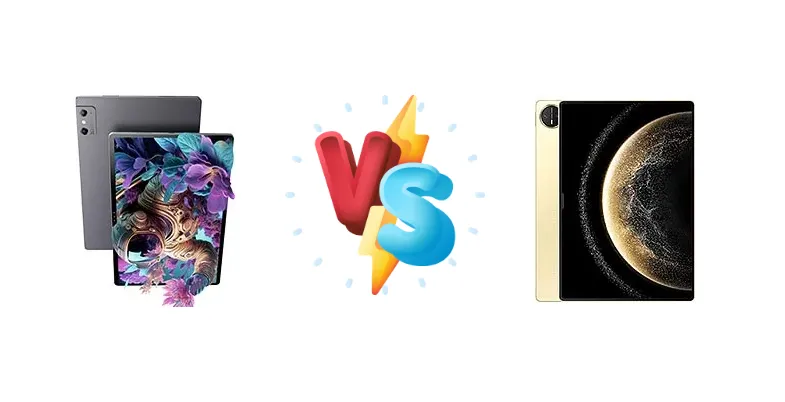
The tablet market is heating up, with the ZTE nubia Pad 3D offering a compelling blend of performance and 5G connectivity, while the Huawei MatePad Pro 13.2 (2025) aims for a premium experience with its new Kirin T92 chipset and blazing-fast charging. This comparison dissects these two devices to determine which one best suits your needs.
🏆 Quick Verdict
For the average user prioritizing rapid charging and potentially smoother software integration within the Huawei ecosystem, the MatePad Pro 13.2 (2025) is the better choice. However, the nubia Pad 3D’s 5G capability and established Snapdragon 888 platform offer a strong value proposition for those needing mobile connectivity.
| Network |
|---|
| 2G bands | N/A | GSM 850 / 900 / 1800 / 1900 |
| 3G bands | N/A | HSDPA 850 / 900 / 1900 / 2100 |
| 4G bands | N/A | LTE |
| EDGE | No | - |
| GPRS | No | - |
| Speed | - | HSPA, LTE - cellular model only |
| Technology | No cellular connectivity | GSM / HSPA / LTE |
| Launch |
|---|
| Announced | 2023, February 28 | 2024, November 26 |
| Status | Available. Released 2023, April 11 | Available. Released 2024, December 12 |
| Body |
|---|
| Build | Glass front, aluminum frame, aluminum back | Glass front, nylon fiber back, magnesium alloy frame |
| Dimensions | 285 x 190 x 8.5 mm (11.22 x 7.48 x 0.33 in) | 289.1 x 196.1 x 5.5 mm (11.38 x 7.72 x 0.22 in) |
| SIM | No | Nano-SIM (cellular model only) |
| Weight | 780 g (1.72 lb) | 580 g (Wi-FI) or 590 g (LTE) (1.28 lb) |
| Display |
|---|
| Protection | Corning Gorilla Glass | - |
| Resolution | 1600 x 2560 pixels, 16:10 ratio (~243 ppi density) | 2880 x 1920 pixels, 3:2 ratio (~262 ppi density) |
| Size | 12.4 inches, 445.8 cm2 (~82.3% screen-to-body ratio) | 13.2 inches, 518.8 cm2 (~91.5% screen-to-body ratio) |
| Type | IPS LCD, 120Hz | OLED, 1B colors, 144Hz, HDR Vivid, 1000 nits (peak) |
| | 3D lightfield display
Real-time 2D to 3D content conversion | - |
| Platform |
|---|
| CPU | Octa-core (1x2.84 GHz Cortex-X1 & 3x2.42 GHz Cortex-A78 & 4x1.80 GHz Cortex-A55) | Octa-core |
| Chipset | Qualcomm SM8350 Snapdragon 888 5G (5 nm) | Kirin T92 |
| GPU | Adreno 660 | - |
| OS | Android 12L | Harmony OS 4.3 |
| Memory |
|---|
| Card slot | microSDXC (dedicated slot) | No |
| Internal | 128GB 8GB RAM, 256GB 8GB RAM | 256GB 12GB RAM, 512GB 12GB RAM, 1TB 16GB RAM |
| Main Camera |
|---|
| Dual | 16 MP, f/1.9, 27mm (wide), AF
16 MP, f/1.9, 27mm (wide), AF | 50 MP, f/1.8, (wide), PDAF
8 MP, f/2.2, (ultrawide) |
| Features | LED flash, HDR, panorama, stereoscopic Al-powered 3D capture | LED flash |
| Video | 1200p@30fps | 4K@30fps, 1080p@30fps |
| Selfie camera |
|---|
| Dual | 8 MP, f.2,2, 105˚ (ultrawide)
8 MP, f.2,2, 105˚ (ultrawide) | - |
| Features | Stereoscopic Al-powered 3D capture | - |
| Single | - | 16 MP, f/2.2 |
| Video | 1200p@30fps | 1080p@30fps |
| Sound |
|---|
| 3.5mm jack | No | - |
| 35mm jack | No | No |
| Loudspeaker | Yes, with stereo speakers (4 speakers) | Yes, with stereo speakers (6 speakers) |
| Comms |
|---|
| Bluetooth | 5.2, A2DP, LE | 5.2, A2DP, LE, L2HC |
| NFC | No | No |
| Positioning | GPS (L1+L5), BDS (B1I+B1c+B2a) | GPS, GALILEO, GLONASS, BDS |
| Radio | No | No |
| USB | USB Type-C 3.1, OTG, magnetic connector, video output | USB Type-C 3.1, OTG, DisplayPort 1.2, accessory connector pins |
| WLAN | Wi-Fi 802.11 a/b/g/n/ac/6, dual-band | Wi-Fi 802.11 a/b/g/n/ac/6, dual-band |
| Features |
|---|
| Sensors | Accelerometer, gyro, compass, proximity (accessories only) | Fingerprint (side-mounted), accelerometer, gyro, compass, proximity (accessories only) |
| Battery |
|---|
| Charging | 33W wired | 100W wired
7.5W reverse wired |
| Type | 9070 mAh | Li-Po 10100 mAh |
| Misc |
|---|
| Colors | Gray | Black, White, Gold |
| Models | - | WEB-W00, PCE-W29 |
| Price | About 1300 EUR | About 680 EUR |
ZTE nubia Pad 3D
- Integrated 5G connectivity for on-the-go use.
- Proven Snapdragon 888 performance.
- Potentially more affordable price point.
- Slower 33W charging.
- Snapdragon 888 prone to thermal throttling.
- Limited camera information.
Huawei MatePad Pro 13.2 (2025)
- Ultra-fast 100W wired charging.
- Potentially more efficient Kirin T92 chipset.
- 7.5W reverse wired charging.
- Lacks integrated 5G connectivity.
- Reliance on Huawei’s HarmonyOS ecosystem.
- Limited camera information.
Display Comparison
While display specifications are missing for the nubia Pad 3D, the MatePad Pro 13.2’s large 13.2-inch screen is a key feature. The absence of LTPO technology in either device suggests both will rely on adaptive refresh rates managed by software, impacting battery life. The MatePad Pro’s larger size will likely offer a more immersive viewing experience, but the nubia Pad 3D’s potentially higher pixel density (depending on resolution) could result in sharper images. Color accuracy and brightness levels remain unknown for the nubia Pad 3D, making a direct comparison difficult.
Camera Comparison
Camera details are sparse for both devices. Without sensor size or aperture information, a meaningful comparison is impossible. It’s reasonable to assume both tablets will feature capable cameras for video conferencing and casual photography, but neither is likely to compete with dedicated camera phones. The absence of detailed camera specs suggests neither device is positioned as a photography powerhouse.
Performance
The core difference lies in the chipsets. The ZTE nubia Pad 3D utilizes the Qualcomm Snapdragon 888 5G (5nm), a flagship processor from 2021. The Huawei MatePad Pro 13.2 (2025) features the Kirin T92. While core counts are identical (Octa-core), the Kirin T92’s architecture and manufacturing process (likely 4nm or smaller) *should* offer improved power efficiency and potentially better sustained performance. The Snapdragon 888 is known to throttle under sustained load, a potential issue for demanding games. The nubia Pad 3D’s 5G modem is a significant advantage for users needing constant connectivity, a feature absent in the MatePad Pro. RAM specifications are missing for both, but LPDDR5x is expected on the MatePad Pro, offering faster memory bandwidth.
Battery Life
The Huawei MatePad Pro 13.2 (2025) boasts a significant advantage with its 100W wired charging, promising incredibly fast top-ups. The ZTE nubia Pad 3D’s 33W charging is comparatively slow. While battery capacity is unknown for both, the faster charging of the MatePad Pro mitigates the impact of a potentially smaller battery. The MatePad Pro also includes 7.5W reverse wired charging, allowing it to charge other devices – a feature absent on the nubia Pad 3D.
Buying Guide
Buy the ZTE nubia Pad 3D if you need a tablet with integrated 5G for on-the-go productivity or entertainment, and value a proven chipset with widespread software support. Buy the Huawei MatePad Pro 13.2 (2025) if you prioritize the fastest possible charging speeds, a potentially more refined user experience within Huawei’s HarmonyOS, and are less concerned with cellular connectivity.
Frequently Asked Questions
❓ Will the Snapdragon 888 in the nubia Pad 3D struggle with demanding games like Genshin Impact after extended play sessions?
The Snapdragon 888 is known to throttle under sustained load due to its 5nm manufacturing process and thermal limitations. While the nubia Pad 3D’s cooling solution is unknown, expect some performance degradation during prolonged gaming sessions. Lowering graphics settings can mitigate this issue.
❓ Does the Huawei MatePad Pro 13.2 (2025) support the Huawei Pencil and keyboard accessories, and how do they enhance productivity?
Yes, the MatePad Pro 13.2 (2025) is fully compatible with Huawei’s Pencil and Smart Magnetic Keyboard. The Pencil offers precise input for note-taking and drawing, while the keyboard transforms the tablet into a laptop-like experience, ideal for document editing and email.
❓ What software experience can I expect on the ZTE nubia Pad 3D, and will it receive timely Android updates?
The nubia Pad 3D runs on Android, but the specific UI and update schedule are dependent on ZTE’s support. Historically, ZTE’s update cadence has been slower than some other manufacturers. Expect a relatively stock Android experience with some ZTE customizations.
❓ Is the lack of 5G on the Huawei MatePad Pro 13.2 a significant drawback for users who frequently travel or work remotely?
For users heavily reliant on constant internet connectivity while on the move, the absence of 5G on the MatePad Pro 13.2 is a notable limitation. It will require reliance on Wi-Fi networks, which may not always be available or secure.