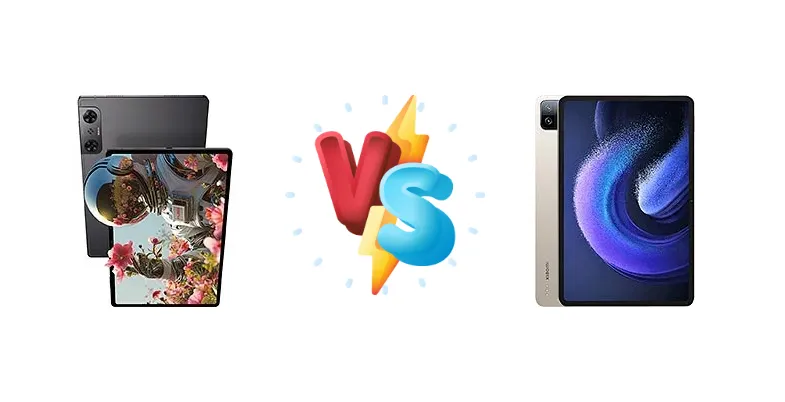
The Android tablet market is heating up, with both ZTE and Xiaomi offering compelling high-performance options. The ZTE nubia Pad 3D II leverages the latest Snapdragon 8 Gen 2, while the Xiaomi Pad 6 Pro opts for the Snapdragon 8+ Gen 1. This comparison dissects the key differences between these two tablets, focusing on performance, charging, and overall user experience to determine which one reigns supreme.
🏆 Quick Verdict
For demanding users prioritizing raw processing power and future-proofing, the ZTE nubia Pad 3D II takes the lead. Its Snapdragon 8 Gen 2 chipset offers a noticeable performance edge, despite the Xiaomi Pad 6 Pro’s competitive features and slightly faster charging.
| Network |
|---|
| 2G bands | N/A | N/A |
| 3G bands | N/A | N/A |
| 4G bands | N/A | - |
| 5G bands | SA/NSA | - |
| EDGE | No | N/A |
| GPRS | No | N/A |
| Speed | 5G | - |
| Technology | 5G | No cellular connectivity |
| Launch |
|---|
| Announced | 2024, February 28 | 2023, April 18 |
| Status | Available. Released 2024, Q2 | Available. Released 2023, April 30 |
| Body |
|---|
| Build | Glass front, aluminum frame, aluminum back | Glass front (Gorilla Glass 3), aluminum frame, aluminum back |
| Dimensions | - | 254 x 165.2 x 6.5 mm (10.0 x 6.50 x 0.26 in) |
| SIM | No | No |
| Weight | - | 490 g (1.08 lb) |
| | - | Stylus support (magnetic) |
| Display |
|---|
| Protection | Corning Gorilla Glass | Corning Gorilla Glass 3 |
| Resolution | 1600 x 2560 pixels, 16:10 ratio (~249 ppi density) | 1800 x 2880 pixels, 16:10 ratio (~309 ppi density) |
| Size | 12.1 inches, 424.5 cm2 | 11.0 inches, 350.9 cm2 (~83.6% screen-to-body ratio) |
| Type | IPS LCD, 144Hz | IPS LCD, 1B colors, 144Hz, HDR10, Dolby Vision, 550 nits |
| Platform |
|---|
| CPU | Octa-core (1x3.2 GHz Cortex-X3 & 2x2.8 GHz Cortex-A715 & 2x2.8 GHz Cortex-A710 & 3x2.0 GHz Cortex-A510) | Octa-core (1x3.19 GHz Cortex-X2 & 3x2.75 GHz Cortex-A710 & 4x1.80 GHz Cortex-A510) |
| Chipset | Qualcomm SM8550-AB Snapdragon 8 Gen 2 (4 nm) | Qualcomm SM8475 Snapdragon 8+ Gen 1 (4 nm) |
| GPU | Adreno 740 | Adreno 730 |
| OS | Android 14 | Android 13, MIUI 14 |
| Memory |
|---|
| Card slot | microSDXC (dedicated slot) | No |
| Internal | 256GB 8GB RAM, 512GB 8GB RAM | 128GB 8GB RAM, 256GB 8GB RAM, 256GB 12GB RAM, 512GB 12GB RAM |
| | - | UFS 3.1 |
| Main Camera |
|---|
| Dual | 13 MP, (wide), AF
13 MP, (wide), AF | 50 MP, f/1.8, (wide), 1/2.76", 0.64µm, PDAF
Auxiliary lens |
| Features | LED flash, HDR, panorama, stereoscopic Al-powered 3D capture | Dual-LED flash, HDR, panorama |
| Video | 1200p@30fps | 4K@30/60fps, 1080p@30/60fps |
| Selfie camera |
|---|
| Dual | 8 MP, f.2,2, 105˚ (ultrawide)
8 MP, f.2,2, 105˚ (ultrawide) | - |
| Features | Stereoscopic Al-powered 3D capture | - |
| Single | - | 20 MP, f/2.2, (wide), 1/3.4", 0.8µm |
| Video | 1200p@30fps | 1080p@30/60fps |
| Sound |
|---|
| 3.5mm jack | - | No |
| 35mm jack | No | No |
| Loudspeaker | Yes, with stereo speakers (4 speakers) | Yes, with stereo speakers (4 speakers) |
| | - | 24-bit/192kHz audio |
| Comms |
|---|
| Bluetooth | 5.2, A2DP, LE | 5.3, A2DP, LE |
| NFC | No | No |
| Positioning | GPS (L1+L5), BDS (B1I+B1c+B2a) | No |
| Radio | No | No |
| USB | USB Type-C 3.1, OTG, magnetic connector, video output | USB Type-C 3.2, accessory connector |
| WLAN | Wi-Fi 802.11 a/b/g/n/ac/6, dual-band | Wi-Fi 802.11 a/b/g/n/a/6e, dual-band, Wi-Fi Direct |
| Features |
|---|
| Sensors | Accelerometer, gyro, compass, proximity (accessories only) | Accelerometer, gyro, proximity (accessories only) |
| Battery |
|---|
| Charging | 66W wired | 67W wired, PD3.0, QC4, 100% in 1 hour |
| Type | 10000 mAh | Li-Po 8600 mAh |
| Misc |
|---|
| Colors | Gray | Black, Blue, Gold |
| Models | - | 23046RP50C |
| Price | About 1300 EUR | About 330 EUR |
ZTE nubia Pad 3D II
- Superior CPU and GPU performance with Snapdragon 8 Gen 2
- More efficient 4nm process for better thermal management
- Advanced ISP for improved image processing
- Potentially higher price point
- Software experience may not be as refined as Xiaomi's MIUI
Xiaomi Pad 6 Pro
- Fast 67W charging with PD3.0 and QC4 support
- Potentially lower price
- Refined MIUI software experience
- Older Snapdragon 8+ Gen 1 chipset
- Slightly lower CPU and GPU performance compared to the nubia Pad 3D II
Display Comparison
While both tablets likely feature high-quality LCD panels (specific display details are missing), the core difference lies in the processing power driving them. The absence of display specs necessitates focusing on the chipset's ability to render graphics smoothly. The Snapdragon 8 Gen 2 in the nubia Pad 3D II will provide a more consistent frame rate in graphically intensive applications. Bezels and color accuracy are assumed to be comparable within the premium tablet segment.
Camera Comparison
Without specific camera details, a direct comparison is limited. However, both tablets likely feature capable main sensors for tablet photography. The focus should be on the image signal processor (ISP) within each chipset. The Snapdragon 8 Gen 2’s ISP is more advanced, offering improved image processing capabilities, better low-light performance, and potentially more sophisticated computational photography features. The Xiaomi Pad 6 Pro’s ISP is still excellent, but a generation behind.
Performance
The ZTE nubia Pad 3D II’s Snapdragon 8 Gen 2 (4nm) represents a significant architectural leap over the Xiaomi Pad 6 Pro’s Snapdragon 8+ Gen 1 (4nm). The Gen 2 features a new CPU configuration – 1x3.2 GHz Cortex-X3, 2x2.8 GHz Cortex-A715, 2x2.8 GHz Cortex-A710, and 3x2.0 GHz Cortex-A510 – compared to the 8+ Gen 1’s 1x3.19 GHz Cortex-X2, 3x2.75 GHz Cortex-A710, and 4x1.80 GHz Cortex-A510. This translates to faster single-core and multi-core performance for the nubia Pad 3D II. The newer Cortex-X3 core is a key advantage. Both utilize LPDDR5x RAM, but the Gen 2’s superior CPU and GPU will minimize bottlenecks. Thermal management will be crucial; the 4nm node of the Gen 2 should offer better efficiency, potentially reducing throttling during sustained workloads.
Battery Life
Both tablets offer fast 66W/67W wired charging, with the Xiaomi Pad 6 Pro claiming a full charge in 1 hour. While the wattage is similar, the Xiaomi Pad 6 Pro’s inclusion of PD3.0 and QC4 adds versatility. Battery capacity is not specified, but the Snapdragon 8 Gen 2’s improved efficiency in the nubia Pad 3D II could offset a potentially smaller battery size, resulting in comparable real-world battery life. The faster charging of the Xiaomi Pad 6 Pro is a slight advantage for users who prioritize quick top-ups.
Buying Guide
Buy the ZTE nubia Pad 3D II if you need the absolute best performance for demanding tasks like video editing, high-end gaming, or running complex applications. Buy the Xiaomi Pad 6 Pro if you prefer a slightly more refined software experience, a potentially lower price point, and a very close performance level for everyday tasks and moderate gaming.
Frequently Asked Questions
❓ Will the Snapdragon 8+ Gen 1 in the Xiaomi Pad 6 Pro throttle under sustained gaming loads?
The Snapdragon 8+ Gen 1 is a capable chip, but it is more prone to thermal throttling than the Snapdragon 8 Gen 2. Expect some performance reduction during extended gaming sessions, particularly with demanding titles. The Xiaomi Pad 6 Pro’s thermal solution will play a crucial role in mitigating this.
❓ Does the ZTE nubia Pad 3D II support external displays or accessories?
While specific details are not provided, given its positioning as a high-performance tablet, the nubia Pad 3D II likely supports USB-C DisplayPort output for connecting to external monitors. Support for accessories like styluses and keyboards is also probable, but confirmation requires further investigation.
❓ How does the software experience differ between the two tablets?
The ZTE nubia Pad 3D II likely runs a near-stock Android experience with ZTE’s customizations, while the Xiaomi Pad 6 Pro utilizes Xiaomi’s MIUI for Pad. MIUI is known for its extensive features and customization options, but some users may find it bloated or prefer the cleaner look of stock Android.