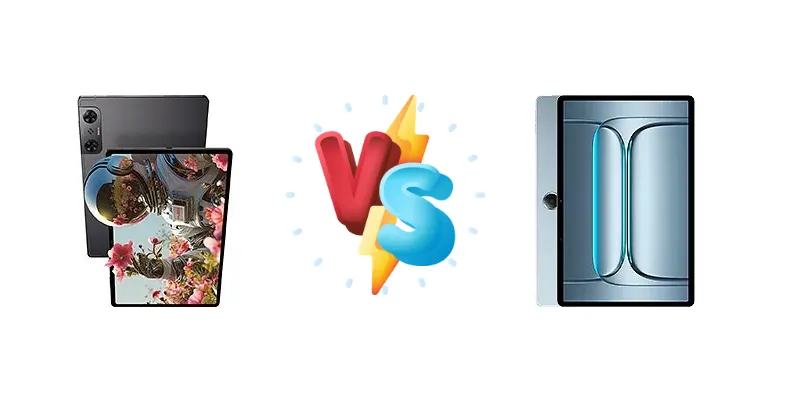
The Android tablet market is heating up, with options ranging from budget-friendly to premium. The ZTE nubia Pad 3D II arrives as a performance-focused contender, leveraging Qualcomm’s flagship Snapdragon 8 Gen 2. Conversely, the OnePlus Pad Lite aims for a balance of features and affordability with a MediaTek Helio G100 chipset. This comparison dissects the key differences to help you determine which tablet best aligns with your needs.
🏆 Quick Verdict
For users prioritizing raw performance and demanding tasks like gaming or content creation, the ZTE nubia Pad 3D II is the clear winner. Its Snapdragon 8 Gen 2 chipset offers a substantial leap in processing power. However, the OnePlus Pad Lite provides excellent value for everyday use, offering a smooth experience at a more accessible price point.
| Network |
|---|
| 2G bands | N/A | GSM 850 / 900 / 1800 / 1900 - cellular model only |
| 3G bands | N/A | HSDPA 850 / 900 / 2100 - cellular model only |
| 4G bands | N/A | LTE - cellular model only |
| 5G bands | SA/NSA | - |
| EDGE | No | - |
| GPRS | No | - |
| Speed | 5G | HSPA, LTE - cellular model only |
| Technology | 5G | GSM / HSPA / LTE |
| Launch |
|---|
| Announced | 2024, February 28 | 2025, July 08 |
| Status | Available. Released 2024, Q2 | Available. Released 2025, August 14 |
| Body |
|---|
| Build | Glass front, aluminum frame, aluminum back | - |
| Dimensions | - | 254.9 x 166.5 x 7.4 mm (10.04 x 6.56 x 0.29 in) |
| SIM | No | Yes - cellular model only |
| Weight | - | 530 g (1.17 lb) |
| Display |
|---|
| Protection | Corning Gorilla Glass | - |
| Resolution | 1600 x 2560 pixels, 16:10 ratio (~249 ppi density) | 1200 x 1920 pixels, 16:10 ratio (~207 ppi density) |
| Size | 12.1 inches, 424.5 cm2 | 11.0 inches, 347.5 cm2 (~81.9% screen-to-body ratio) |
| Type | IPS LCD, 144Hz | IPS LCD, 1B colors, 90Hz, 500 nits |
| Platform |
|---|
| CPU | Octa-core (1x3.2 GHz Cortex-X3 & 2x2.8 GHz Cortex-A715 & 2x2.8 GHz Cortex-A710 & 3x2.0 GHz Cortex-A510) | Octa-core (2x2.2 GHz Cortex-A76 & 6x2.0 GHz Cortex-A55) |
| Chipset | Qualcomm SM8550-AB Snapdragon 8 Gen 2 (4 nm) | Mediatek Helio G100 (6 nm) |
| GPU | Adreno 740 | Mali-G57 MC2 |
| OS | Android 14 | Android 15, OxygenOS 15 |
| Memory |
|---|
| Card slot | microSDXC (dedicated slot) | Unspecified |
| Internal | 256GB 8GB RAM, 512GB 8GB RAM | 128GB 6GB RAM, 128GB 8GB RAM |
| Main Camera |
|---|
| Dual | 13 MP, (wide), AF
13 MP, (wide), AF | - |
| Features | LED flash, HDR, panorama, stereoscopic Al-powered 3D capture | - |
| Single | - | 5 MP |
| Video | 1200p@30fps | 1080p@30fps |
| Selfie camera |
|---|
| Dual | 8 MP, f.2,2, 105˚ (ultrawide)
8 MP, f.2,2, 105˚ (ultrawide) | - |
| Features | Stereoscopic Al-powered 3D capture | - |
| Single | - | 5 MP |
| Video | 1200p@30fps | 1080p@30fps |
| Sound |
|---|
| 35mm jack | No | No |
| Loudspeaker | Yes, with stereo speakers (4 speakers) | Yes, with stereo speakers (4 speakers, Hi-Res audio) |
| Comms |
|---|
| Bluetooth | 5.2, A2DP, LE | 5.2, A2DP, LE, aptX HD |
| NFC | No | No |
| Positioning | GPS (L1+L5), BDS (B1I+B1c+B2a) | GPS, (cellular model only) - unconfirmed |
| Radio | No | No |
| USB | USB Type-C 3.1, OTG, magnetic connector, video output | USB Type-C 2.0 |
| WLAN | Wi-Fi 802.11 a/b/g/n/ac/6, dual-band | Wi-Fi 802.11 a/b/g/n/ac, dual-band |
| Features |
|---|
| Sensors | Accelerometer, gyro, compass, proximity (accessories only) | Unspecified |
| Battery |
|---|
| Charging | 66W wired | 33W wired |
| Type | 10000 mAh | Li-Po 9340 mAh |
| Misc |
|---|
| Colors | Gray | Aero Blue |
| Models | - | OPD2480 |
| Price | About 1300 EUR | About 200 EUR |
ZTE nubia Pad 3D II
- Exceptional performance with Snapdragon 8 Gen 2
- Faster 66W wired charging
- Likely higher-quality display and camera system
- Higher price point
- Potentially shorter battery life if battery capacity is lower
OnePlus Pad Lite
- More affordable price
- Good value for everyday tasks
- Decent performance for casual use
- Significantly slower charging
- Less powerful processor for demanding applications
Display Comparison
While display specifications are missing for both devices, the nubia Pad 3D II’s positioning suggests a higher-quality panel is likely, potentially with a higher refresh rate. The OnePlus Pad Lite, targeting a more budget-conscious market, will likely feature a standard LCD panel. The difference in chipsets suggests the nubia Pad 3D II could support higher resolutions and more advanced display features. Bezels are a key consideration, and the nubia’s premium positioning hints at slimmer bezels for a more immersive viewing experience.
Camera Comparison
Camera details are limited, but the nubia Pad 3D II, as a higher-tier device, is expected to feature a more sophisticated camera system. While megapixel counts aren't provided, the Snapdragon 8 Gen 2’s image signal processor (ISP) offers superior image processing capabilities, resulting in better dynamic range, noise reduction, and overall image quality. The OnePlus Pad Lite will likely offer a functional camera for casual snapshots, but won’t compete with the nubia’s potential for more detailed and vibrant photos and videos.
Performance
The performance gap is significant. The ZTE nubia Pad 3D II’s Qualcomm Snapdragon 8 Gen 2 (4nm) is a flagship chipset built on a more efficient process node than the OnePlus Pad Lite’s MediaTek Helio G100 (6nm). The Snapdragon 8 Gen 2’s octa-core configuration – 1x3.2 GHz Cortex-X3, 2x2.8 GHz Cortex-A715, 2x2.8 GHz Cortex-A710, and 3x2.0 GHz Cortex-A510 – provides a substantial advantage in both single-core and multi-core performance compared to the Helio G100’s 2x2.2 GHz Cortex-A76 and 6x2.0 GHz Cortex-A55. This translates to faster app loading times, smoother multitasking, and a significantly better gaming experience on the nubia Pad 3D II. The Snapdragon 8 Gen 2 also benefits from a more powerful GPU, crucial for graphically intensive tasks.
Battery Life
Battery capacity is not specified for either device. However, the nubia Pad 3D II’s 66W wired charging significantly outpaces the OnePlus Pad Lite’s 33W charging. This means the nubia Pad 3D II will be able to replenish its battery much faster, minimizing downtime. While a larger battery capacity on the OnePlus Pad Lite could offset the slower charging, the efficiency gains of the Snapdragon 8 Gen 2 in the nubia Pad 3D II could result in comparable or even better real-world battery life despite a potentially smaller battery size.
Buying Guide
Buy the ZTE nubia Pad 3D II if you need uncompromising performance for gaming, video editing, or multitasking, and are willing to pay a premium. Its Snapdragon 8 Gen 2 ensures future-proofing and handles demanding applications with ease. Buy the OnePlus Pad Lite if you prioritize a smooth, reliable tablet experience for everyday tasks like browsing, streaming, and light productivity, and want to maximize value for your money. It’s ideal for students, casual users, and families.
Frequently Asked Questions
❓ Will the Snapdragon 8 Gen 2 in the ZTE nubia Pad 3D II get hot during extended gaming sessions?
The Snapdragon 8 Gen 2 is a highly efficient chipset, but demanding games will inevitably generate heat. However, the 4nm process node and likely advanced thermal management system in the nubia Pad 3D II should mitigate throttling and maintain consistent performance for longer periods compared to the Helio G100.
❓ Is the MediaTek Helio G100 in the OnePlus Pad Lite sufficient for streaming video and browsing the web?
Yes, the Helio G100 is perfectly capable of handling everyday tasks like streaming video, browsing the web, and running social media apps. It provides a smooth and responsive experience for these common use cases, making it ideal for casual users.
❓ How much faster is the 66W charging on the ZTE nubia Pad 3D II compared to the 33W charging on the OnePlus Pad Lite?
66W charging will significantly reduce charging times. While exact 0-100% times are unavailable, expect the nubia Pad 3D II to charge considerably faster – potentially cutting charging time in half – compared to the OnePlus Pad Lite, allowing for quicker top-ups and less downtime.