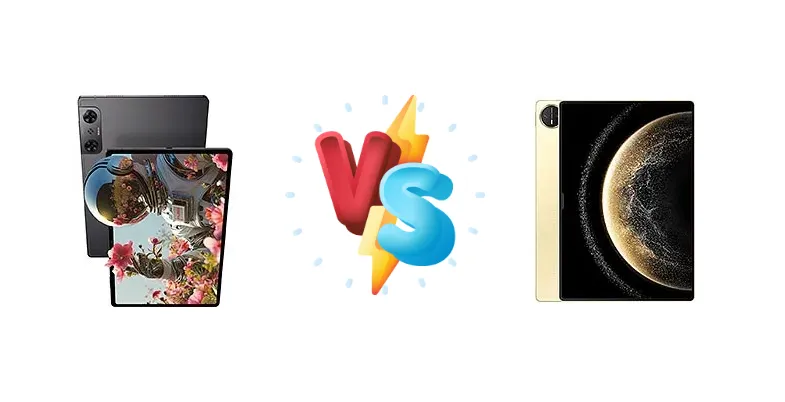
The large-screen Android tablet market is heating up. The ZTE nubia Pad 3D II, powered by the Snapdragon 8 Gen 2, aims to deliver flagship performance. Meanwhile, Huawei’s MatePad Pro 13.2 (2025) introduces the Kirin T92 chipset, promising a blend of power and efficiency. This comparison dissects these two contenders, focusing on their core strengths and weaknesses to help you determine which tablet best suits your needs.
🏆 Quick Verdict
For users prioritizing raw processing power and established gaming optimization, the ZTE nubia Pad 3D II with its Snapdragon 8 Gen 2 is the clear winner. However, the Huawei MatePad Pro 13.2 (2025) counters with significantly faster 100W charging, potentially appealing to those who value convenience and minimal downtime.
| Network |
|---|
| 2G bands | N/A | GSM 850 / 900 / 1800 / 1900 |
| 3G bands | N/A | HSDPA 850 / 900 / 1900 / 2100 |
| 4G bands | N/A | LTE |
| 5G bands | SA/NSA | - |
| EDGE | No | - |
| GPRS | No | - |
| Speed | 5G | HSPA, LTE - cellular model only |
| Technology | 5G | GSM / HSPA / LTE |
| Launch |
|---|
| Announced | 2024, February 28 | 2024, November 26 |
| Status | Available. Released 2024, Q2 | Available. Released 2024, December 12 |
| Body |
|---|
| Build | Glass front, aluminum frame, aluminum back | Glass front, nylon fiber back, magnesium alloy frame |
| Dimensions | - | 289.1 x 196.1 x 5.5 mm (11.38 x 7.72 x 0.22 in) |
| SIM | No | Nano-SIM (cellular model only) |
| Weight | - | 580 g (Wi-FI) or 590 g (LTE) (1.28 lb) |
| Display |
|---|
| Protection | Corning Gorilla Glass | - |
| Resolution | 1600 x 2560 pixels, 16:10 ratio (~249 ppi density) | 2880 x 1920 pixels, 3:2 ratio (~262 ppi density) |
| Size | 12.1 inches, 424.5 cm2 | 13.2 inches, 518.8 cm2 (~91.5% screen-to-body ratio) |
| Type | IPS LCD, 144Hz | OLED, 1B colors, 144Hz, HDR Vivid, 1000 nits (peak) |
| Platform |
|---|
| CPU | Octa-core (1x3.2 GHz Cortex-X3 & 2x2.8 GHz Cortex-A715 & 2x2.8 GHz Cortex-A710 & 3x2.0 GHz Cortex-A510) | Octa-core |
| Chipset | Qualcomm SM8550-AB Snapdragon 8 Gen 2 (4 nm) | Kirin T92 |
| GPU | Adreno 740 | - |
| OS | Android 14 | Harmony OS 4.3 |
| Memory |
|---|
| Card slot | microSDXC (dedicated slot) | No |
| Internal | 256GB 8GB RAM, 512GB 8GB RAM | 256GB 12GB RAM, 512GB 12GB RAM, 1TB 16GB RAM |
| Main Camera |
|---|
| Dual | 13 MP, (wide), AF
13 MP, (wide), AF | 50 MP, f/1.8, (wide), PDAF
8 MP, f/2.2, (ultrawide) |
| Features | LED flash, HDR, panorama, stereoscopic Al-powered 3D capture | LED flash |
| Video | 1200p@30fps | 4K@30fps, 1080p@30fps |
| Selfie camera |
|---|
| Dual | 8 MP, f.2,2, 105˚ (ultrawide)
8 MP, f.2,2, 105˚ (ultrawide) | - |
| Features | Stereoscopic Al-powered 3D capture | - |
| Single | - | 16 MP, f/2.2 |
| Video | 1200p@30fps | 1080p@30fps |
| Sound |
|---|
| 35mm jack | No | No |
| Loudspeaker | Yes, with stereo speakers (4 speakers) | Yes, with stereo speakers (6 speakers) |
| Comms |
|---|
| Bluetooth | 5.2, A2DP, LE | 5.2, A2DP, LE, L2HC |
| NFC | No | No |
| Positioning | GPS (L1+L5), BDS (B1I+B1c+B2a) | GPS, GALILEO, GLONASS, BDS |
| Radio | No | No |
| USB | USB Type-C 3.1, OTG, magnetic connector, video output | USB Type-C 3.1, OTG, DisplayPort 1.2, accessory connector pins |
| WLAN | Wi-Fi 802.11 a/b/g/n/ac/6, dual-band | Wi-Fi 802.11 a/b/g/n/ac/6, dual-band |
| Features |
|---|
| Sensors | Accelerometer, gyro, compass, proximity (accessories only) | Fingerprint (side-mounted), accelerometer, gyro, compass, proximity (accessories only) |
| Battery |
|---|
| Charging | 66W wired | 100W wired
7.5W reverse wired |
| Type | 10000 mAh | Li-Po 10100 mAh |
| Misc |
|---|
| Colors | Gray | Black, White, Gold |
| Models | - | WEB-W00, PCE-W29 |
| Price | About 1300 EUR | About 680 EUR |
ZTE nubia Pad 3D II
- Superior CPU and GPU performance with Snapdragon 8 Gen 2
- Proven thermal management of the Snapdragon platform
- Excellent for gaming and demanding applications
- Slower 66W charging compared to the MatePad Pro
- Potential for higher price point
Huawei MatePad Pro 13.2 (2025)
- Ultra-fast 100W wired charging
- 7.5W reverse wired charging for accessories
- Potentially optimized software experience with HarmonyOS
- Kirin T92 chipset may offer slightly lower peak performance
- GPU performance likely lags behind Snapdragon 8 Gen 2
Display Comparison
While specific display details are missing for both devices, the larger 13.2-inch screen of the MatePad Pro suggests a focus on media consumption and productivity. The nubia Pad 3D II’s display quality will be crucial, as the Snapdragon 8 Gen 2 has the horsepower to drive high refresh rates and resolutions. Without knowing panel technology (LTPO, OLED, LCD) or peak brightness, it’s difficult to definitively declare a winner, but the larger canvas of the MatePad Pro offers inherent advantages for multitasking and visual immersion.
Camera Comparison
Without specific camera specs, it’s challenging to make a direct comparison. However, given Huawei’s history with camera technology, the MatePad Pro 13.2 likely prioritizes image quality and computational photography. The nubia Pad 3D II may lean towards a more balanced approach, focusing on overall performance rather than solely camera prowess. The absence of details makes this a tie, pending further information on sensor sizes, apertures, and image processing algorithms.
Performance
The core of this comparison lies in the chipsets. The ZTE nubia Pad 3D II’s Snapdragon 8 Gen 2 (4nm) is a well-established flagship processor known for its exceptional CPU and GPU performance. Its octa-core configuration (1x3.2 GHz Cortex-X3, 2x2.8 GHz Cortex-A715, 2x2.8 GHz Cortex-A710, 3x2.0 GHz Cortex-A510) provides a balanced approach to handling demanding workloads. The Huawei MatePad Pro 13.2 (2025) utilizes the Kirin T92. While details on its architecture are limited, it’s likely built on a less advanced node (potentially 5nm or 6nm), which could translate to slightly lower thermal efficiency and potentially more throttling under sustained load. The Snapdragon 8 Gen 2’s Adreno 740 GPU is a significant advantage for gaming, offering superior graphics capabilities compared to the Kirin T92’s integrated GPU. The nubia Pad 3D II will likely excel in graphically intensive applications and games.
Battery Life
The Huawei MatePad Pro 13.2 (2025) takes a clear lead in charging speed with its 100W wired charging capability. This will significantly reduce charging times compared to the ZTE nubia Pad 3D II’s 66W charging. While battery capacity isn’t specified for either device, the faster charging of the MatePad Pro offsets any potential capacity disadvantage. The MatePad Pro also offers 7.5W reverse wired charging, a convenient feature for topping up accessories. The nubia Pad 3D II will likely offer respectable battery life given the Snapdragon 8 Gen 2’s efficiency, but won’t match the MatePad Pro’s charging convenience.
Buying Guide
Buy the ZTE nubia Pad 3D II if you are a demanding gamer, content creator, or power user who needs the absolute best performance from an Android tablet. The Snapdragon 8 Gen 2 provides a proven track record for handling intensive tasks. Buy the Huawei MatePad Pro 13.2 (2025) if you prioritize rapid charging and a potentially more streamlined software experience (depending on HarmonyOS preferences), and are less concerned with achieving the absolute highest benchmark scores.
Frequently Asked Questions
❓ Will the Kirin T92 chipset in the Huawei MatePad Pro 13.2 overheat during extended gaming sessions?
While the Kirin T92’s thermal performance is unknown, chipsets built on larger nodes (potentially 5nm or 6nm) are generally more prone to throttling under sustained load compared to the 4nm Snapdragon 8 Gen 2. Expect potentially reduced performance after prolonged gaming, though Huawei’s thermal management solutions may mitigate this.
❓ How does the Snapdragon 8 Gen 2’s performance translate to real-world benefits for content creators on the ZTE nubia Pad 3D II?
The Snapdragon 8 Gen 2’s powerful CPU and Adreno 740 GPU accelerate tasks like video editing, photo processing, and 3D rendering. This means faster export times, smoother editing experiences, and the ability to work with larger, more complex projects without significant lag.
❓ Does the 100W charging on the Huawei MatePad Pro 13.2 support Power Delivery (PD) for charging other devices?
The MatePad Pro 13.2 includes 7.5W reverse wired charging, but it's unlikely the 100W charging port fully supports the Power Delivery standard for high-wattage output to other devices. It's primarily designed for quickly charging the tablet itself.