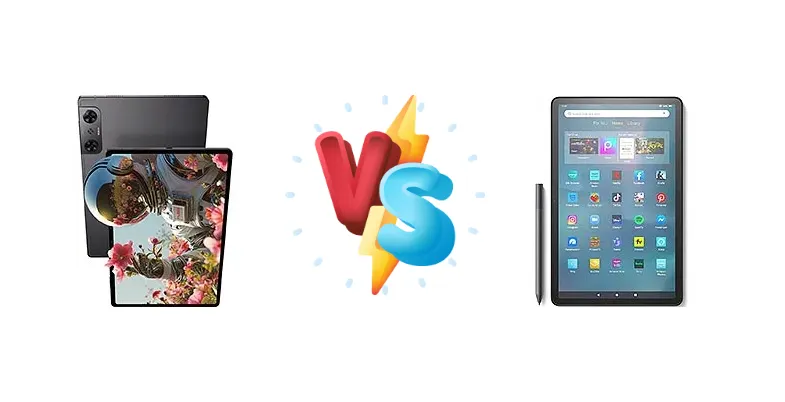
The tablet market offers a spectrum of choices, from full-fledged Android experiences to streamlined, content-focused ecosystems. We pit the ZTE nubia Pad 3D II, a performance-oriented device powered by the Snapdragon 8 Gen 2, against the Amazon Fire Max 11, a more affordable option geared towards Amazon’s ecosystem. This comparison will dissect the core differences to help you determine which tablet best suits your needs.
🏆 Quick Verdict
For users prioritizing performance, gaming, and a versatile Android experience, the ZTE nubia Pad 3D II is the clear winner. Its Snapdragon 8 Gen 2 chipset delivers significantly faster processing speeds and superior graphics capabilities. However, the Amazon Fire Max 11 remains a compelling option for those deeply invested in Amazon’s services and seeking a budget-friendly large-screen device.
| Network |
|---|
| 2G bands | N/A | N/A |
| 3G bands | N/A | - |
| 4G bands | N/A | - |
| 5G bands | SA/NSA | - |
| EDGE | No | No |
| GPRS | No | No |
| Speed | 5G | - |
| Technology | 5G | No cellular connectivity |
| Launch |
|---|
| Announced | 2024, February 28 | 2023, May 23 |
| Status | Available. Released 2024, Q2 | Available. Released 2023, May 23 |
| Body |
|---|
| Build | Glass front, aluminum frame, aluminum back | - |
| Dimensions | - | 259.1 x 163.7 x 7.5 mm (10.20 x 6.44 x 0.30 in) |
| SIM | No | No |
| Weight | - | 490 g (1.08 lb) |
| Display |
|---|
| Protection | Corning Gorilla Glass | - |
| Resolution | 1600 x 2560 pixels, 16:10 ratio (~249 ppi density) | 2000 x 1200 pixels, 5:3 ratio (~212 ppi density) |
| Size | 12.1 inches, 424.5 cm2 | 11.0 inches, 344.4 cm2 (~81.2% screen-to-body ratio) |
| Type | IPS LCD, 144Hz | IPS LCD |
| Platform |
|---|
| CPU | Octa-core (1x3.2 GHz Cortex-X3 & 2x2.8 GHz Cortex-A715 & 2x2.8 GHz Cortex-A710 & 3x2.0 GHz Cortex-A510) | Octa-core (2x2.2 GHz Cortex-A78 & 6x2.0 GHz Cortex-A55) |
| Chipset | Qualcomm SM8550-AB Snapdragon 8 Gen 2 (4 nm) | Mediatek MT8188J |
| GPU | Adreno 740 | Mali-G57 MC2 |
| OS | Android 14 | Android 11, Fire OS 8 |
| Memory |
|---|
| Card slot | microSDXC (dedicated slot) | microSDXC (dedicated slot) |
| Internal | 256GB 8GB RAM, 512GB 8GB RAM | 64GB 4GB RAM, 128GB 4GB RAM |
| Main Camera |
|---|
| Dual | 13 MP, (wide), AF
13 MP, (wide), AF | - |
| Features | LED flash, HDR, panorama, stereoscopic Al-powered 3D capture | - |
| Single | - | 8 MP, AF |
| Video | 1200p@30fps | 1080p |
| Selfie camera |
|---|
| Dual | 8 MP, f.2,2, 105˚ (ultrawide)
8 MP, f.2,2, 105˚ (ultrawide) | - |
| Features | Stereoscopic Al-powered 3D capture | - |
| Single | - | 8 MP |
| Video | 1200p@30fps | 1080p |
| Sound |
|---|
| 35mm jack | No | No |
| Loudspeaker | Yes, with stereo speakers (4 speakers) | Yes, with stereo speakers |
| Comms |
|---|
| Bluetooth | 5.2, A2DP, LE | 5.3, A2DP, LE |
| NFC | No | No |
| Positioning | GPS (L1+L5), BDS (B1I+B1c+B2a) | No |
| Radio | No | No |
| USB | USB Type-C 3.1, OTG, magnetic connector, video output | USB Type-C 2.0, OTG, magnetic accessory connector |
| WLAN | Wi-Fi 802.11 a/b/g/n/ac/6, dual-band | Wi-Fi 802.11 a/b/g/n/ac/6, dual-band |
| Features |
|---|
| Sensors | Accelerometer, gyro, compass, proximity (accessories only) | Fingerprint (side-mounted), accelerometer, proximity (accessories only) |
| Battery |
|---|
| Charging | 66W wired | 15W wired |
| Type | 10000 mAh | Li-Ion |
| Misc |
|---|
| Colors | Gray | Gray |
| Models | - | KFSNWI |
| Price | About 1300 EUR | About 270 EUR |
ZTE nubia Pad 3D II
- Exceptional performance with Snapdragon 8 Gen 2
- Ultra-fast 66W charging
- Likely superior build quality and display
- Higher price point
- Software experience may require more customization
Amazon Fire Max 11
- Affordable price
- Seamless integration with Amazon ecosystem
- Good for media consumption
- Significantly weaker performance
- Slow 15W charging
- Limited app availability outside Amazon Appstore
Display Comparison
While both tablets likely feature LCD panels (data unavailable for nubia Pad 3D II), the core difference lies in the processing power driving them. The nubia Pad 3D II’s Snapdragon 8 Gen 2 will handle graphically intensive content with ease, potentially supporting higher refresh rates for smoother visuals. The Fire Max 11’s Mediatek MT8188J, while adequate for streaming, will struggle with demanding games or complex UI animations. Bezels and color accuracy are unknown for both, but the nubia Pad 3D II’s higher price suggests a potentially more refined display experience.
Camera Comparison
Camera details are sparse for both devices. However, given the Fire Max 11’s focus on affordability, its camera system is likely basic. The nubia Pad 3D II, positioned as a higher-end device, may offer a more capable camera, though details are unavailable. Without specific sensor sizes or aperture information, it’s difficult to make a definitive comparison, but the nubia Pad 3D II is expected to deliver superior image quality due to its overall higher component quality.
Performance
The performance gap is substantial. The ZTE nubia Pad 3D II’s Snapdragon 8 Gen 2 (4nm) is a flagship-level chipset featuring a tri-cluster architecture – 1x3.2 GHz Cortex-X3, 2x2.8 GHz Cortex-A715, 2x2.8 GHz Cortex-A710, and 3x2.0 GHz Cortex-A510 – designed for peak performance and efficiency. This contrasts sharply with the Amazon Fire Max 11’s Mediatek MT8188J, an octa-core processor with 2x2.2 GHz Cortex-A78 and 6x2.0 GHz Cortex-A55 cores. The Snapdragon 8 Gen 2’s advanced architecture and smaller 4nm process node translate to significantly faster CPU and GPU performance, and improved thermal management, crucial for sustained workloads. The nubia Pad 3D II will excel in multitasking, gaming, and demanding applications.
Battery Life
Battery capacity is unknown for both devices. However, the charging speeds reveal a significant difference. The ZTE nubia Pad 3D II supports 66W wired charging, enabling significantly faster top-ups compared to the Amazon Fire Max 11’s 15W charging. This means the nubia Pad 3D II can recover from low battery levels much quicker, minimizing downtime. While a larger battery capacity on the Fire Max 11 could offset the slower charging, the 66W charging on the nubia Pad 3D II provides a tangible advantage for users on the go.
Buying Guide
Buy the ZTE nubia Pad 3D II if you need a tablet capable of demanding tasks like video editing, high-end gaming, or running multiple applications simultaneously. Its powerful processor and fast charging will keep you productive on the go. Buy the Amazon Fire Max 11 if you primarily consume media, read ebooks, and utilize Amazon’s ecosystem of services like Prime Video and Kindle. Its lower price point and focus on content consumption make it an excellent value for casual users.
Frequently Asked Questions
❓ Will the Mediatek MT8188J in the Fire Max 11 struggle with graphically demanding games like Genshin Impact?
Yes, the Mediatek MT8188J is not designed for high-end gaming. While it can handle casual games, you'll likely experience significant frame rate drops and lag in more demanding titles like Genshin Impact, even on lower settings. The nubia Pad 3D II’s Snapdragon 8 Gen 2 is specifically engineered for such games.
❓ How much faster is the 66W charging on the nubia Pad 3D II compared to the 15W charging on the Fire Max 11?
The 66W charging on the nubia Pad 3D II will dramatically reduce charging times. While exact figures depend on battery capacity, you can expect a full charge in under an hour, whereas the Fire Max 11 could take upwards of 3-4 hours. This is a significant advantage for users who need to quickly top up their tablet's battery.
❓ Is the Amazon Fire Max 11 a good choice if I'm heavily invested in the Amazon ecosystem (Prime Video, Kindle)?
Absolutely. The Fire Max 11 is specifically designed to integrate seamlessly with Amazon's services. Accessing Prime Video, Kindle books, and other Amazon content is effortless, and the Fire OS interface is optimized for these experiences. However, be aware of the limitations of the Amazon Appstore.